“Zero pricing for three hours a day does not match how the market actually works,” EnergyAustralia chief customer officer Kate Gibson said.
“This could erode competition due to the potential cost to retailers, which is not in the interests of consumers in the long term.”
Why is the government doing this?
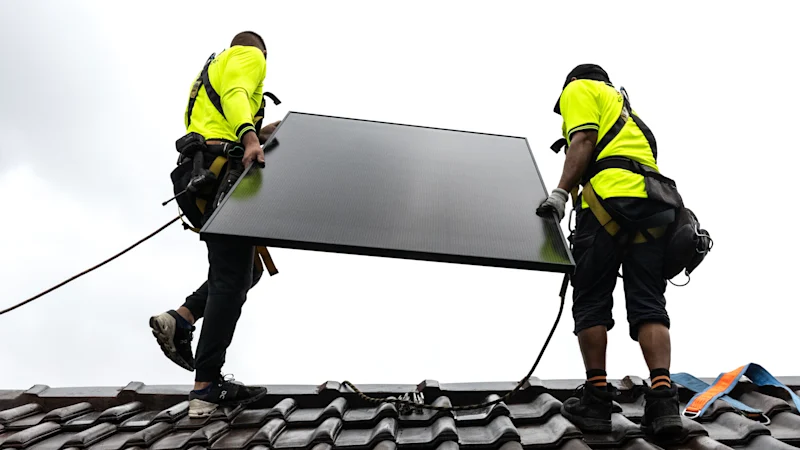
Australia is a world leader in rooftop solar uptake, with more than 4 million households – about one in three – now fitted with rooftop panels.
When the sun is brightest in the middle of the day, all of these rooftops, as well as large-scale solar farms, are generating enormous amounts of electricity. This sends wholesale power prices – what retailers pay for electricity before on-selling it to customers – tumbling to below zero for hours at a time.
But there’s a problem: not enough households use electricity in the middle of the day. By the time people begin arriving home in the evenings and turning on their appliances, the sun is setting, solar power is receding, and electricity prices spike because the grid is forced to call on more expensive generators, such as gas-powered turbines.
Minister for Climate Change and Energy Chris BowenCredit: Alex Ellinghausen
The government’s Solar Sharer plan is designed to increase daytime power consumption to absorb more of the daylight solar glut and shift usage away from the busy evening peak demand period.
It is hoped millions of Australians will, in the middle of the day, charge electric vehicles or use the free power hours to switch on power-hungry appliances such as hot water heaters, dishwashers, clothes washers and dryers.
How does the scheme work?
Electricity retailers will be forced to offer new power plans that supply free electricity during the middle of the day when solar power is at peak supply, roughly from 11am to 2pm.
Solar Sharer energy plans will be available to all home and apartment owners and renters, including those with and without solar panels. Property owners who cannot install solar panels are encouraged to install a battery to soak up free power and use it later in the day.
Loading
Energy users can choose to sign up to the Solar Sharer plans, which will be introduced alongside the Australian Energy Regulator’s default market offer, which sets the maximum prices that electricity retailers can charge on standard plans for customers who do not take up special deals.
Some retailers, including AGL and Snowy Hydro’s Red Energy, already offer free access to power for some customers in the middle of the day in certain circumstances.
Eligible customers will not need solar panels, but will need to have a smart meter, a device with a digital two-way communication system that measures electricity use.
In Victoria, more than 99 per cent of homes already have a smart meter. They are being rolled out in NSW and Queensland, where most retailers install them for free on request.
The Solar Sharer plan will be available from July next year to customers in NSW, South Australia and south-east Queensland, where the AER sets benchmark power plans. A Victorian government spokesperson said it was working on a rollout as well.
How much money can I save?
It depends on a few factors. Changing when you use electricity will drive any savings, with the more appliances you can shift to running during the free hours leading, the better your bill relief.
Running an average dishwasher load at a cost of 30c per kilowatt hour – relatively common during peak times – costs around 34 cents, according to the South Australian government’s energy advisory service. Running a front loader washing machine at the same rate costs about 20 cents, while a medium load in a dryer would cost about 50 cents.
While shifting those tasks to free hours may save a couple of dollars a day, that can add up, according to government data on the policy. It predicts some households could save up to $800 through the initiative.
Energy Department analysis found a large household would save about 28 per cent off their bill by shifting 25 per cent of its electricity consumption to a free period. The average household bill in Sydney is about $2000. The average in Victoria is about $1700.
Frank Jotzo, professor of environmental and climate change economics at ANU, said if energy companies are forced to offer plans with free energy during the middle of the day, they may look to increase energy prices at other times.
“If there’s a situation where you get three hours free during the middle of the day but a higher price for the remaining 21 hours, it could be that many households, if they need to use more energy during those times, won’t find this attractive,” Jotzo said.
Will it be a lot of effort?
Shifting energy use can be tricky to maximise for homes without a battery, said Marnie Shaw, associate professor at the ANU’s Energy Change Institute. Electric hot water, air conditioning, heating, as well as charging electric vehicles, account for most households’ largest uses of electricity, Shaw said.
Loading
While water heaters can be timed to run during the free hours; and air conditioning and heating can be set to pre-heat or pre-cool a home; the free hours of energy will not make it cheaper to run air conditioning or a heater during peak usage hours, which is traditionally when most people are in their homes. The same goes for charging electric vehicles.
Most modern washing machines, dryers and dishwashers can be programmed to run at set times, but their lower energy consumption means potential savings are less pronounced.
Professor Gigi Foster, an economist at the University of NSW, said households required sustained routine changes to claw back significant savings, as well as potentially large investments in smart technologies and timer equipped appliances.
“For many customers, energy has already been cheaper, not free, during the middle of the day, but I’m not sure everyone has shifted their washing machine cycles as a result,” Foster said.
“Free energy sounds like a carrot, a traditional incentive, but this requires a lot of behavioural change.”
Cut through the noise of federal politics with news, views and expert analysis. Subscribers can sign up to our weekly Inside Politics newsletter.