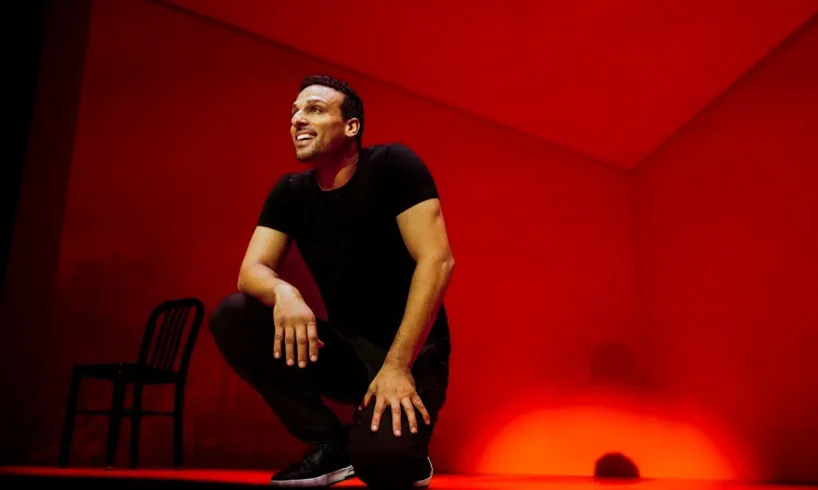
Identity is not fixed. It shifts depending on who is looking and what they expect to see. Ari’el Stachel’s “Other” asks what happens when the world names you faster than you can name yourself — and how those externally imposed names can shape a sense of belonging long before you fully understand who you are.
Before he launches into a retelling of his childhood, Stachel introduces the companion who quietly shaped much of his life: his anxiety. As a child, he named it Meredith, after the villainous almost–stepmom in “The Parent Trap.” Meredith becomes more than a metaphor; she’s both a catalyst and a symptom of his fractured identity, a constant reminder of the impossibility of sincerely belonging to any of the communities he moves through.
Ari’el Statchel in “Other” (Ogata)
“The Band’s Visit” actor grew up at the crossroads of two distinct Jewish histories: an Ashkenazi American mother and a Yemenite Israeli father. Both are Jewish, both are loving, yet each is rooted in a different culture, language, and set of expectations. From the start, Stachel lived in multiple stories at once, but the communities around him rarely knew how or were willing to hold space for all of those stories to coexist.
“Other” exploring performing belonging
Jewish day school was the first test case. As the only dark-skinned kid in his grade, Stachel’s peers did not know where to place him. His father’s advice was to lean into being Israeli, so, much to his classmates’ amusement, he feigned an Israeli accent for an entire year, in an attempt to make himself more legible to the kids around him. It was an early lesson in how identity can become something you perform to make others feel more comfortable with your presence.
This anecdote becomes the template for what would become a pattern in Stachel’s life. In each new environment, he would select an aspect of his identity to lean into and perform, hoping that if he played the role convincingly enough, belonging would follow. When a performance no longer felt sustainable, he would transfer to a new school. Meredith would kick in; reinvention became habit. Stachel tried to present as “more white,” sometimes “more Black,” depending on the school and social scene he was hoping to fit into. Each shift pulled him further from a stable sense of self that had never been given its own space to flourish.
Ari’el Statchel in “Other” (Ogata)
After 9/11, the misreadings sharpened. It was the first time Stachel had seen brown faces like his on television, and almost always in the context of danger. The fear directed at those faces reached him too. Even though he was unquestionably Jewish, strangers and classmates would inevitably label him as Arab based solely on how he looked.
His religious and social worlds reflected a similar sense of partial belonging. In college, during the period he described as his time “being Black,” he attended a Baptist church in Harlem on weekends with his friends, joined racial social justice groups, and performed slam poetry, absorbing and echoing the cadences around him. Later, when he more visibly embraced his Middle Eastern roots, he found himself at a Yemenite synagogue on the Upper West Side every morning at 6 a.m., as per the rabbi’s request. He was thrilled to finally be surrounded by people who shared his specific, niche identity. But even there, he did not feel a complete sense of belonging. The rabbi assumed — incorrectly — that Stachel could read from the Torah because of his background, and put him on the spot in front of the congregation. After that humiliating moment, he and Meredith decided it would be better not to return. Many spaces welcomed him, yet none fully recognized him. Every community saw a different slice of who he was; none held the whole.
Throughout the show, Stachel performs these transformations with disarming self-deprecation and physical precision—his voice shifting between accents, his body language morphing to match each attempted identity. The piece moves fluidly between confession and stand-up, using humor to soften the painful edges of these constant reinventions.
Ari’el Statchel in “Other” (Ogata)
His early acting career collapsed his heritage into an even cruder stereotype: when he walked into audition rooms, casting directors saw “terrorist No. 2.” Even “The Band’s Visit” — a production he deeply loved, one that placed Hebrew and Arabic side by side on a Broadway stage and earned him a Tony Award — brought its own tensions. Friends of color, who had spent years lamenting the scarcity of roles available for actors who looked like Stachel, now questioned his decision to play an Arab when his background was Yemenite Israeli. Once again, a community warmly embraced one part of him and rejected the rest.
And then, years later, the categories flipped entirely.
Identity after October 7
After October 7, the same features that once made him “too Arab” suddenly made him “too Jewish.” While the show is not about October 7 itself, the war and its aftermath fundamentally reframe how Stachel’s identity is read and weaponized in the present moment. Stachel experienced antisemitic backlash in spaces that previously misread him in the opposite direction. As a brown Jew, he felt people around him pressuring him to leverage certain parts of his identity for moral or political meaning — to be legible proof of a point. The labels shifted, but the projections stayed the same: others insisted on deciding which version of him mattered, and how he should perform that version to best advance a cause.
Related post: How Seth Rudetsky became Broadway’s loudest Jewish voice after October 7
One of the clearest insights in “Other” comes when Stachel says, “I can’t solve the war, but I can be a bridge.” It lands less as a political stance than as an autobiography distilled. His life has been shaped by being misread in opposite directions; the most honest thing he can do is speak from that complex center and hope it widens someone else’s understanding of what a life like his can look like.
Ari’el Statchel in “Other” (Ogata)
The emotional resolution of the play arrives when he finally tells his father how much of himself — and his family — he hid growing up, sharing candidly that Meredith has accompanied him through adulthood. There is no dramatic explosion, no theatrical rupture. Instead, there is just a quiet recognition that protecting himself through performance may have worked in the moment, but at the cost of wholeness. A life constructed around other people’s assumptions leaves little room to inhabit one’s full self.
“Other” builds steadily toward its final moment: the full introduction. For the first time, Stachel stops editing and adjusting his identity and offers every part of himself without hesitation:
“My name is Ari’el and I am a proud Yemenite-Israeli-Ashkenazi-Jewish-American from Berkeley, California, and I have spent most of my life pretending to be other people, leading me to become an actor who currently lives in New York City alongside my anxiety disorder named Meredith, who I used to hate but I am learning to love, even though she still drives me crazy sometimes, which means that I may sweat, but just know that if I do, it means that me and Mer are especially thrilled to meet you.”
It’s warm, wry, and whole — the first moment when every part of him stands without apology.
“Other” does not attempt to define Jewish identity or draw hard lines around who “counts.” Instead, it reveals how easily communities misname people and how much is lost when identity is reduced to binaries. The play suggests that performance becomes inevitable when communities fail to make space for a person’s full complexity. Stachel’s final introduction isn’t a moral lesson so much as permission to live as a composite, without apology, even when the world keeps asking for a simpler story.