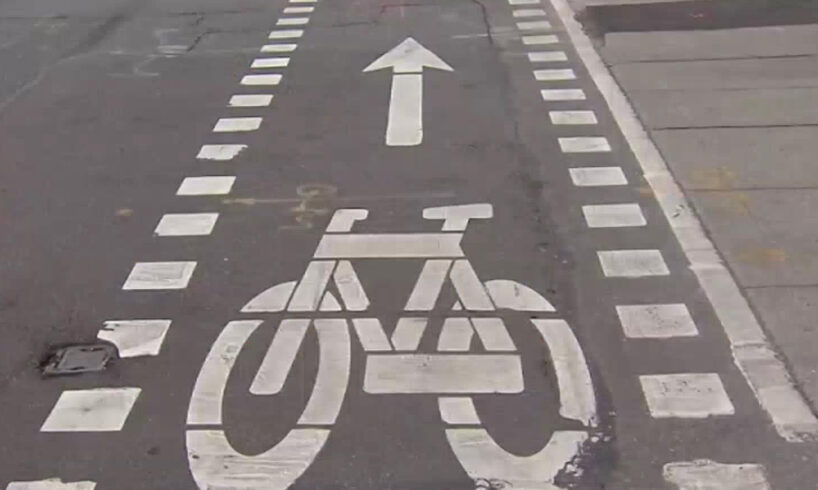
Narrow is the road that leads to new bike lanes in Toronto.
It appears the City has found a way to pedal around provincial legislation surrounding the contentious issue of bike lanes.
Rather than contravening the Ontario government by removing vehicle lanes, the City of Toronto is instead planning to narrow them to accommodate bikes.
With the passing of Bill 60, the Fighting Delays, Building Faster Act, Doug Ford’s government essentially banned any new bike lanes that “reduce or permit a reduction in the number of marked lanes available for travel by motor vehicles …”
But in its recent Cycling Network Plan update, the City of Toronto outlined how it can appease the province while simultaneously adding more than 20 new kilometres of bike lanes.
In its report, the City said “vehicle lane widths would be narrowed to align with current City guidelines and promote safer travel speeds.”
Asked about the plans on Monday, Toronto Mayor Olivia Chow said it was a fair compromise.
“From day one, I said there’s a win-win solution,” Chow said during a morning announcement on transit fares.
“We keep the car lanes, we put the bike lanes in, everyone’s happy and we keep cyclists safe, so that’s what’s happening. It’s not a loophole. It works, it’s just better design.
“The bike lanes will be installed, the car lanes will remain, and the design of the roads is better. We are moving ahead.”
A six-kilometre stretch of Kingston Road is being targeted for new bike lanes. The City’s rendering (below) shows how it plans to squeeze the bike lanes in.
Ontario’s Minister of Transportation, Prabmeet Sarkaria, was asked if the City had simply found a way to circumvent the provincial legislation.
Sarkaria said as long as vehicle lanes aren’t impacted, he’s fine with the City’s plan.
“What we want to see is the vehicle lanes remain … we’ve seen gridlock at an all-time high here in the city, but for us if the vehicle lane is still there that is in compliance with the legislation,” he said.
“If there is a way where you can have both the vehicle lane and a bike lane on the same street, then that is OK.”
In its quarterly cycling infrastructure update, the City outlined the following projects, which include new bike lanes, cycle tracks, and multi-use trails. The proposed initiatives came with an estimated price tag of $30,400,000.
Alton Towers Neighbourhood Connections on Ingleton Boulevard (cycle track and
multi-use trail, Ward 23).
Keele Street Safety and Bikeway Improvements (multi-use trail, Wards 6 and 7).
A Safer Kingston Road (cycle track, Wards 20 and 24).
Kipling Avenue Roadway Improvements on Kipling Avenue, Albion Road, Panorama
Court, and Penlea Avenue (cycle track and multi-use trail, Ward 1).
Malvern Neighbourhood Connections on Breckon Gate, Brenyon Way, Casebridge
Court, Crow Trail, Grand Marshall Drive, Venture Drive, and Water Tower Gate
(cycle track, bike lane, multi-use trail, shared lanes, and sidewalk, Wards 23 and
25).
Cycling Network Plan: 2025 Cycling Infrastructure – Fourth Quarter Update Page 2 of 65
Martin Grove Cycling Connections on Martin Grove Road, Acorn Avenue, Bloor
Street West, Charleston Road, Montesson Street, Rockfield Drive, Swan Avenue,
and Wilmar Road (cycle track and shared lanes, Ward 2).
Morningside Avenue Connections (multi-use trail, Ward 24).
Rathburn Road Bikeway and Safety Improvements (cycle track, Ward 2).
Shoreham Drive and Murray Ross Parkway (cycle track, Ward 7).
Trethewey Drive Cycling Connections and Intersection Safety Improvements on
Trethewey Drive, Clearview Heights, and Municipal Drive (cycle track, shared lanes,
and contra-flow bike lane, Ward 5).
Weston Road Streetscape and Road Safety Improvements (cycle track, Ward 7).
The Ford government is currently appealing a recent Ontario Superior Court decision that struck down its plan to remove bike lanes on three major Toronto streets. Ford called the ruling “the most ridiculous” he’s ever seen.
The court found the province’s legislation — which targeted bike lanes on Bloor Street, Yonge Street, and University Avenue — unconstitutional, citing increased risks to cyclist safety and a lack of evidence that the removals would reduce traffic congestion.