A New South Wales government-backed renewable energy project has been accused of environmental vandalism after dozens of threatened birds were found in native trees it had cleared.
Newborn birds were saved after a corridor of native trees was cut down as part of the construction of the Central West Orana Renewable Energy Zone (REZ).
The $5.5 billion Net Zero project spans from Cassilis to Narromine and north of Orange to Gilgandra.
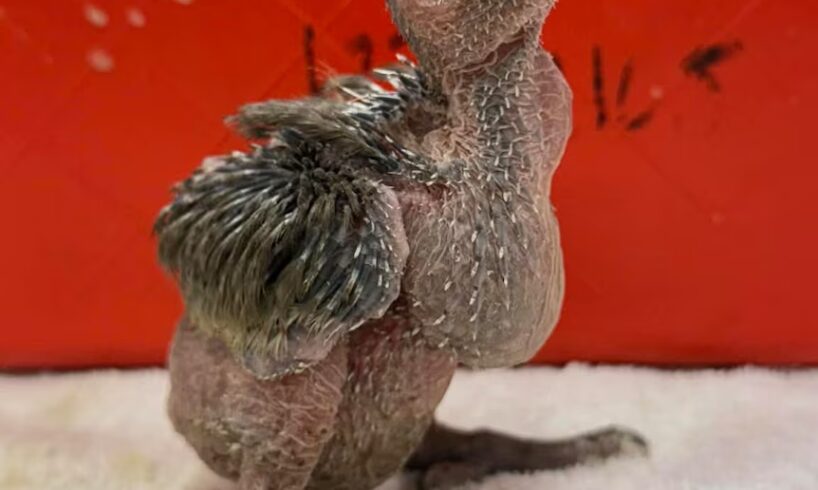
Mudgee Vet Hospital said about 60 hatchlings, including kookaburras, kestrels, rosellas and galahs had been brought in by workers since late October.
“We were inundated without any warning and just horrified at the numbers,” veterinarian Paige Loneregan said.
“It’s very distressing for all our staff, we’ve never had this many baby birds ever.”
One kookaburra chick had to be euthanised because it had a broken pelvis.
Trees were cleared along Merotherie Road, about 20 kilometres from Gulgong, in November. (Supplied: Andrew Gee)
Energy company ACEREZ cleared vegetation along the Merotherie Road, north of Mudgee, to upgrade the dirt road that led to the Merotherie Energy Hub.
It was awarded the contract for the REZ transmission project by state government body EnergyCo to connect solar and wind energy to the grid.
The company said in a statement that the clearing was “taking place on private property in accordance with the project’s environmental impact statement, planning approval and biodiversity management plan”.
The affected fledglings have since been handed over to the wildlife rescue organisation WIRES.
WIRES emergency response manager Matthew Godwin said local volunteers were so “overwhelmed” by the number of birds that his organisation brought in a wildlife ambulance from Sydney to spread them among carers across the region.
Eastern rosellas were found in the Merotherie Road vegetation corridor. (Supplied: WIRES)
“It’s one of the more troubling instances that I’ve been a part of,” Mr Godwin said.
He said the aim was to reunite the birds with their parents if they were still in the area.
In a statement, an ACEREZ spokesperson said it is “liaising with WIRES and working with Taronga Wildlife Hospital at Dubbo … to care for any birds displaced by the clearing required”.
“Ecologists and fauna spotters are also onsite to ensure the birds can be safely relocated or taken to vets or wildlife carers,” the spokesperson said.
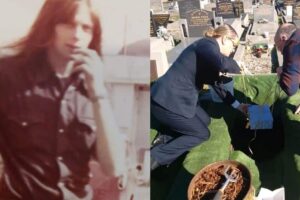
David Allworth and Sue Stoddart stand on Merotherie Road before the tree removal (left) and the aftermath (right). (Supplied: David Allworth)
Mudgee-based ecologist David Allworth first came across Merotherie Road in 2019 through his cycling group the Central West Cycle Trail, which maps out quiet country roads.
“There were very ancient … centuries-old trees,” Mr Allworth said.
“It was Australian native trees, the eucalypts, lining those roads, a classic quiet country lane.
“It’s those trees that are so critical for so much of Australia’s fauna for providing hollows.”
Mr Allworth said the cycling group had raised concerns about plans to remove the vegetation and wrote to the state government suggesting the road be built on adjacent EnergyCo-owned land which would not require clearing.
A galah chick stands on a towel after being rescued near Mudgee. (Supplied: WIRES)
“It’s been an unnecessary tragedy,” Mr Allworth said.
“It greatly puts into question some of the environmental credentials of the implementers and it puts into question the environmental credentials of the regulator.
“Here was a simple solution and you didn’t take it.
“Renewable energy is meant to take us on a positive path and I’m afraid in this case it’s failed quite miserably.”
Google Maps shows the trees surrounding Merotherie Road prior to being cleared in October. (Supplied: WIRES)
Member for Calare Andrew Gee described it as an act of “environmental vandalism” to make way for what was supposed to be clean, green energy infrastructure.
“There is a bitter irony in it that this destruction is being made and taking place in the name of the environment,” Mr Gee said.
“They could easily have put in another road parallel to Merotherie Road which would have bypassed that crucial wildlife corridor but they chose not to do that.”
Mr Gee said he had written to the NSW premier requesting ACEREZ halt all further tree removal in the area and come up with a plan to prevent further destruction of native habitat.
Critically endangered habitat
Plans to build twin transmission lines between Wollar and the proposed substations at Merotherie and Elong Elong were approved by the NSW Department of Planning, Housing and Infrastructure in June 2024.
The Central West Orana Renewable Energy Zone (REZ) spans 20,000 square kilometres. (ABC Rural: Emily Middleton)
Biodiversity assessments for the transmission infrastructure, lodged with the state’s planning department in 2023, show the cleared area was identified as containing critically endangered hollow bearing trees, including white box, yellow box and Blakely’s red gum.
The studies show it was potential habitat for threatened fauna species including the koala, glossy black cockatoo, little eagle, squirrel glider and eastern pygmy possum.
A little eagle nest was found during surveys, with two of the birds observed flying over the area in 2022.
The NSW goverment’s EnergyCo referred the ABC to ACEREZ and provided a media release about a $140 million biodiversity offset program.
The release, from October 2025, reads “the Minns Labor Government is showing that renewable energy and nature conservation can go hand-in hand”.
It details how it will invest in biodiversity offsets in the region and include creating wildlife corridors and habitat connectivity.
Kestrel fledglings are being cared for after hollow-bearing trees were removed. (Supplied: WIRES)
Mr Allworth said offsets should only be used as a “last resort when there is no alternative”.
“There were alternatives for Merotherie Road,” he said.
“You can’t replace these mammoth old hollow bearing trees in our generation or even a couple of generations.”