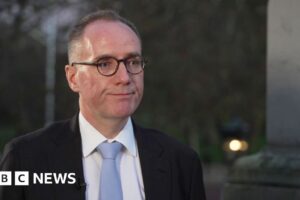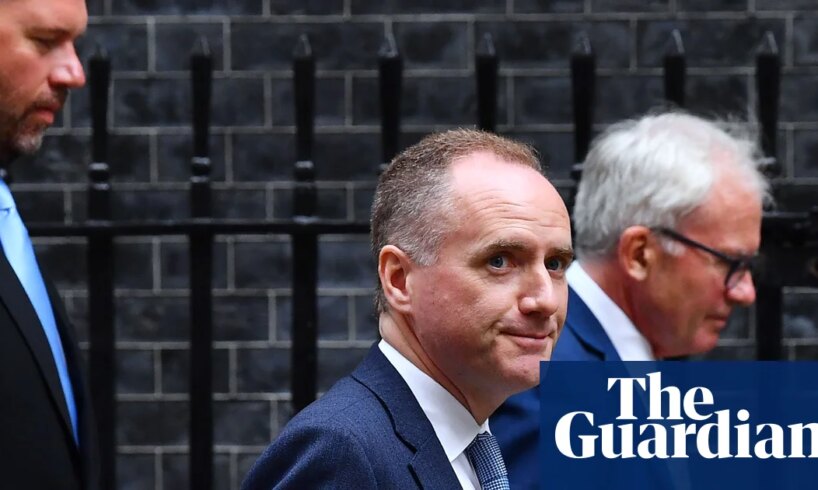
The chair of the Office for Budget Responsibility has resigned after a damning internal inquiry into the leak that threw Rachel Reeves’s budget into chaos described it as the “worst failure” in the institution’s history.
The departure of Richard Hughes, who said he took “full responsibility” for the watchdog’s failure to handle sensitive information, dragged the rolling recriminations over the budget into a fifth day.
Keir Starmer had notably failed to express confidence in the senior economist, while criticising the OBR for the “serious error” that he said was a breach of market-sensitive information and a “massive discourtesy” to parliament.
While ministers hope the resignation will draw a line under tensions with the OBR, the chancellor remains under pressure, with critics seeking to draw a contrast between Hughes’s decision to quit and Reeves’s defiance over her handling of the budget.
Opposition leaders have accused the chancellor of misleading the public by claiming there was a hole in the public finances to justify tax rises, a charge that the government has denied.
Kemi Badenoch, the Conservative leader, said: “Someone has resigned as a result of the budget chaos … but it isn’t Rachel Reeves. The chancellor is trying to use the chair of the OBR as her human shield. But I will not let her.”
Pete Wishart, the SNP’s deputy leader at Westminster, said: “The head of the OBR has taken responsibility, and resigned, to restore confidence after the budget leak. The head of the BBC took responsibility and resigned. Why is Rachel Reeves refusing to do the same?”
Government insiders, however, rejected the attempt to link the OBR leak with the chancellor’s decisions over the budget. “Now the Tories have suddenly decided they are the great defenders of the OBR? Laughable and totally unserious,” one source said.
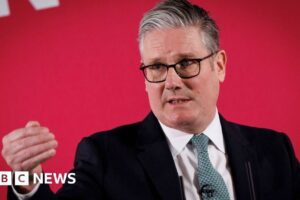
In a major speech on Monday, setting out the government’s economic plans in the run-up to the next election, the prime minister attempted to secure Reeves’s position. Many in Westminster feel that Starmer’s fate is inextricably linked with the chancellor’s.
In the run-up to the budget she had indicated that she was planning to increase income tax rates, pointing to gloomy productivity forecasts. When that plan was dropped, the Treasury briefed journalists that the decision was the result of a rosier outlook.
But last week the OBR revealed it had already told the Treasury that its downgrade to productivity would be offset by higher incomes, which in turn boosted the government’s tax receipts.
In response, Starmer said the OBR’s productivity downgrade had left the government with a “starting point” of £16bn less than it would otherwise have been, and that he had also wanted to maintain public spending, ease the cost of living and double the fiscal headroom.
“It was inevitable that we would always have to raise revenue, so there’s no misleading there,” he told reporters. “There was a point at which we thought, myself included, that we might have to reach for a manifesto breach of some significance.
“As the process then continued, it became clear to me and others that we might be able to do what we needed to do with our priorities without that manifesto breach.”
Starmer said he was proud to be tackling the cost of living through cuts to energy bills, freezing rail fares and boosting the minimum wage. He added that lifting the two-child benefit cap was “a moment of personal pride for me”.
“On the substance of the budget, I’d defend it any day of the week. They’re the right steps for our country and I’m proud that we’ve taken them,” he said.
But he acknowledged there were still significant challenges ahead. “I will level with you, as the budget showed, the path to a Britain that is truly built for all requires many more decisions that are not cost-free, and they’re not easy.”
Setting out his plans for the rest of this parliament, Starmer said he believed “we do need to get closer” to the European Union. He also admitted the welfare system must be reformed, after attempts earlier this year failed.
skip past newsletter promotion
Our morning email breaks down the key stories of the day, telling you what’s happening and why it matters
Privacy Notice: Newsletters may contain information about charities, online ads, and content funded by outside parties. If you do not have an account, we will create a guest account for you on theguardian.com to send you this newsletter. You can complete full registration at any time. For more information about how we use your data see our Privacy Policy. We use Google reCaptcha to protect our website and the Google Privacy Policy and Terms of Service apply.
after newsletter promotion
After the budget leak, the OBR had commissioned Ciaran Martin, the former chief executive of the National Cyber Security Centre, to assist with a rapid investigation into what happened, overseen by independent members of its board.
The resulting report described the leak as “the worst failure in the 15-year history of the OBR” and strongly criticised its processes for protecting sensitive information.
It found the OBR had uploaded its budget documents to a link that it believed to be inaccessible to the public. However, because the organisation was using a particular add-on to the WordPress publishing system, the link ended up being live, unbeknownst to the OBR itself.
The forecaster confirmed the market-sensitive report was accessed 43 times from 32 different devices in the hour before the chancellor’s speech.
More damagingly, the inquiry found this autumn was not the first time the OBR had inadvertently published budget documents early, with its reports being accessed early in March 2025, although no action resulted from the breach.
The Treasury has said it will contact former chancellors to make them aware of the developments that relate to previous fiscal events.
Hughes wrote to the chancellor and Meg Hillier, the Labour chair of the Treasury select committee, saying he took “full responsibility [for] the shortcomings identified in this report”.
He wrote in the letter: “The OBR plays a vital role in the UK’s fiscal policymaking, and it is critical that the government, parliament, and the public continue to have confidence in the work that it does.
“The inadvertent early dissemination of our economic and fiscal outlook (EFO) on 26 November was a technical but serious error.”
He added: “I also need to play my part in enabling the organisation that I have loved leading for the past five years to quickly move on from this regrettable incident.”
Hughes had been due to face questions from the Treasury select committee on Tuesday about the budget and the OBR’s economic forecasts, but it was confirmed that he would no longer attend.