On 26 November, the Kyiv International Centre of Culture and Arts hosted the third annual UP100 awards ceremony, celebrating one hundred leaders of Ukraine who are working tirelessly to shape the country’s future.
Winners were selected in six categories: Defenders, Society, Public Administration, Business, Culture and Sport. The full list is available here.
The event’s general partners were the law firm Ader Haber and Ajax Systems, with additional support from Inzhur, Biosphere Corporation, Fractal, Aga.te, Gasanova, Damirli, La Famiglia Catering, Gemini, Coca-Cola HBC Ukraine and Truskavetska. The official sponsor was Ararat.
Advertisement:
Advertisement:
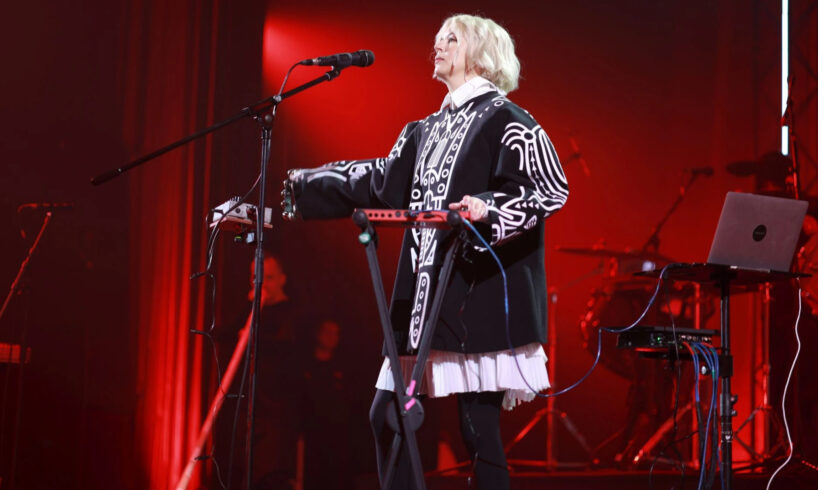
This year’s ceremony, titled The Edge of Choice / Choice on the Edge and attended by 1,300 guests, opened with a spectacular performance by the electro-folk band Onuka. Ukrainska Pravda Editor-in-Chief Sevğil Musaieva then took to the stage to welcome the audience.
Onuka opened the ceremony, performing three of their hits
“We’ve gathered here at one of the most difficult moments in our modern history, when each one of us is living on the edge – between exhaustion and strength, between compromise and principle, between adapting and remaining who we are,” Sevğil said.
“That’s why the name of tonight’s event – The Edge of Choice / Choice on the Edge – does not sound like an abstraction, but like a formula for our present. The idea for this year’s awards came to me back in the summer, on the days when we witnessed attempts to dismantle the National Anti-Corruption Bureau (NABU) and the Specialised Anti-Corruption Prosecutor’s Office (SAPO), when many of us felt, for the first time in a long while, that even in wartime, there are some situations that are capable of breaking society’s backbone.
It was hard to imagine then that within a few months, we would find ourselves at a point of even more intense emotions and even more painful decisions. The past few weeks have been tough, and we shouldn’t hide that. We have seen things that are hurtful, that are disappointing, and that make us doubt people, systems, and sometimes even whether there are any lines left that cannot be crossed.”
Sevğil’s speech reflected on the fact that Ukrainians live on the edge and every day make the difficult choice not to give up.
Photo: Oleksandra Chekmenova
Sevğil then shared the moving stories of three Ukrainians, each of whom has personally faced a choice on the edge. The first was Viktoriia Kuzmina, whose husband was killed on the first day of the full-scale invasion while defending Ukraine’s skies.
“Viktoriia could have left the service as she has two young children, and no one would have judged her. But she made a different choice: she stayed in the Air Force, learned English, mastered the Patriot system, and became one of those who down Russian missiles, saving the lives of hundreds of Ukrainian soldiers and civilians.”
Senior Lieutenant Viktoriia Kuzmina, an air defence officer, is among this year’s UP100 leaders, as is Colonel Yevhen Bulatsyk, commander of the 7th Tactical Aviation Brigade named after Petro Franko and Hero of Ukraine
Sevğil then told the story of 18-year-old Ivan Sarancha, a young man from temporarily occupied Luhansk “who did the impossible – he broke free from an environment of fear and propaganda and consciously chose to be Ukrainian”.
“With no support, no guarantees, relying only on his inner honesty and willpower, he walked a path many adults would not dare to take. His escape from occupation was not merely an escape, but an act of freedom. Ivan dreams of becoming an architect, but even today he is an architect of choice – a symbol of the fact that even in the darkest surroundings, one can remain oneself and choose Ukraine.”
The third story was that of Viacheslav Zaporozhets, who began evacuating people and went on to found a prosthetics centre for soldiers.
“Before she died, his mother asked him to ‘become a real human being’. Today, he is exactly that: the one who goes first where others are afraid to go, and holds onto those who suffer the most.”
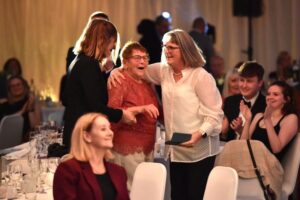
Sevğil then began the awards ceremony, presenting symbolic pins to the winners. The award for the late Oleksandr Hordiienko, a farmer from Kherson Oblast who single-handedly cleared hundreds of hectares of fields of landmines, was accepted by his daughter and grandson on his behalf.
Hordiienko’s grandson could not hold back his emotions as he accepted the award
“This award should have been collected by my father,” Oleksandr’s daughter Alina said. “He was often an opinion leader. He was posthumously awarded the country’s highest honour – Hero of Ukraine. Dad, I know you are here with us now, and the easiest thing would be to give up and mourn, but we are the Hordiienkos, a Cossack family, so we try to stay strong and accept your honours.”
Oleksandr Hordiienko’s daughter moved many in the audience to tears with her words
The second pin was awarded to the R.T. Weatherman Foundation in Ukraine and its president, Meaghan Mobbs, whose team works to bring fallen soldiers home. Meaghan had recorded a video message for the audience.
“For me, leadership means moral courage. It means being willing to say the hard truth even if everyone is saying the easy lie… And when I saw the images coming out of Russian paratroopers over Ukraine, not coming to liberate, but coming to oppress, to occupy, for me it was an extraordinarily horrific, surreal moment… It is here in Ukraine that that battle is being genuinely fought in real time every day,” Mobbs said.
Meaghan Mobbs mentioned that she herself comes from a military family. Her father is Keith Kellogg, the US President’s special envoy, whose visits to Kyiv are much loved by everyone
After her address, Sevğil introduced the hosts of the first part of the evening: UP political correspondent Roman Romaniuk and journalist Myroslava Gongadze, who recalled a crucial chapter in Ukraine’s history.
“Twenty-five years ago, Ukrainska Pravda was born. Twenty-five years ago, the authorities murdered its founder and my husband, Georgiy Gongadze. Twenty-five years ago, a tape scandal erupted that would go down in history as Kuchmagate. Twenty-five years of struggle and unpunished evil have brought us to the point where, 25 years later, Ukraine has once again been plunged into a tape scandal.”
This year’s ceremony was hosted by Roman Romaniuk, Oksana Lebedieva, Sevğil Musaieva, Myroslava Gongadze and Ihor Liski
The hosts then announced the winners in the first two categories, Defenders and Society, and they were invited on stage to be formally congratulated.
This was followed by a panel discussion titled Our Land, focused on Kherson and moderated by UP Deputy Editor-in-Chief Yevhen Buderatskyi. He was joined on stage by military pilot Yevhen Soloviov and former Kherson mayor Volodymyr Mykolaienko, who survived Russian captivity. Mykolaienko was asked about propaganda claiming that “the people of Kherson have never been patriots”.
Advertisement:
Volodymyr Mykolaienko, Yevhen Soloviov and Yevhen Buderatskyi spoke about Kherson
“I don’t know what more the people of Kherson have to do to prove to the world that they have nothing to do with Russia and want nothing to do with Russia. The people of Kherson are true patriots of Ukraine.”
Volodymyr also reflected on why some people choose not to leave dangerous areas.
“I’m the same: I survived captivity, I’ll survive the attacks. I’m staying in Kherson and I’m not going anywhere,” he said. “I felt this especially strongly yesterday, when my wife sent me a video of our apartment on fire after a strike. It hurts, but we have all faced these losses. That’s life. It is harder when you lose the people you loved, who went to war.”
You can watch UP’s interview with Volodymyr Mykolaienko here.
In contrast, Yevhen Soloviov offered a different perspective:
“It’s no secret that the Armed Forces are doing everything they can to ensure safety. But sadly, it’s impossible to guarantee safety from artillery or drone attacks. Everything our people are doing now, they’re doing for life, because life is the most precious thing. I believe that leaving in order to stay safe is not a sign of weakness; it’s an investment in the future… And later, we will rebuild an even better Kherson.”
Volodymyr rounded off the discussion with an emotional address that clearly resonated with the room.
“I am deeply frustrated by politicians who treat a government crisis as an opportunity to enrich themselves,” he said. “Everyone treats Ukrainians as a resource, but this resource is not infinite… People are all we have. I have seen Russia up close, and I am certain that there is nothing more vile, more despicable, or more utterly unlike Ukraine, than Russia.”
Hryhorii Yanchenko, a pensioner and volunteer from Kherson
Next to step onto the stage was Marta Levchenko, a winner in the Society category and the founder of City of Goodness, a charity that provides shelter for children.
“I want to speak for children whose stories remain untold – children who are lonely, evacuated, seriously ill,” Marta said. “Every child has the right to a family and a home. We started out on the thin line between reality and dream, between how things are and how they ought to be. We provide medical treatment for people living with serious illness – but more than that, we bring light back into their lives.”
Marta Levchenko and little Ania, who was rescued by the City of Goodness
A painting created by children from the shelter, Four Seasons of the City of Goodness, was auctioned for UAH 1 million (around US$23,650).
Viktoriia Zaichenko, Ukrainska Pravda’s event director, holding the painting created by children from the City of Goodness
The second panel discussion, Our Culture, Our Heritage, brought together cinematographer Oleksandr Babenko, writer Artem Chekh and singer Maryna Krut. The discussion was moderated by Kateryna Zagoriy, founder of the Zagoriy Foundation.
“We are living through the first war that can be fully documented, thanks to technological progress,” Oleksandr said. “Now it is vital that we preserve this memory and this experience, so that it can be shown both to people today and to those who will look back years from now. Technology enables us to see the war through the eyes of a Ukrainian infantryman in a first-person view.”
Maryna Krut, Oleksandr Babenko, Artem Chekh and Kateryna Zagoriy
“The life of a creative person is split in two,” Maryna reflected. “The part lived on earth, and the part that lives on in their work. You realise you want to convey all of this [the war] to future generations. I care about what will come after me, about what will remain. That brings with it a huge responsibility. I try to be the ears that will later become the voice.”
Kateryna put a difficult question to Artem: should death be softened and romanticised in art, or depicted more realistically?
“People get used to death very quickly, and that’s normal,” the writer replied. “Maybe you come out of it later as a different person, with a different state of mind. Should we present it in some refined way, should we turn it into heroism? No, we shouldn’t. We see the war online, we understand what happens. So let’s show it as it is.”
Oleksandr Babenko and Artem Chekh
The panellists highlighted six pillars that are keeping Ukraine going right now: the army, the language, culture, truth, memory, and values.
Yurii Ihnat, Head of the Communications Department of the Ukrainian Air Force Command
After a brief interval, the audience was treated to a spectacular performance by the Pavlo Virsky Ukrainian National Folk Dance Ensemble: Dance of the Zaporizhzhians.
For the next part of the evening, presenters Oksana Lebedieva and Ihor Liski stepped into the spotlight to reveal this year’s winners in the final UP100 categories – Public Administration, Business, Culture and Sport.
Sevğil Musaieva also presented a special award to Ukraine’s energy workers, who continue to “keep the lights on when it feels as though darkness is winning”, inviting employees from DTEK Energo, the country’s largest private energy company, to come on stage to accept it.
The energy workers were given a standing ovation with thunderous applause from everyone in the auditorium
Roman Huryk, an illustration by Serhii Maidukov, was auctioned off and bought by Tomáš Fiala for UAH 2 million (around US$47,300)
Tomáš Fiala, founder of Dragon Capital and owner of Ukrainska Pravda
The third panel, Our Justice, moderated by Mykhailo Tkach, Ukrainska Pravda’s head of investigations, brought together Oleksandr Klymenko, head of SAPO, Semen Kryvonos, director of NABU, and Dmytro Koziatynskyi, a veteran of the Russo-Ukrainian war who launched the Cardboard Maidan, a series of anti-government protests held in July 2025 in response to the passing of the law that stripped Ukraine’s anti-corruption institutions of their independence.
Where else would you see investigative journalist Mykhailo Tkach and the heads of NABU and SAPO sharing the same stage?
Oleksandr Klymenko reminded the audience: “We have to recognise that corruption exists everywhere, in every country. War is fertile ground for it to flourish, which is why we cannot stop fighting it for one moment.”
Oleksandr Klymenko
As Dmytro Koziatynskyi put it starkly, “Sadly, there are some people for whom the war is very far away, both physically and mentally. For them, the war is nothing more than a chance to line their pockets… I hoped the protests would make a difference, because protesting during a war is a last resort. At that moment, I realised protest was all we had left.”
Dmytro Koziatynskyi
NABU director Semen Kryvonos warned: “We have weak law enforcement institutions that are subject to political influence, carrying out political orders to notice or ignore certain things. During the war, this influence has grown. People with unexplained job titles are giving orders to the law enforcement system. This is a major problem… We need to build independent institutions.”
Oleksandr Abakumov and Semen Kryvonos
Kryvonos also commented on the main objective of NABU’s high-profile Operation Midas.
“We have to see this case through to the end and show the Ukrainian public exactly how much money has actually been stolen and how much of it has been converted into expensive villas in Switzerland, flats, property, and cash in bank accounts. And we must return all of it to the Ukrainian budget. That is our task.”
Mykhailo Tkach asked Semen how often they receive threats.
“Every day, about three times a day,” Kryvonos replied. “One moment they’re threatening to jail us, then to arrest us, charge us, detain us. There’s complete and utter chaos in the law enforcement system. It’s a mess.”
Незабаром доступ до матеріалів на “Українській правді” може стати платним.
Але ми вважаємо, що якісний контент має бути доступний для всіх, тож до останнього не будемо вводити обмеження. Підтримайте нас, аби і ми без обмежень могли продовжувати роботу – долучайтеся до Клубу УП!
Дізнатись більше
At the end of the panel discussion, Mykhailo Tkach auctioned off a legendary cardboard placard that reads “We have a f**kton more cardboard”. The successful bidder was Andrii Zhurzhii, founder and CEO of Inzhur
The final panel discussion, Our Money, brought together Vyriy Drone founder Oleksii Babenko, OKKO Group CEO Vasyl Danyliak and Honey café co-founder Anna Zavertailo, who discussed building a business in wartime. The conversation was moderated by Ukrainska Pravda journalist Mariia Melnyk.
Reflecting on whether Ukraine can forge a global arms brand, Oleksii Babenko said: “It absolutely can. This is exactly how the Ukrainian defence brand is now being built. Whether it will work… judging by reports and business trips, it has already happened at the level of defence companies in other countries. This business has become independent and not only on a par with other countries. It’s an example of how Ukraine has created a technological phenomenon.”
The third UP100 awards ceremony drew to a close with a blazing set from Armed Forces veteran Ivan Tkalenko, inventor of the electric bandura.
Ivan Tkalenko
Oleksandra Fedotova, a partner at leading law firm Ader Haber, which has supported UP100 for the third year running
Ukrainska Pravda’s event manager and event director, Oksana Bedzai and Viktoriia Zaichenko
Read about last year’s UP100 awards ceremony in our 2024 report. Earlier this year, Ukrainska Pravda also honoured 100 women leaders at our Power of Women Awards.
The UP100 awards ceremony was attended by 1,300 people.
Alina Mykhailova, Masi Naiiem and Mariia Berlinska
Yevhen Rybchynskyi
Sevğil and UP100 award winner Borys “Fidel” Martynenko
Yuliia “Taira” Paievska
Oleksii Danilov
Oleh Horokhovskyi and his wife Tamara
UP100 award winner, photographer Oleksandr Glyadyelov
UP100 award winner Denys Khrystov
Advertisement:
UP100 award winner Yurii Shapovalov
UP100 award winner Yuliia “Kuba” Sidorova
Sevğil and UP100 award winner Viacheslav Zaporozhets
UP100 award winner Viktor “Sova” Pecherytsia
Everyone fights for the state as they can. The editorial board of Ukrainska Pravda does what it does best – it searches, checks and publishes information. And this work objectively helps to change life and influence the course of events. Support Ukrainska Pravda on Patreon!
Photos: Ihor Vasyliev, Emma Soldatova
Authors: Tamara Kudriavchenko, Karyna Timkova
Translation: Tetiana Buchkovska, Ganna (Anna) Bryedova
Editing: Teresa Pearce