Becky MortonPolitical reporter
Watch: Sir Keir Starmer denies “misleading” ahead of Budget
Sir Keir Starmer has denied his chancellor misled the public about the nation’s finances ahead of last week’s Budget.
The Conservatives have accused Rachel Reeves of giving an overly pessimistic impression as a “smokescreen” to raise taxes, with Kemi Badenoch claiming she “lied to the public”.
The prime minister insisted there was “no misleading”, pointing to downgraded forecasts for economic productivity which he said meant the government had £16bn less than it otherwise would have had.
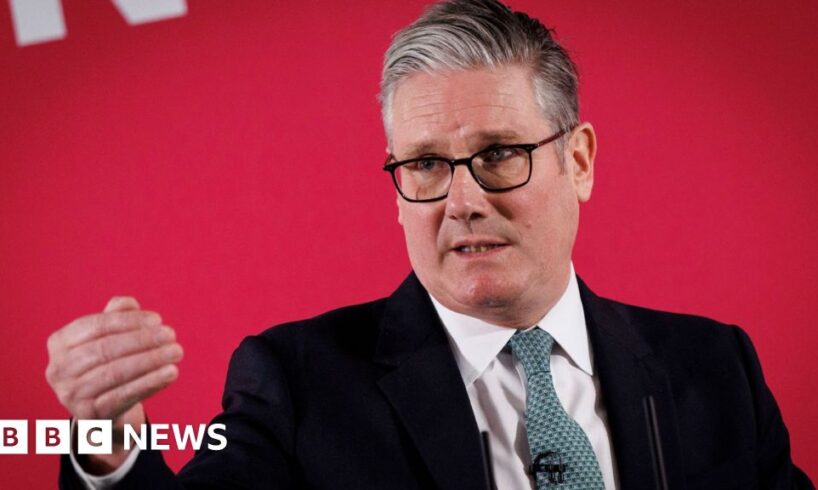
In a speech, Sir Keir said he was “proud” of the Budget, highlighting measures aimed at reducing child poverty and the cost-of living.
In the run-up to her Budget on 26 November, Reeves gave strong indications the government was planning to increase income tax rates – a move which would have broken a key manifesto promise made by Labour during last year’s general election campaign.
The chancellor repeatedly refused to rule this out, as she pointed to forecasts for economic productivity being weaker than expected.
In a rare Downing Street news conference on 4 November, she warned this “has consequences for the public finances too, in lower tax receipts”, in comments which were widely interpreted as laying the ground for tax rises.
However, on Friday the government’s independent spending watchdog, the Office for Budget Responsibility (OBR), revealed it had told the Treasury before the chancellor’s news conference that the downgrade to productivity was offset by higher wages, which increase the government’s tax revenues.
This was not made public until the Financial Times reported on 13 November that income tax rates would not go up in the Budget after all, when government sources explained the move by citing better-than-expected forecasts on wages and tax receipts.
Ultimately, the Budget included £26bn of tax rises, with £8bn raised by extending the freeze on income tax and National Insurance thresholds for a further three years, but no increase in the rates of income tax.
Taking questions from journalists after his speech, Sir Keir was asked by BBC political editor Chris Mason whether, by failing to be candid about what she knew about the public finances in her pre-Budget news conference, Reeves misled the public.
In response, the prime minister said the downgrade to productivity was “a difficult starting point”, while the government had also committed to protecting the NHS, cutting borrowing costs and bearing down on the cost of living.
He added: “Against that backdrop it was inevitable that we would always have to raise revenue. So there’s no misleading there.”
Sir Keir also confirmed publicly for the first time there was a point when the government thought it would have to break its manifesto pledge on tax.
However, he said that during the pre-Budget process, the numbers improved and “it became clear to me and others that we might be able to do what we needed to do with our priorities without that manifesto breach”.
He added: “I didn’t want to breach the manifesto, and that’s why we came to the decisions that we did.”
Badenoch has called for Reeves to resign, saying people made “real decisions because the chancellor was telling them that she was going to raise all sorts of taxes, only for us to find out that was not the case”.
Criticising leaks of potential measures ahead of the Budget, the Conservative leader told the BBC: “Some people drew down their pension, something that is irreversible.
“Some people left the country because they were worried about an exit tax. Others fixed their mortgages in a way they would not have done.”
While she did not call for the PM to go, Badenoch said “if he had anything to do with those misleading briefings, he has questions to answer”.
In his speech, Sir Keir defended the Budget as making “necessary” and “fair choices”.
He acknowledged that “tax rises do make life harder for people” but argued the alternatives were cutting public services, ignoring child poverty or extra borrowing.
The PM said the Budget “was a moment of personal pride”, highlighting how the decision to scrap the two-child benefit cap would lift hundreds of thousands of children out of poverty.
He also promised to push ahead with reforming the welfare system, which he said had “trapped people in poverty” and “wrote young people off as too ill to work”.
Over the summer, the government abandoned planned benefit cuts in the face of a major rebellion by Labour MPs.
Challenged over whether he could get the support of his own MPs to reform the system, Sir Keir said this was a “moral mission” and there was a “strong consensus” on the need to get young people into work.
He did not give further details about potential reforms, saying two ongoing reviews into “Neets” – 16-24-year-olds who are not in education, employment or training – and another on health and disability benefits needed to “complete their course”.
The prime minister also insisted the Budget would boost economic growth, despite the OBR concluding that not a single measure it included would change the watchdog’s growth forecast for the next five years.
Sir Keir said he was “confident we can beat the forecasts”, after the OBR predicted the economy would grow at a slower rate than previously expected from next year.
He vowed to cut “unnecessary red-tape” and regulations to get the country building.
Meanwhile, he said the Brexit deal had “significantly hurt our economy” and promised to “keep moving towards a closer relationship with the EU”.
However, Lib Dem leader Sir Ed Davey said: “Keir Starmer’s speech talked about boosting growth but he is refusing to do the single biggest thing to achieve that – fixing our trade with the EU through a new customs union.”