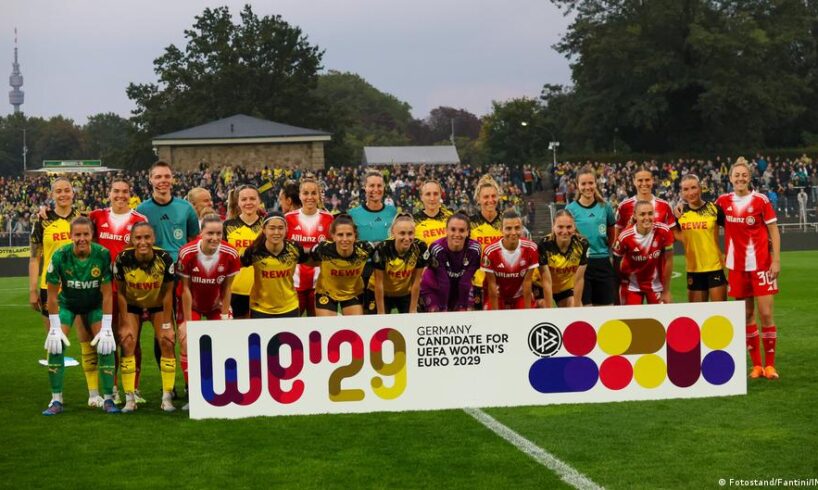
“A tournament like this would benefit society and strengthen gender equality,” said Celia Sasic of the 2029 Women’s Euros being held in Germany. In her role as vice president of the German Football Association (DFB), the former Germany player is responsible for equality and diversity.
Sasic, who twice won the Euros with the national team, is cautiously optimistic that Germany will be awarded the hosting rights.
“But in the end, it’s a competition and an election process; you can’t predict the outcome,” she noted.
Former Germany player Celia Sasic is now vice president responsible for equality and diversity at the DFBImage: Henning Kaiser/dpa/picture alliance
DW answers the key questions about the awarding of the Women’s European Championship.
Who decides the host of the 2029 Women’s European Championship?
The decision rests with the 20-member UEFA Executive Committee, which is to vote on December 3 at the headquarters of football’s European governing body in Nyon, Switzerland. The result is expected at around 5 p.m. CET.
UEFA President Aleksandar Ceferin of Slovenia chairs the committee. Sixteen of the committee’s members are elected by the UEFA Congress, two are appointed by the European Football Clubs Association, and one represents the European Leagues Association.
Germany’s Hans-Joachim Watzke (left) is on the Executive Committee but will not have a voteImage: Nico Herbertz/IMAGO
The German representative on the Executive Committee is Hans-Joachim Watzke, chairman of the supervisory board of the German Football League (DFL) and president of Borussia Dortmund. However, because Germany is one of the bidders to host the 2029 Women’s European Championship, Watzke is not allowed to vote.
What is Germany’s approach?
The slogan of the bid is: “WE’29 – Together we will rise.” According to the DFB’s pitch, it’s about more than just a tournament.
“Our goal is to create a tournament that promotes women’s football in every corner of Europe, with world-class venues, substantial revenue streams, and expanded opportunities for knowledge exchange. We will leave no country out.”
If Germany’s bid is successful, eight German cities would host matches: Munich, Frankfurt am Main, Cologne, Düsseldorf, Dortmund, Hanover, Wolfsburg, and Leipzig.
The DFB is promising that this will be the first Women’s European Championship to turn a profit. This is based on its projection of more than a million tickets sold, financial commitments from each of the would-be host cities, and support from German business. With no previous women’s Euros having turned a profit, this is bound to have scored points with the UEFA decision-makers.
Although Euro 2025 drew more spectators than ever before, UEFA still lost money on the ventureImage: Manuel Winterberger/justpictures.ch/IMAGO
UEFA lost an estimated €35 million ($40 million) on the 2025 Women’s Euros in Switzerland. By comparison, the 2024 men’s European Championship in Germany generated a profit of €1.3 billion.
Who else is bidding to host Euro 2029?
The field of competitors has shrunk. Of the original five applicants, only three remain. At the end of August, Italy withdrew its bid without giving any reason. It’s possible the Italians didn’t want to overextend themselves financially, as they – together with Turkey – are already hosting the 2032 men’s European Championship.
The Portuguese Football Association (FPF) withdrew from the race on November 19, saying it wanted to concentrate on the 2030 Men’s World Cup, the first to be held across three continents with Morocco, Portugal, and Spain as the main hosts.
This leaves the bid of Poland, as well as Denmark and Sweden’s joint-bid as Germany’s only competition.
What are Germany’s chances?
As the host of the 2024 men’s European Championship, which ran smoothly, Germany cast itself in a good light. The last Women’s European Championship to be hosted by Germany was almost a quarter of a century ago, in 2001. Then, the record European champions won the tournament – as they also did in 1989, when Germany first hosted a Women’s European Championship.
However, the election is not a foregone conclusion, as demonstrated by FIFA’s vote in the spring of 2024 for the host of the 2027 Women’s World Cup: Germany, along with the Netherlands and Belgium, lost out to Brazil, who will become the first South American country to host the tournament.
Germany won what was then called the UEFA Women’s Championship when they last hosted the tournamentImage: WEREK/IMAGO
Poland would be the first Eastern European country to host the tournament. However, support for Poland within UEFA doesn’t appear to be very strong. In the 2023 vote for the 2025 host, Poland failed to reach the decisive third round, where Switzerland prevailed over the trio of Norway, Denmark, and Sweden.
The defeat of the Scandinavian bid was seen as a rebuke from UEFA to the outspoken Norwegian FA president, Lise Klaveness.
In the current vote, only Denmark and Sweden remain, which, according to this logic, would improve their chances. On the other hand, Sweden hosted the Women’s European Championship in 2013 – much more recently than Germany.
This article was originally published in German.
Edited by: Jonathan Harding