Australian National University walks back on cuts to music and humanities
Caitlin Cassidy
The Australian National University (ANU) has walked back on a major restructure to its arts and social sciences college after facing backlash from staff, students, politicians and stakeholders over the handling of its controversial $250m cost-cutting plan.
On Tuesday, ANU released its updated implementation plan for the college, after the initial proposal, released this July, was widely canned. It included shutting the Australian National Dictionary Centre, the Centre for European Studies, the Humanities Research Centre and the ANU School of Music, in addition to job cuts.
In September, days before the resignation of then-vice-chancellor of ANU, Prof Genevieve Bell, almost 30 staff in the school stopped work after an internal report warned of psychological hazards in their workplace related to the restructure.
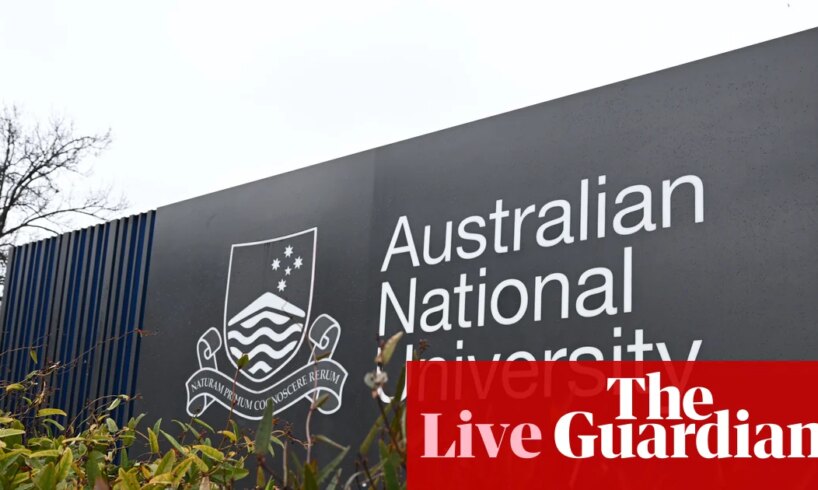
Australian National University in Canberra. Photograph: Lukas Coch/AAP
The interim vice-chancellor of ANU, Prof. Rebekah Brown, said due to “higher-than-expected voluntary separations, staff attrition, retirements and vacancy management, the university’s financial position has improved” and humanities schools could be saved.
Its dean, Prof Bronwyn Parry, said the Dictionary of Biography and the Australian National Dictionary Centre secured its future through philanthropic generosity, while no structural changes would be made to the School of Music, which would feature a new Performance+ Hub.
Parry said the updated plan reflected the “extensive feedback received during consultation and demonstrates that we have listened and responded”.
Share
Updated at 01.09 CET
Key events
Show key events only
Please turn on JavaScript to use this feature
Josh Butler
LinkedIn, Lemon8 could be added to under-16s social media ban
More platforms are likely to be added to the federal government’s social media ban for under-16s after the scheme comes into effect next week, with communications minister Anika Wells saying if large numbers of kids migrate to other sites or apps not currently in the framework, they could also be lumped in.
Speaking in Adelaide today, Wells told media to “stay tuned” for news about Lemon8, an Instagram-style app not currently included in the ban. She said:
But I’ve also made the point LinkedIn is currently an exempt platform. If everybody ends up on LinkedIn, and LinkedIn becomes a place where there is online bullying, algorithms targeting of 13 to 16-year-olds in a way that’s deteriorating their mental and physical health, then we will go after LinkedIn, and that’s why all platforms are on notice. We have to be agile and dynamic.
The ban comes into effect on 10 December. Several platforms have warned users about the age verification methods they’ll be using, but some others have not yet. The Coalition opposition is raising concerns about the timing and implementation of the ban, and there is at least one legal challenge in the works.
Wells said the government “we will not be flinching in the face of any intimidation, any threats” from big tech platforms who may be considering challenging the ban. She warned that “people with ulterior motives are going to throw the kitchen sink and try to strike this down, or water this down”.
Wells will speak and take questions at the National Press Club in Canberra on Wednesday.
Share
Australian National University walks back on cuts to music and humanities
Caitlin Cassidy
The Australian National University (ANU) has walked back on a major restructure to its arts and social sciences college after facing backlash from staff, students, politicians and stakeholders over the handling of its controversial $250m cost-cutting plan.
On Tuesday, ANU released its updated implementation plan for the college, after the initial proposal, released this July, was widely canned. It included shutting the Australian National Dictionary Centre, the Centre for European Studies, the Humanities Research Centre and the ANU School of Music, in addition to job cuts.
In September, days before the resignation of then-vice-chancellor of ANU, Prof Genevieve Bell, almost 30 staff in the school stopped work after an internal report warned of psychological hazards in their workplace related to the restructure.
Australian National University in Canberra. Photograph: Lukas Coch/AAP
The interim vice-chancellor of ANU, Prof. Rebekah Brown, said due to “higher-than-expected voluntary separations, staff attrition, retirements and vacancy management, the university’s financial position has improved” and humanities schools could be saved.
Its dean, Prof Bronwyn Parry, said the Dictionary of Biography and the Australian National Dictionary Centre secured its future through philanthropic generosity, while no structural changes would be made to the School of Music, which would feature a new Performance+ Hub.
Parry said the updated plan reflected the “extensive feedback received during consultation and demonstrates that we have listened and responded”.
Share
Updated at 01.09 CET
How the first Aboriginal bilingual school in NSW is resurrecting an Indigenous language
The Gumbaynggirr Giingana Freedom school in Coffs Harbour opened three years ago amid a broader push to breathe new life into the critically endangered Gumbaynggirr language.
As Indigenous languages decline nationally, Gumbaynggirr is experiencing a resurgence.
For 12-year-old Darruy, the difference to his previous school is “like night and day”. He says:
The other school … they didn’t really understand the components of Aboriginal culture. I do prefer this school a lot more, because they understand how culture is to us.
How the first Aboriginal bilingual school in NSW is resurrecting an Indigenous language – videoShare
Updated at 01.00 CET
Metro Tunnel goes viral as Melbourne’s commuters turn into ambassadors
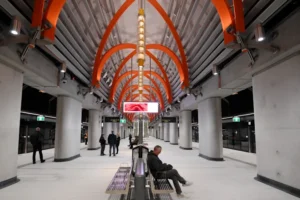
Melbourne’s new Metro Tunnel has become a social media sensation, and the public transport system was packed over the weekend as people rode the new train route for the first time.
Melbourne’s new Metro Tunnel. Photograph: Ye Myo Khant/SOPA Images/Shutterstock
Brodie Lancaster was one of them, and he wrote about it here:
Share
Updated at 01.03 CET
Josh Butler
Pocock says ‘now it’s clear’ why Labor was ‘hiding’ the report into government board appointments
David Pocock says “it’s clear why the Albanese government was hiding” the Briggs report into government job appointments, after Labor shrugged off major recommendations about cleaning up a “jobs for mates” culture.
Briggs’ report – finally released on Tuesday after a long fight from politicians including Pocock – warns the major parties have abused appointments to government boards so routinely that the public fears being lumped with “overpaid political hacks” who cannot do important jobs properly.
Nonetheless, Labor has decided not to take up many of the suggestions about reforming the system.
Pocock led a Senate revolt over the government’s failure to release the report in recent weeks. On Tuesday, he said it was:
… very disappointing that the Albanese government has refused to accept the full suite of recommendations from the Briggs review designed to stop the rampant jobs for mates culture that exists in federal politics.
He continued:
It is no surprise there is such low trust in politicians. Communities constantly call for more integrity but are ignored.
I’ve worked hard with all non-government senators to secure the release of the Briggs review. Now it’s clear why the Albanese government was hiding it for two years.
Independent senator David Pocock. Photograph: Mick Tsikas/AAPShare
Updated at 00.23 CET
Tim Ayres says government ‘up to cracking down hard’ where needed in AI landscape
Ayres added that the government’s new AI safety institute would help protect Australians, saying officials would “not hesitate” to crack down “hard” where needed.
He said:
This government is absolutely up to cracking down hard where there’s harms in the digital landscape.
The eSafety commissioner and the government crack down hard on deepfake pornographic images, we cracked down hard on other areas of social media, we’re making sure we’re protecting our kids from social media harms and we will be watching very closely the interaction of artificial intelligence with social media and other digital platforms because of all of its implications.
Share
Updated at 00.29 CET
Government says AI roadmap should not be concerning to Australian creatives
Tim Ayres, the minister of industry and innovation, just spoke in Sydney about the government’s new AI roadmap.
He was asked about any plans to better protect the rights of creatives from AI. Ayres said there were no plans to weaken copyright law:
Australian creatives, Australian writers, Australian journalists should be confident that the Albanese government will in no way weaken our approach to copyright law. We’re for the creative community.
Read more:
Share
Updated at 00.26 CET
Benita Kolovos
Allan also announced $4.92m in funding for sports and arts programs, as part of the government’s new crime education program.
She says the funding – as part of the violence re-education unit – will be provided to programs run by Melbourne Storm, Melbourne Victory, Western Bulldogs and Foundation House.
This is an initial list, and we will add to this list … as part of the violence reduction unit, understanding that crime isn’t inevitable, it’s preventable. But we do need new approaches here in Victoria to keep young people connected to school, to family and community as well.
Share
Updated at 23.52 CET
Benita Kolovos
Allan says Victoria parliament will sit until ‘adult time for violent crime’ bill passes
The Victorian premier, Jacinta Allan, held a press conference at AAMI Park to announce parliament will sit this week until her “adult time for violent crime” bill passes.
The bill will be introduced to parliament today. If passed, it would uplift several serious crimes committed by children to adult courts, likely leading to much lengthier sentences.
The attorney general, Sonya Kilkenny, says the bill will introduce a new carjacking offence to capture conduct where a person steals a car with a child under 10 inside. She says:
What we are doing with the laws that we’re introducing today is responding to this new type of offending that we’ve seen, including the carjacking or theft of vehicles with a child inside. I think there was an example recently in regional Victoria but there have been others as well. As a mum, I have watched in horror when I’ve seen these particular stories broadcast and shared with the public. So it is in response to that.
Kilkenny says it will be fast-tracked through the lower house as an urgent bill, with the expectation the upper house will debate it through Thursday. She says:
Parliament will not be rising until this bill passes.
Victorian attorney general Sonya Kilkenny (right) and premier Jacinta Allan. Photograph: James Ross/AAPShare
Updated at 23.45 CET
NSW police urging parents to do their research and only buy legal ebikes for Christmas
NSW police are urging parents to only buy legal ebikes for their children for Christmas this year, saying officers are cracking down on modified bikes and dangerous riding.
David Driver, the commander assistant commissioner of traffic and highway patrol, said parents had a responsibility to ensure any purchase was not modified and to ensure their kids are able to ride a bike safely before they went on to the road or footpath.
He said in a statement:
Don’t get pressured by your children, peers or salespeople into buying the most powerful bike. Police don’t want someone to make a mistake that costs them their life or causes them serious injury.
We have seen more modified bikes and powerful motors fitted. We need riders to understand the dangers of riding on one wheel, without a helmet or in the dark with no lights.
He added parents needed to be aware about how “easy” it can be to modify an ebike.
Share
Updated at 23.29 CET
Chris Minns says NSW considering ‘serious’ change to maximum power of ebikes amid safety concerns
The NSW premier, Chris Minns, said the state government is considering a “serious change” to the maximum power of legal ebikes amid growing concerns about the devices’ safety.
Minns spoke to 2GB this morning, saying the government currently allows ebikes on the road that have up to 500 watts of power. New rules, if put forward, would limit that to 250 watts of power. He said:
We spent a lot of time on the road in my job, and we see some kids on bikes that are more like motorbikes …
It means the highest limit you can travel at is currently 50 to 60 kilometres an hour. [Under a change], that’ll be reduced to 25 to 30 kilometres an hour …
They can go as fast as a car, and as a result, people can get hurt.
Minns said he expects the change could be done by regulation, not legislation, in the coming months.
I don’t want perfection to be the enemy of good here. We do need to make a change and we want to do it.
NSW premier Chris Minns. Photograph: Flavio Brancaleone/AAPShare
Updated at 23.22 CET
Josh Taylor
Instagram’s age-verification identified a moustachioed adult as over 16 – but how did it go with a 13-year-old?
Instagram’s process for determining whether a user is over 16 is relatively quick and painless if you’re clearly an adult – but how does it work if a 13-year-old tries to change their account’s date of birth to make them appear grown up?
Meta in November began notifying Instagram and Facebook users whose date of birth is set as under 16 – or who the platform understands to be under 16 – that their accounts will be deactivated as part of Australia’s social media ban for children. The ban takes effect on 10 December, but Meta has said it will start removing access to users under 16 from 4 December.
As part of Guardian Australia’s reporting on what the platforms show to various age demographics, a phone was set up with dummy social media accounts.
See what our reporter, Josh Taylor, found:
Share
Victorian government announces changes to political donation laws
Benita Kolovos
The Victorian premier, Jacinta Allan, has announced changes to the state’s donation laws that will cap how much money major political parties can withdraw from their war chests during a campaign and set a 10-day early voting period.
It comes ahead of a high court challenge to the state’s donation laws next year, brought by two candidates who ran as independents at the 2022 state election. Melissa Lowe and Paul Hopper argued the government’s donation laws, which allow Labor, the Liberals and Nationals to withdraw unlimited sums from their fundraising bodies, known as “nominated entities”, set up a David and Goliath battle for independents.
A sign of the teal candidate Melissa Lowe in 2022. Photograph: Diego Fedele/AAP
Under the electoral amendment bill, to be introduced to parliament this morning, parties will be able to withdraw a maximum of $500,000 over an election period. Independent candidates will also be able to set up a nominated entity but will only be able to withdraw $50,000 during a campaign.
The bill also caps early voting at 10 days and ensures if a political party drops its support for a candidate or if a grouping of candidates changes mid-election, that will be reflected on the ballot paper.
Allan said:
We’re making elections fairer and easier to run while also ensuring there is integrity and transparency when it comes to political donations. Fair elections are the bedrock of democracy, and we are delivering these reforms to ensure Victorians can be confident in their electoral processes.
It’s unlikely to be the only changes to election laws before November 2026 – the government is also considering scrapping group voting tickets. More on that issue here:
Share
Updated at 23.22 CET