Survey creates map of what different parts of Japan call one of its favorite traditional desserts.
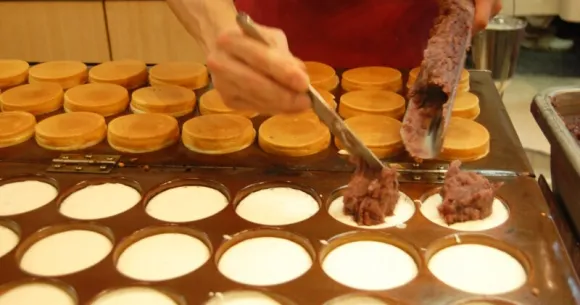
Every region of Japan has its own local foods, either dishes or ingredients, that it’s particularly proud of. There are some things, however, that transcend prefectural and regional borders, things that are loved across Japan, and one of them is the treat seen in these photos.
These discs of pancake like batter, thick and with sweet fillings such as anko (sweet red bean paste), custard, or chocolate cream, can be found at snack stands and supermarkets from one end of Japan to another. They’re something that pretty much every single person in Japan has eaten several times in their lifetime, instantly recognizing and craving them whenever one comes into view.
So what are they called? Well, that’s the thing; Japan hasn’t reached a consensus on that.
To be clear, these are not some brand-new, trendy snack riding a wave of fad popularity that’s gotten in front of linguistic development. They’ve been around for generations. It’s just that different names caught on in different parts of the country, and perhaps because they’re a simple pleasure, no big-budget marketing campaign pushing one name or another has been made to unify the nomenclature nationwide.
Instead, different names have gained traction in different parts of Japan, and to get a better understanding of the situation, Nichirei Foods, one of many companies who make this kind of snack, conducted a survey, gathering 14,057 responses from participants aged 20 to 79, asking them what they call these sweets. Then they sorted the responses by prefecture to determine the most common name for it in each of them, and used that to create this color-coded map showing which of six different names is the most prevalent for each prefecture.
Let’s take a look at each.
1. Imagawayaki (shown in red on map)
● Most common name in 19 prefectures: Chiba, Fukui, Fukushima, Gunma, Hiroshima, Ibaraki, Kanagawa, Kyoto, Miyagi, Nagano, Okinawa, Saitama, Shiga, Shizuoka, Tochigi, Tokyo, Toyama, Wakayama, Yamanashi
While far from universal, the top response, both in terms of total responses and number of prefectures where it was the most common, was Imagawayaki. The exact origin of the name is unclear, but one theory is that the sweet became popular in Edo, the old name for Tokyo, at a shop located near the Imagawa Bridge, which was built by a village headman with the family name Imagawa.
Imagawayaki is the most common name for the sweets in Tokyo and the prefectures of Japan’s eastern Kanto region, but the name also stretches up into parts of the Tohoku region and also has a few pockets of support far from the capital, including Kyoto, Hiroshima, and Okinawa. And though its 19 prefectures still give it a minority share of Japan’s total of 47, those 19 prefectures include some of Japan’s most populous cities, leading to 60.5 percent of the survey participants given Imagawayaki as a response.
2. Obanyaki (shown in blue on map)
● Most common name in 15 prefectures: Aichi, Akita, Ehime, Gifu, Ishikawa, Iwate, Kagawa, Kochi, Mie, Niigata. Okayama, Shimane, Tokushima, Tottori, Yamaguchi
Unlike Imagawayaki, the linguistic origin of obanyaki is pretty easy to figure out, since oban literally means “big coin.” Granted, coins in the old days of Japan were more oval shaped than purely circular, but the resemblance is still close enough to warrant tacking a yaki (“grilled”) onto it to get obanyaki.
With Nichirei’s survey apparently allowing for multiple responses, obanyaki was chosen by 52 percent of the respondents, so while it’s not as common as Imagawayaki, you’ve probably still got a pretty good chance of most people in Japan understanding the term if you say it, even if it’s not the top pick for their prefecture. In addition to obanyaki’s pockets of support in the Tokai region and western end of Japan’s main island of Honshu, it also claims the entirety of Shikoku as its domain.
3. Kaitenyaki (shown in green on map)
● Most common name in 9 prefectures: Fukuoka, Kagoshima, Kumamoto, Miyazaki, Nagasaki, Nara, Osaka, Ota, Saga
Chosen by 25.9 percent of respondents, kaitenyaki holds sway over all of Kyushu, as well as Osaka, one of Japan’s most enthusiastic foodie prefectures. In addition to tasty food, Osaka loves a good laugh, so that might have something to do with their fondness for the name kaitenyaki, as kaiten means “revolve,” so it’s a fitting name for a snack that could roll away if you accidentally drop it.
4. Oyaki (shown in yellow on map)
● Most common name in 2 prefectures: Aomori, Hokkaido
Oyaki was the most popular name in Japan’s two northernmost prefectures, but it’s not hard to see why oyaki hasn’t spread very far. It’s just the yaki (“grilled”) we mentioned before with an honorific o- added to the front, so it could sort of refer to anything, which could be especially confusing when you’re trying to talk about something that doesn’t have a unified definitive name in first place.
5 (tie). “A certain brand name” (shown in pink on map)
● Most common name in Hyogo
Nichirei gets a little cagey with the results for Hyogo, the prefecture that includes the city of Kobe, only saying that “a certain brand name” is the most common way to refer to this snack. A little digging around indicates that it’s most likely Gozasoro, a confectioner maker headquartered in Ehime (also in Hyogo) that specializes in the sweet and has a handful of shops in other parts of Japan that sell it, but is apparently most popular in its home prefecture.
5 (tie). Ajiman (shown in orange on map)
● Most common name in Yamagata
Yamagata’s situation is pretty much exactly the same as Hyogo’s, in that the top response for the prefecture was also the name of a locally based maker of the snack that has modest operations in other parts of Japan. For whatever reason, though, the survey was comfortable revealing what that name is: Ajiman.
Amazingly, the survey turned up even more names than these six, with some respondents saying they called them taiko (“drum”), jiman (“pride”), niju (“two layer”), or enban (“disk”) -yaki.
Ultimately, with so many different possibilities, it’s probably best to be prepared for the possibility that if you’re talking about Imagawayaki/obanyaki/kaitenyaki/etc., the listener might not immediately get the mental picture of what you’re talking about the first time you say it, so you might have to use another of its possible names for things to click. Thankfully, though, these sweets really are delicious, so they’re worth putting in a bit of effort to talk about, though if it all starts to feel like too much hassle, you can always switch gears and talk about desserts with clearly correct names instead, like the Chocobo-yaki.
Source: PR Times, Nihon Keizai Shimbun, Lasisa
Top image: Free Sozai.com
Insert images: Free Sozai.com (1, 2), PR Times, Free Sozai.com (3, 4)
● Want to hear about SoraNews24’s latest articles as soon as they’re published? Follow us on Facebook and Twitter!
Like this:
Like Loading…