Listen to this article
Estimated 4 minutes
The audio version of this article is generated by text-to-speech, a technology based on artificial intelligence.
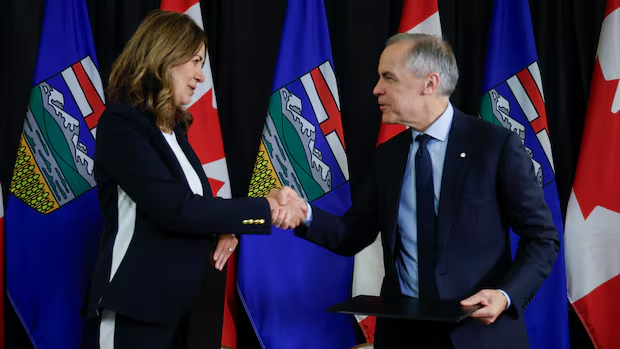
Ottawa’s clean electricity regulations’ days are numbered in Alberta, after Prime Minister Mark Carney and Alberta Premier Danielle Smith signed their memorandum of understanding last week.
The federal government suspended the regulations meant to rein in Canada’s worst polluter, but it hasn’t explained how it is going to ensure the country’s climate goals will be met.
Carbon pricing, though, is expected to play a dominant role.
The federal electricity regulations were supposed to have the biggest impact in Alberta, displacing nearly 214 million tonnes of pollution. That’s equivalent to removing the tailpipe emissions from more than 49 million cars.
WATCH | Environment minister discusses Alberta energy deal with Rosemary Barton:
Is the Ottawa-Alberta energy deal unravelling Canada’s climate policy?
Chief political correspondent Rosemary Barton speaks with Minister of Environment and Climate Change Julie Dabrusin about the environmental implications of the Alberta-Canada energy agreement. Plus, Brian Jean, Alberta’s energy minister, talks about what benefits a new pipeline would bring to the province. And B.C. Minister of Energy and Climate Solutions Adrian Dix explains why a bitumen pipeline is a non-starter for the west coast.
Environment Minister Julie Dabrusin says she has the power to negotiate a side deal with Alberta that achieves similar outcomes.
“If they can show me that they can meet the objectives of the regulation with their own regional path, I can negotiate with them,” Dabrusin told CBC’s Rosemary Barton Live.
The technical term to describe what Dabrusin is talking about is an equivalency agreement, although neither the minister nor Albertan officials have used that term. The Canadian Environmental Protection Act authorizes Dabrusin to enter into such deals with provinces, territories and Indigenous governments.
Saskatchewan, Nova Scotia, British Columbia and Alberta have all signed such agreements with the federal government.
How will Alberta make up for emissions?
Thursday’s agreement commits Alberta to “achieving a net-zero power grid by 2050,” the goal also outlined in the clean electricity regulations.
Alberta argued those rules would force the province to phase out natural gas power generation and plunge it into blackouts.
The regulations do not ban natural gas power, but do require facilities to build out carbon capture and storage and purchase carbon credits to offset emissions.
A spokesperson for Alberta’s minister of the environment and protected areas said the province will hit its emissions targets through its carbon pricing system, the Technology Innovation and Emissions Reduction (TIER) program, which already regulates heavy electricity generation emitters.
The memorandum signed with Ottawa requires Alberta to negotiate an agreement by April 1 to raise the price of carbon credits traded in the TIER system.
However, for years, officials at Environment and Climate Change Canada studied whether a strong enough price on emissions alone would be enough to put the country on track to achieve its climate targets.
The answer that emerged from modelling is, on its own: no.
According to one assessment of Canada’s electricity sector released in 2024, even a carbon price of $170 per tonne “would be insufficient.”
The memorandum committed to raising the province’s effective carbon price to a minimum of $130 per tonne.
Higher carbon price ‘possible’ solution: Think-tank
The Canadian Climate Institute think-tank however, said it’s not impossible for Alberta to achieve its emissions goals with robust carbon pricing.
“It is possible,” said Dale Beugin, the executive vice-president with the Canadian Climate Institute. “The federal government or others should do that math and should demonstrate that it can be equivalent. And that strengthens the case for this memo of understanding.”
The Pembina Institute, a clean-energy think-tank, is skeptical about whether both Alberta and the federal government can lower energy emissions without regulations.
“[Clean electricity regulations] would have done a lot to send a signal to Alberta’s beleaguered renewable sector that they are wanted,” said Scott MacDougall, the electricity program director with the Pembina Institute.
The deal itself does specify carbon pricing alone will not do the job of reducing the emissions from Alberta’s electricity sector. The memorandum of understanding states it will factor in “all other measures” before it permanently suspends the clean electricity regulations.
What those other measures are remains unknown.