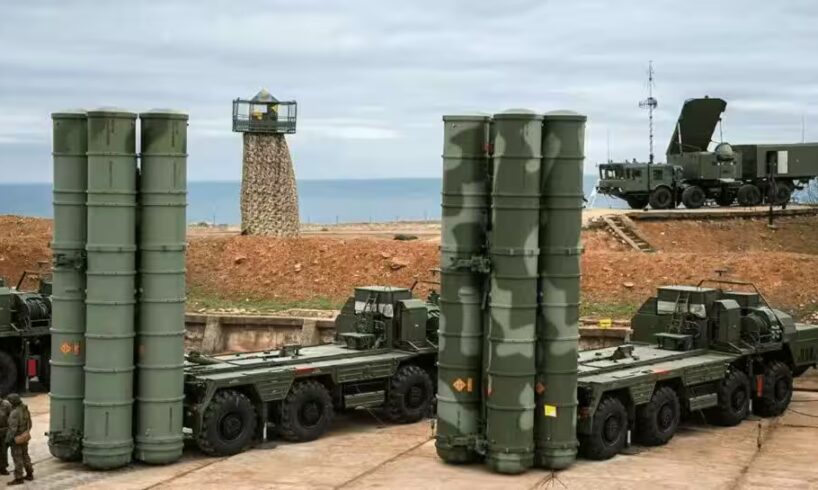
Comparison Between S-400 And S-500: India’s defence planners are closely watching Russia’s next-generation S-500 missile system, which promises to expand the country’s already formidable air-defence capabilities. While India’s S-400 long-range system has proven its worth, the S-500 (also called Prometheus) represents a higher tier, capable of reaching faster, higher and more sophisticated aerial and ballistic threats, possibly even low-earth-orbit targets.
S-400: India’s Shield In The Sky
India procured the S-400 in 2018 to secure its airspace against aircraft, cruise missiles and select ballistic threats. This mobile and layered system relies on a mix of interceptors to create a protective umbrella over high-value areas.
Add Zee News as a Preferred Source
“The S-400 provides a very strong regional air-defence capability,” say analysts, highlighting its proven track record in multiple deployments.
Its interceptors can engage aerodynamic targets over a few hundred kilometres and reach altitudes up to approximately 30 kilometres, with some missiles designed for even higher-altitude ballistic threats.
S-500: The Next Layer Of Defence
Russia’s S-500 is designed to operate above and beyond the S-400, targeting faster and higher-flying threats such as advanced ballistic missiles and hypersonic glide vehicles.
Public claims suggest the system can engage low-earth-orbit objects, taking air and missile defence into near-space. Interceptors for the S-500 reportedly reach ranges of 500-600 kilometres and altitudes measured in tens to possibly over a hundred kilometres for certain targets.
The analysts describe it as a theatre anti-ballistic missile system with counter-hypersonic capabilities that complement existing S-400 batteries.
Target Capabilities, Tactical Reach
The S-400 efficiently engages fighters, bombers, UAVs, cruise missiles and tactical ballistic missiles, creating a layered defence for both regional and point-specific protection.
The S-500 expands this envelope to extremely high-speed ballistic threats and hypersonic units. Depending on interpretation of Russian sources, it may also threaten select LEO objects.
This ability could provide India a limited counter-space advantage, though operational proof remains classified.
Advanced Sensors, Battle Management
The S-400 combines panoramic and multifunction radars to maintain situational awareness across multiple layers of defence. The S-500 incorporates next-generation radar and command systems with broader frequency coverage, faster reaction times and improved high-altitude tracking.
These enhancements allow the S-500 to cue interceptors against numerous simultaneous high-velocity targets, a capability critical against hypersonic and ballistic threats.
Proximity vs Hit-to-Kill
S-400 interceptors rely largely on proximity-fused warheads, using layered missile types to improve kill probability. The S-500 introduces a mix of kinetic “hit-to-kill” interceptors designed to neutralise ballistic payloads and hypersonic units that can survive proximity blasts.
Hit-to-kill technology becomes essential at extreme speeds and altitudes, though its real-world effectiveness in operational conditions remains closely guarded.
Space, Anti-Satellite Potential
One of the most intriguing discussions around the S-500 is its reported ability to engage certain low-earth-orbit targets, a domain entirely beyond the S-400’s design.
Analysts caution that independent verification is limited, but if operational, this capability would give India a strategic edge in near-space defence.
Deployment Status, Export Prospects
The S-400 is already operational in India and several other countries. In contrast, the S-500 has been inducted in limited numbers by Russia since 2021, with production volumes still small. Any potential sale to India would be high-profile and politically significant, requiring detailed negotiations.
Strategic Implications
If India were to acquire the S-500, it would strengthen defence against hypersonic and high-speed ballistic threats, protect critical strategic assets at unprecedented altitudes and offer a limited counter-space deterrent.
The S-500 would extend the S-400 umbrella rather than replace it, creating a multi-layered air-defence network capable of handling modern aerial threats.
Political, logistical and operational factors, including command-and-control integration, maintenance, training and sanctions considerations, will influence any acquisition.
As discussions between India and Russia continue, defence experts believe a successful integration of S-500 systems would mark a new era for India’s strategic capabilities, extending the nation’s shield from conventional air threats to near-space contingencies.