2025-12-02T23:12:55+00:00
font
Enable Reading Mode
A-
A
A+
Shafaq News
Iraq’s reliance on foreign operators to sustain its oil
industry is deepening, with Chinese companies now entrenched across many of the
country’s largest fields and American firms re-entering through a new wave of
high-profile deals. This shift has placed Iraq’s most strategic resource at the
center of a quiet competition between Beijing and Washington—one that,
according to experts, is shaping government decisions in ways that are “purely
political.”
Oil expert Hamza al-Jawaheri told Shafaq News that Baghdad’s
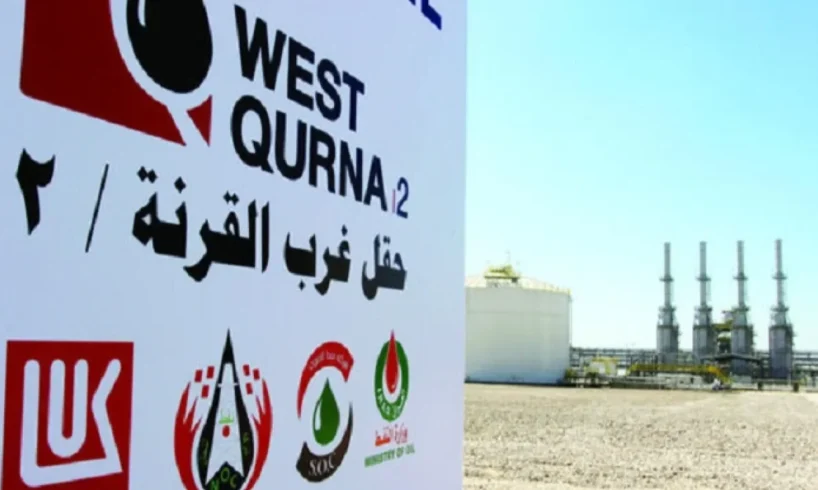
recent exclusive invitation to US companies to develop the West Qurna-2
field—discovered in 1973 and long regarded as one of Iraq’s most valuable
assets—in Basra aims to counterbalance China’s expanding reach. He explained
that the government seeks to reassure Washington that it “is not being
marginalized,” particularly as Chinese operators have secured the dominant
share of Iraq’s producing fields.
Any American involvement in West Qurna-2, he added, would
remain within Iraq’s technical-service model, without granting companies a
stake in production.
The invitation followed Russia’s Lukoil declaring force
majeure on its 75 percent stake after sanctions disrupted its operations.
China’s Expanding Footprint
Chinese companies have become central to Iraq’s upstream sector,
operating or co-developing fields from Wasit to Basra. CNPC and its subsidiary
PetroChina hold positions in Ahdab, Halfaya, Rumaila, and West Qurna-1.
Sinopec, Geo-Jade, Zhenhua Oil, United Energy Group, and Zhongman extend this
footprint across Mansuriyah, Sumer, Addan, Siba, Block 9, Sindbad, Fao, East
Baghdad, the Middle Euphrates, and other blocs.
Their presence has recently deepened through substantial
investments. A Geo-Jade–led consortium in 2025 committed $848 million to expand
the Tuba field and construct a 200,000-barrel-per-day refinery, a petrochemical
complex, and two power plants. Zhenhua Oil plans to double its production to
250,000 bpd by 2030, while Zhongman allocated $481 million to develop blocks
won in 2024.
A Renewed American Push
After years of limited participation, American companies are
returning to Iraq’s oil sector through a series of strategic agreements.
ExxonMobil signed an accord in October 2025 to develop the Majnoon field and
improve export-infrastructure from Basra.
In August, Iraq reached an agreement in principle with
Chevron covering exploration blocks and producing fields under the broader
Nassiriya project. HKN Energy concluded an initial deal with the North Oil
Company in July to develop the Hamrin field, and engineering firm KBR secured a
renewed contract for project management services at Majnoon.
Analysts attribute this renewed interest to Iraq’s
combination of low extraction costs, large reserves, and the scale required by
companies facing production declines elsewhere. Executives from smaller Chinese
firms, meanwhile, point to improved investment conditions and policy
coordination that have made Iraq more attractive to both Asian and Western
operators.
A Sector Built on Foreign Partnerships
Iraq, OPEC’s second-largest producer, aims to raise its
production capacity by more than 50 percent—surpassing six million barrels per
day by 2029. Achieving this goal depends on sustained foreign involvement, with
recent assessments emphasizing that approximately 70 percent of Iraq’s
production relies on foreign operators, reflecting a structural reliance that
is deepening rather than receding.
In this context, Baghdad’s overture to American firms at
West Qurna-2 signals an attempt to balance partnerships without disrupting
existing Chinese-led development. The government views both relationships as
essential: Chinese companies provide low-cost, large-scale project delivery,
while American firms offer advanced technology, export-infrastructure expertise,
and a channel of strategic engagement with Washington.
As Iraq prepares to select a new operator for West Qurna-2,
the decision is likely to shape the distribution of influence between China and
the United States across the wider sector.
Written and edited by Shafaq News staff.