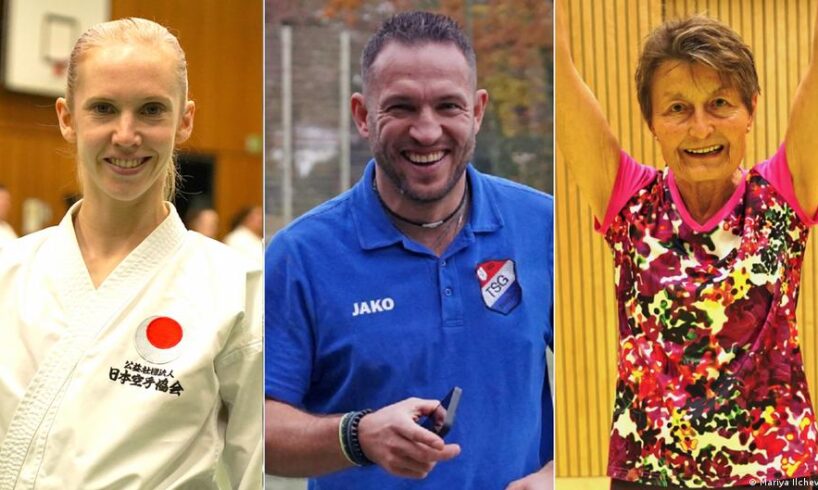
Imagine you do karate for fun, but are being trained by a 10-time European champion and it only costs you around €20 ($23) a month. Sound unlikely? In Germany, it is possible.
At the Dojo Ochi karate club in the western city of Bonn, Melissa Rathmann volunteers as part of an eight-person team of coaches. In addition to her 10 European Championship titles, the 33-year-old has won numerous German championships and was twice runner-up in the World Championships. Despite her great sporting success, she has always remained loyal to her club.
Melissa Rathmann in action at the karate club in BonnImage: Mariya Ilcheva/DW
For the love of sport
“It’s not about power, politics, nepotism, or other forms of exploitation,” Rathmann told DW. “There is a harmonious club life that is all about togetherness and a love of sport.”
While in many countries, popular sports have established themselves as a lucrative business model, in Germany non-profit clubs are the first port of call for those interested in sports. They are mainly financed by membership fees, public subsidies, and volunteer work.
Coaches usually do not receive a salary, but rather a small expense allowance in recognition of their work. With more than 86,000 clubs, a total of around 30 million members, and almost two million volunteers, Germany’s sports club culture has even been designated a UNESCO cultural heritage.
Rathmann, who works as a controller at the University Hospital in Bonn, does all this in her spare time. Her work at the club is important to her because it is about more than just sport.
“Sports clubs also promote social skills. People with different backgrounds, origins, and ages come together,” said Rathmann, adding that these encounters strengthen social cohesion.
Chris Leize says coaching brought him back to life after his accidentImage: Mariya Ilcheva/DW
‘Sport brought me back to life’
Chris Leize couldn’t imagine his life without his favorite sport. The 41-year-old is a volunteer football coach at TSG Steinheim. After a serious car accident 10 years ago that saw him need 17 operations, Leize fought his way back to life, and sport played a major part.
“It’s my great passion. I wanted to get back to being as good on the football field as I was before the accident,” the trained mechanic told DW. His long-term health issues prevented him from doing so, which is why he turned to coaching.
“I want to teach the boys what I was able to do in my prime,” said Leize.
Unsurprisingly, football is the sport with the most members in German clubs. In Steinheim, a town north of Stuttgart that only has a population of around 12,000 inhabitants, 300 children and young people attend football training several times a week. The membership fee is just €65 euros per year.
Empathy, respect, and fairness
“Here, they learn more than just soccer skills and discipline. A lot of emphasis is also placed on human interaction,” said Leize. Empathy, respect, and fairness are also important values, as are self-confidence and courage.
The football field is also an important place for integration: Chris Leize’s team includes children from a wide variety of backgrounds, for whom team spirit is the only thing that counts.
“Learning to lose is also important, because life doesn’t always go smoothly, as my own life shows. Football taught me never to give up,” said coach.
Leize’s players are aged between 11 and 13 years old and for many of them, the club is a refuge from everyday life. “On the field, they get recognition, they feel free and can develop,” explained Leize.
“That’s important at their age. And it’s actually true for me, too. No matter how stressful my week has been, I forget my worries during training. Even with the chronic pain I’ve had since the accident.”
Maria Helwich keeps her ladies motivated with her fitness classesImage: Mariya Ilcheva/DW
‘It’s never too late to start exercising’
Exercise keeps Maria Helwich alive. The 78-year-old has been running a fitness course at a club in Alfter, a town near Bonn, for almost three decades, even though she first became a coach aged 50.
“Before that, it was a duty, but then it became a pleasure,” Helwich said.
Helwich does gymnastics every morning.
“I want to be fit – for my ladies,” said the retiree, explaining that she prepares diligently for each class. She watches videos on the internet, thinks up new choreography, and selects the right music.
The participants in her classes are between 50 and 80 years old and love the zest for life that their coach radiates. And Helwich admits that the greatest reward for her is seeing the women beam with joy while exercising.
Helwich’s club also offers yoga, volleyball, and many other sports and courses, all for €60 per year.
Without coaches and instructors like Helwich, Chris Leize, and Melissa Rathmann, who volunteer wholeheartedly, Germany’s low-threshold club offerings would not be possible. But they, and many other coaches like them, are precisely what makes Germany’s sports club culture unique.
This article was adapted from German.