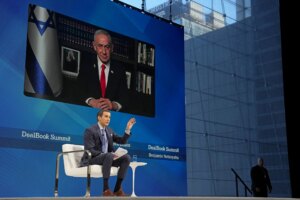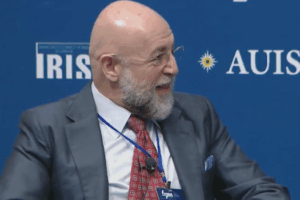
Israel and Lebanon have launched their first ever direct talks at the civilian level to explore potential economic and other cooperative initiatives that are not tied to the ongoing military campaign against Hezbollah. This unexpected development followed a meeting in Naqoura between an Israeli team led by Dr. Uri Resnick, deputy head of foreign policy at Israel’s National Security Council, and a Lebanese delegation led by Simon Karam, the former Lebanese ambassador to the US. The talks were mediated by Morgan Ortagus, President Donald Trump’s envoy to the region, and included representatives of the IDF, the Lebanese Armed Forces and the UN.
The statement released by the Prime Minister’s office after the meeting said that under Netanyahu’s direction and as part of the ongoing security dialogue among the US, Israel and Lebanon, Resnick met Ortagus and Lebanese civilian representatives in Naqoura. According to the statement, the meeting was held in a “positive atmosphere” and the sides agreed to formulate “ideas for potential economic cooperation between Israel and Lebanon”. Israel clarified that “disarming Hezbollah is a fundamental requirement that stands independently of any progress on economic issues. The sides agreed to hold follow-up discussions.”
Joseph Aoun | Photo: Anwar Amro/AFP
Earlier statements described the meeting as a first attempt to establish the basis for economic cooperation and a future relationship between Israel and Lebanon. Beyond the immediate discussions on monitoring the ceasefire, this was presented as the early groundwork for eventual normalization, even if actual political agreements remain distant. The process, Israeli officials say, has now begun.
These contacts mark a significant shift. During the maritime border negotiations in previous years, Lebanon, under pressure from Hezbollah, refused to send civilian officials, and the talks were conducted indirectly through the US and France and handled by military officers. Even then, Beirut participated only after Israel agreed to relinquish nearly all of the disputed maritime area. The current civilian-level dialogue is a strong indication of the decline in Hezbollah’s influence over Lebanese government policy.
For Israel, this represents a policy adjustment coordinated with and encouraged by Washington. Two tracks are now separated: the campaign against Hezbollah and efforts to dismantle its arsenal, and the political process with Lebanon. Israel will continue to strike Hezbollah targets as the organization works to rebuild and rearm, while Lebanon’s government continues pursuing its stated commitment to disarm the terrorist organization. Separately, Israel and Lebanon will engage in civilian talks. The US administration has given Israel a green light to continue its military actions against Hezbollah, while at the same time pressing Jerusalem to support steps that bring the Lebanese government and President Joseph Aoun closer to Washington and promote confidence building measures.
Hezbollah terrorists during a drill in southern Lebanon (archive). Photo: AP
The content of the civilian talks is not yet clear. One of the primary expected avenues is cooperation related to natural gas exploration in the eastern Mediterranean, including securing offshore gas fields and the shipping lanes used by oil tankers. Agricultural cooperation may also be explored, along with mechanisms to oversee the return of residents of southern Lebanon to their homes. Many of these residents are Christians, whose return Israel views as a moderating factor compared with Shiite communities, many of whom have been Hezbollah members or supporters.
According to an Israeli political official, the dialogue is expected to lay the foundation for broad negotiations between Israel and Lebanon on all outstanding issues, including formalizing the land border and resolving disputes created largely by Hezbollah. Still, the official added that as long as Hezbollah remains active, progress on matters such as an IDF withdrawal from positions inside Lebanon or halting Israeli strikes against Hezbollah operatives and infrastructure will remain extremely difficult.