Mr. Sato heads to one of Japan’s biggest Chinatowns to see how things are following China’s travel advisory.
The Chinese government recently made a statement telling citizens not to travel to Japan, which was seconded by the Chinese Embassy in Tokyo on November 26. Since the diplomatic spat started, we’ve been making the rounds of some of Japan’s most popular sightseeing destinations and shopping spots to see whether or not the travel advisory is having an affect on the size of tourist crowds, and the next spot on our list was Yokohama’s Chinatown.
Yokohama Chinatown is about 45 minutes south of downtown Tokyo by train. As he made the trip down from SoraNews24 HQ on a Monday morning, our ace reporter Mr. Sato mused over the sort of tourism demographics it attracts. Being so close to Tokyo, you can always count on a large number of Japanese day trippers from the capital, but it’s famous among international tourists too, since it’s one of the largest Chinatowns in Japan, rivaled in size only by Kobe’s and Nagasaki’s. Yokohama Chinatown is also located close to many of Yokohama’s other popular sightseeing spots, almost adjacent to the beautiful seaside Yamashita Park and fashionable Motomachi shopping avenue, and it’s geographically pretty easy to fold into an itinerary that includes the Minato Mirai harbor district or the Cup Noodle Museum. Basically, if you’re an international tourist spending a full day in Yokohama, there’s a pretty good chance you’re going to spend part of it in Chinatown.
And the other thing Mr. Sato was thinking about on the train? Food. Yokohama Chinatown’s biggest draw is its collection of Chinese restaurants and street food stalls, and we can’t rule out the possibility that Mr. Sato quickly volunteered for this assignment because he knew he’d be able to sneak a lunch into his field work.
It’s actually hard to not think about food when arriving in the neighborhood, since Motomachi Chukagai Station, the closest rail stop to Yokohama Chinatown, features several restaurant ads, like the one above for Hotenkaku, a xiaolongbao specialty shop that boasts about its “very long lines” (大行列) of customers.
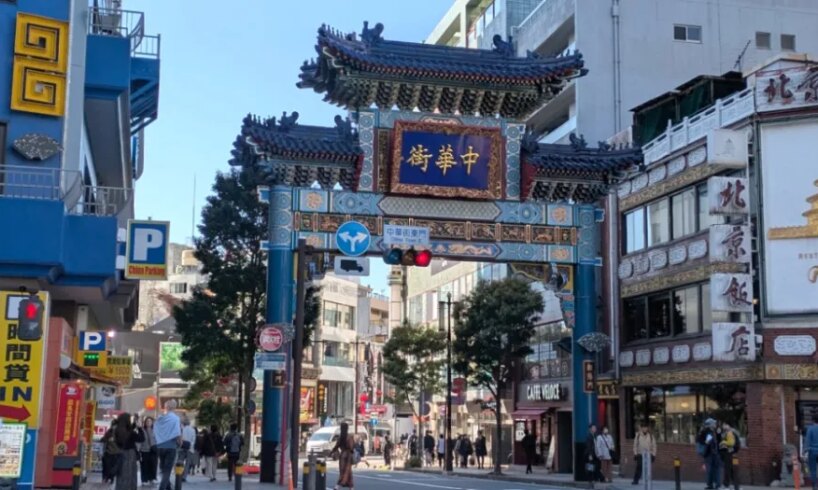
Heading out of the station and onto the street near one of the gates that marks an entrance to Chinatown, Mr. Sato checked his watch and saw that it was just about 11 a.m. Considering that it was still before noon on a weekday, there were actually quite a lot of people browsing the shops and checking out the restaurants as they sorted through their lunch options, and the crowds got denser as he progressed deeper into the neighborhood down its main street.
The mood was fun and festive, and as he passed by other pedestrians Mr. Sato could hear some of them speaking Chinese. There’s a chance some of them were speaking Taiwanese, and even those speaking Mandarin might be residents of Japan, but in any case, the amount of Chinese he heard being spoken felt about the same as the last time he was in Yokohama Chinatown, which was well before the Chinese government’s recent travel advisory.
As it got closer to lunchtime, even more people started showing up, and Mr. Sato also started noticing Japanese schoolkids in uniform here on field trips too. Eventually he found himself in front of the main branch of Hotenkaku, the xiaolongbao shop with the supposedly long lines, and yep, there were a whole bunch of people waiting to buy some.
Unbeknownst to them, apparently, Hotenkaku has another branch in the neighborhood, one that’s farther away from the station. There was no line at that one, but that might just be because of its less convenient location and because it was a weekday. Regardless of the reason, Mr. Sato recognized this as an opportunity to try a local favorite without having to wait, and treated himself to four of the delicious dumplings.
Hotenkaku wasn’t the only place doing a brisk business on this day, either. Among the other restaurants with huge lunch crowds were Shanghai-style restaurant Jogenro, which had this many people already outside even before they opened for the day…
…and Shatenki, where there was a line out the door of people craving their congee rice porridge.
▼ It’s said that Shatenki has a picture of Santa Claus on their sign because they want the restaurant to become as famous and recognized as St. Nick. They’re not quite there yet, but it definitely does help the place stand out.
It’s hard to say if the Chinese government’s travel advisory has caused a reduction in the number of Chinese tourists in Yokohama Chinatown, since at a glance it can be hard to differentiate them from ethnic-Chinese residents of Japan who’re visiting the neighborhood for the day. However, there’s something we can say a little more definitively after Mr. Sato’s visit, which is that the number of Japanese sightseers in Yokohama Chinatown doesn’t seem to have shrunk at all.
Yes, there’s an increased level of diplomatic tension right now between the Chinese and Japanese governments, but the continued interest from Japanese tourists in Yokohama Chinatown at least shows that most people in Japan are able to keep their feelings towards the Chinese government from having a significant negative effect on their perception of Chinese culture or Chinese people.
Seeing that, it’s heartening to know that while governments may sometimes have beef with each other, most people are more interested in having xiaolongbao.
Photos ©SoraNews24
● Want to hear about SoraNews24’s latest articles as soon as they’re published? Follow us on Facebook and Twitter!
Like this:
Like Loading…