[SINGAPORE] In a five-year master plan, Singapore has set aside S$37 billion for research and innovation in key economic sectors such as semiconductors, and priorities such as active ageing.
Released on Friday (Dec 5), the Research, Innovation and Enterprise (RIE) 2030 plan marks a 32 per cent increase from RIE2025’s S$28 billion. RIE funding is usually about 1 per cent of gross domestic product.
Aside from strategic priorities, RIE2030 focuses on “things that improve our economy, effectiveness (and) our competitiveness”, said Professor Tan Chorh Chuan, permanent secretary for National Research and Development, at a media briefing earlier this week.
Some S$10.8 billion, or 29 per cent of RIE2030’s budget, is for four existing areas: manufacturing, trade and connectivity; human health and potential; urban solutions and sustainability; and smart nation and digital economy.
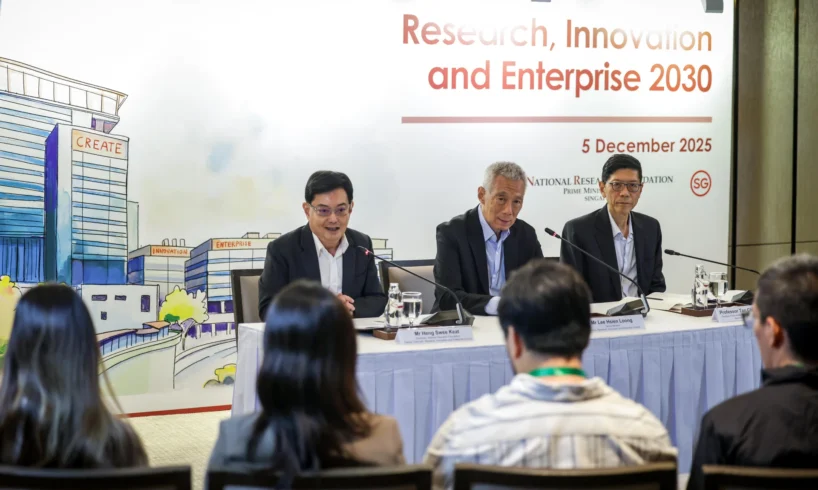
Unlike RIE2025, each domain will now oversee its own innovation and enterprise efforts, enabling more end-to-end, sector-specific strategies, said Senior Minister and RIE Council chair Lee Hsien Loong at Friday’s launch.
“This will be complemented by support for early stage research translation and enterprise innovation activities across all fields and sectors,” he added.
MNCs not pulling back
At the media briefing, National Research Foundation (NRF) chief executive officer John Lim noted that planning for RIE2030 began before current geopolitical tensions.
Prof Tan said the manufacturing, trade and connectivity domain involves partnerships with multinational corporations (MNCs) – and these companies have not scaled back despite trade tensions.
“If anything, there is growing interest in our research and development (R&D),” he said, adding that Singapore’s research strengths “align with what MNCs are looking for”.
SEE ALSO
SM Lee also highlighted the momentum in Singapore’s tech startup ecosystem. Over the past five years, deep-tech startups here have attracted S$1 billion or more in venture capital funding annually, in “a reflection of their quality”.
Apart from the four domains, RIE2030’s budget will also go to foundational research (24 per cent), innovation and enterprise (20 per cent), “white space” such as physical infrastructure and new programmes (17 per cent), as well as talent development (10 per cent).
A new Singapore-Horizon Europe Complementary Fund will also support local researchers participating in projects by Horizon Europe, the European Union’s flagship research and innovation programme.
Horizon Europe “supports key areas that are of strategic interest”, from next-generation clean energy technologies to precision medicine and artificial intelligence (AI), said NRF chairman Heng Swee Keat.
NRF will set up national contact points to support Singapore researchers participating in Horizon Europe grant calls.
First Flagship for semiconductors
Of the S$10.8 billion for the four domains, S$3 billion is for two new programme types: RIE Flagships and RIE Grand Challenges.
RIE Flagships are for key economic sectors. The first aims to deepen local semiconductor capabilities and ensure Singapore remains a key node in the industry’s global supply chain.
Led by the Agency for Science, Technology and Research (A*Star) and the Economic Development Board, it has four priorities.
One is developing world-leading capabilities in areas such as advanced packaging, heterogeneous integration and photonics. These are expected to underpin the next wave of semiconductor growth, said Professor Yeo Yee Chia, A*Star’s deputy chief executive for innovation and enterprise.
The other priorities are aligning public R&D with industry needs; growing local companies in partnership with MNCs and through venture building; and attracting and developing talent.
Semiconductor investments have become a “strategic issue” and “security matter”, noted SM Lee, with countries investing domestically to reduce their reliance on others.
Yet even in this environment, Singapore can still play a role as a “semiconductor centre”, he said, given its skilled, disciplined workforce and a stable economic and political environment.
Prof Yeo said the industry’s global revenue is about S$700 billion today, and is projected to grow to between S$1 trillion and S$1.3 trillion over the next five years, driven by demand for AI and memory-related chips. “Singapore is well-positioned to ride this wave.”
In the past two years, Singapore has secured more than S$18 billion in semiconductor investments.
The Grand Challenge of ageing
RIE Grand Challenges address national strategic priorities, with the first being for active ageing.
By 2030, a quarter of Singaporeans are projected to be 65 or older, said Lim. Yet while people now live longer, “the last 10 years or so tend to be fraught with frailty or disease”.
SM Lee said the new Grand Challenge will tackle critical knowledge gaps, and strive to delay and slow cognitive and physical decline in older people.
This will involve establishing a long-term study population of older Singaporeans, and setting up centralised platforms for health, genomic, lifestyle and clinical data.
There will be a test bed for rapid validation of healthy-ageing solutions, which can then be translated into preventive or therapeutic measures.
NRF said a second Flagship and Grand Challenge will be introduced, with details to be announced.
Aside from RIE Flagship and Grand Challenge programmes, RIE2030 funding will go towards other efforts in the four domains.
Manufacturing, trade and connectivity
To strengthen Singapore’s position as an advanced manufacturing and logistics hub, this domain focuses on areas such as semiconductors, supply-chain technologies, robotics and AI.
It will also support emerging sectors such as the space economy and bioeconomy.
Human health and potential
Apart from building Singapore as a biomedtech and biomanufacturing hub, funding will support areas such as precision health and translational research for disease prevention and treatment.
There will also be research into cognitive development and skills acquisition at different ages.
Urban solutions and sustainability
This domain focuses on climate resilience and the low-carbon transition, aiming to strengthen capabilities in climate science and adaptation, and set up Centres of Excellence.
There will be a stronger focus on real-world deployment of technologies.
Smart nation and digital economy
This aims to deepen capabilities in AI, quantum technologies and digital trust, and support the deployment of these technologies across sectors.
Funding will also go towards building a talent pipeline and partnerships.
Asked if Singapore has sufficient research talent, Prof Tan said the talent base is “robust and very competitive”, supported by strong local pipelines and overseas recruitment.
He added that NRF actively identifies emerging scientific areas early so Singapore can build the necessary capabilities.
Large-scale programmes require diverse teams: not just researchers, but also engineers, data scientists and technical specialists, he noted. The NRF will place a greater emphasis on attracting and developing young talent.
Asked how research success is evaluated, he said it cannot be measured solely by commercialisation. Instead, it is assessed over the longer term, including whether significant contributions are made to scientific understanding.
Foundational research remains essential, as disruptive ideas often emerge from scientific work that may not have immediate market applications, he said. “If we start off by saying the measure of success is commercialisation, then you often end up with just very near-term (outcomes).”
“But if you want something more needle-moving… it often has to come from very novel areas of science and application.”
Decoding Asia newsletter: your guide to navigating Asia in a new global order. Sign up here to get Decoding Asia newsletter. Delivered to your inbox. Free.