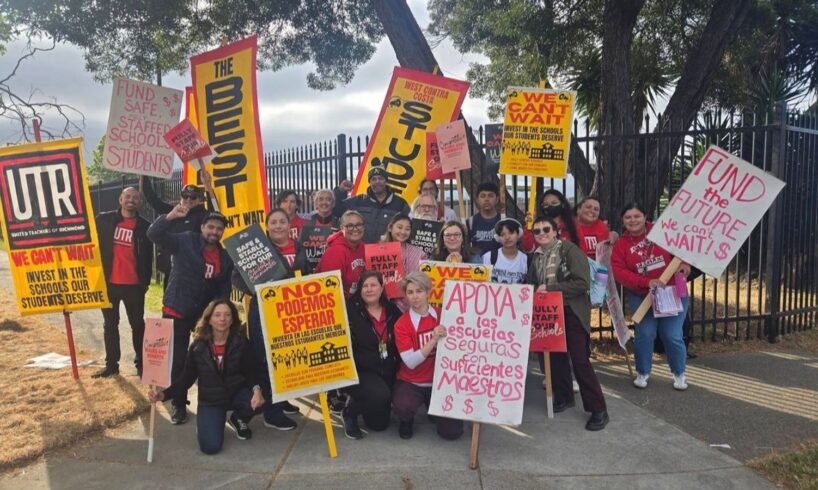
West Contra Costa teachers before the strike. [Photo: United Teachers of Richmond]
West Contra Costa educators joined with classified school workers to launch a powerful joint strike Thursday morning, shutting down normal operations in one of the San Francisco Bay Area’s largest districts and opening a new front in the growing wave of educator struggles across California and the United States.
Picket lines went up before dawn at schools in Richmond, San Pablo, El Cerrito, Pinole, Hercules and surrounding communities, as roughly 1,500 K–12 teachers, counselors, psychologists, speech pathologists, early childhood educators and nurses—members of United Teachers of Richmond (UTR)—walked out for the first time in the district’s history.
Educators were joined the same day with about 1,500 members of Teamsters Local 856, including paraprofessionals, custodians, clerical staff, food service workers, maintenance workers and campus security. The united action of some 3,000 school workers marks a significant escalation of class conflict in California and poses the urgent question of how this struggle can be taken forward.
The immediate issues in the strike are wages, staffing and intolerable working conditions. Teachers and other certificated staff face low pay that does not keep up with soaring Bay Area housing and living costs, ballooning class sizes and a chronic teacher shortage that leaves many students without permanent instructors. The district’s schools have become increasingly reliant on substitutes and short-term hires, while special education, English learner support and mental health services are systematically starved of resources.
Classified staff are among the lowest‑paid workers in the education system. Many paraprofessionals and support workers are forced to work multiple jobs or rely on public assistance to survive. Custodians and maintenance workers struggle to keep aging facilities functioning, while clerical and food service workers shoulder impossible workloads. Their decision to join the strike side by side with teachers underscores the unity of interests between all sections of school workers.
But educators in California, like their counter-parts across the country, are in a direct battle with the Trump administration’s war against public education, immigrants and the working class as a whole.
The first day of the strike already revealed the depth of support among students and parents and the degree to which the district depends on the labor of educators and staff. One Richmond High teacher reported to a local news outlet that only about 50 of the school’s 1,300 students attended classes.
At Highland Elementary, only 33 of 407 students were present and just three substitute teachers were on site. Across the district, administrators were forced to admit that attendance had plummeted, while the strike rally at Veterans Memorial Park in Richmond drew a crowd of teachers, classified workers, students and community supporters. On Tuesday, dozens of students at Kennedy High School walked out in support of their teachers going on strike.
Central to the development of this struggle was the vote by Teamsters 856 members to reject a tentative agreement jointly crafted by the union leadership and the district. The proposed contract offered only a token wage increase that did not come close to offsetting inflation and left many classified workers effectively trapped in poverty. It advanced nothing fundamental to resolve understaffing, overwork, or the widespread use of part‑time, precarious positions and split shifts. In short, it was a contract designed to preserve the district’s austerity budget at the direct expense of some of the most exploited workers in the system.
That this deal was brought forward by the Teamsters bureaucracy is a warning. The apparatus sought to present the agreement as the “best possible” under existing budget constraints, attempting to stampede workers into ratification with the usual scare tactics about layoffs, fiscal crisis and the alleged impossibility of fighting for more. The narrow margin of rejection expresses both rank‑and‑file anger and the pressure exerted from above to push through a rotten agreement. The vote confirms that there is a disconnect between the aspirations of the rank and file and the pro‑corporate outlook of the union bureaucracy, which functions as an arm of the Democratic Party and the political establishment.
In response to the strike, the district declared that schools would remain open, a strikebreaking maneuver aimed at undermining the strike and pitting parents and students against educators. The district attempted to staff buildings by paying substitute teachers double their usual rate and by redeploying administrators to classrooms, especially at elementary schools. At middle and high schools, students were reportedly crowded into gyms and cafeterias, supervised by a patchwork of administrators and a handful of substitutes.
Negotiations were set to continue Thursday evening, but under conditions where all the official parties—the district administration, UTR leadership and Teamsters officials—accept the framework of “what the district can afford.” In previous struggles around the country, such as in Chicago, Minneapolis and Philadelphia, this framework has been used to wear down striking workers, drag out talks and ultimately impose concessionary contracts that only fuel the underlying crisis.
Whatever promises district and union officials eventually make to educators will quickly be abandoned once the impact of the administration’s deep cuts in federal funding to low-income, special education and English learner students hit. That is why the struggle must be expanded and converted into a conscious political struggle against the Trump administration and its existential threat to public education.
The strike in West Contra Costa is not an isolated event. Across the country, educators are engaged in bitter struggles over the same issues: starvation wages, short staffing, decaying buildings and the ongoing diversion of public funds to charter schools and private vendors. In California, the WCCUSD strike coincides with a growing wave of discontent in major districts. In San Francisco, educators voted Wednesday by 99 percent to authorize a strike in the first of two votes. In Los Angeles and Berkeley, and numerous other districts, contracts have expired, negotiations are stalled and teachers are working without agreements. The conditions facing Richmond teachers and classified staff are part of a broader national and international crisis.
The state affiliate, California Teachers Association (CTA) has responded with its much‑publicized “We Can’t Wait” campaign, touted as a coordinated bargaining effort for dozens of districts whose contracts lapsed around the same time—nearly six months ago! In reality, the campaign has been designed to force educators to wait, keep them locked within district boundaries and prevent a unified, state-wide strike.
Such a walkout would immediate escalate into a political confrontation with the Trump administration.
Allied with the Democrats, the CTA and its affiliates, including UTR, have focused on isolated, local actions that can be tightly controlled and brought back under the discipline of the Democratic Party and the state government. Under conditions in which educators across California and, more broadly, across the country confront essentially identical conditions, this deliberate fragmentation only serves to sabotage the struggle.
To understand why schools remain chronically underfunded despite California’s immense wealth, it is necessary to look beyond the bargaining table to the underlying class interests at stake. For more than half a century, both Democrats and Republicans have carried out a bipartisan assault on public education. Tax cuts for the wealthy, corporate subsidies, and the expansion of charter schools and standardized testing regimes have gone hand in hand with school closures, program cuts and attacks on teachers and staff.
Today, this offensive is entwined with a rapidly intensifying global crisis of capitalism. Enormous resources are being poured into imperialist war preparations, including escalating threats and deployments in Latin America, as well as in Europe and the Asia‑Pacific. The financial oligarchy demands that the working class pay for these adventures through austerity at home—cuts to education, health care, housing and social services. Under such conditions, capitalism is increasingly incompatible with even the limited forms of democracy that existed in the past.
The Trump administration is spearheading an open drive to destroy public education, expand privatization and strip away basic democratic rights. But it does not act alone. At every level—federal, state and local—the Democratic Party coordinates with Republicans to impose corporate demands.
To prevent the West Contra Costa strike from being isolated and betrayed, educators and school workers must take the conduct of the struggle into their own hands! This requires the formation of rank‑and‑file committees in every school and worksite, democratically elected by workers themselves and independent of the union apparatus.
Such committees must insist that there be no secret negotiations, that all proposals be made public immediately, and that workers—not union officials—decide on demands and strategy. They should fight for a program based not on what the district claims is “affordable,” but on what students and workers actually need.
Such demands include substantial, inflation‑beating pay increases for all certificated and classified staff, with especially large raises for the lowest‑paid workers; massive hiring to reduce class sizes, guarantee a full‑time qualified teacher in every classroom, and ensure adequate support staff; an end to the division of workers by union and job classification, with no separate deals or return to work by one group while others remain out, and full transparency and rank‑and‑file oversight over all negotiations.
This must be combined with an active campaign to mobilize educators and broader sections of the working class to defend immigrant students and their families from ICE. The industrial mobilization of the working class, led by rank-and-file committees, must be fused with a political counter-offensive to drive Trump and his fascist cabal from power.
The continued existence of public education and democratic rights as a whole is incompatible with oligarchic rule. The resources to fully fund public education and social services must be found by ending the squandering of society’s resources on war and corporate subsidies, and by expropriating the financial oligarchy and reorganizing economic life on socialist foundations.
To win, the West Contra Costa strike must be consciously expanded and unified. Rank‑and‑file committees in WCCUSD should reach out to educators in San Francisco, Oakland, Berkeley, Los Angeles, San Diego and beyond, as well as to workers in health care, logistics, ports, manufacturing and other sectors throughout the Bay Area and California.
I want to discuss joining or building an educators rank-and-file committee: