BENGALURU – When English professor Shweta Philip sleeps, she needs the reassuring hum of an air purifier in her studio apartment.
“Since I’ve been using the air purifier, I wake up without sniffles and a headache,” she told The Straits Times.
In October, after her runny nose, itchy eyes and allergies intensified into a week-long bout of wheezing, the 27-year-old’s parents bought her a Honeywell air purifier.
Prof Philip initially felt it was unnecessary, since she lives in Bengaluru with its clear skies, not New Delhi, which frequently makes headlines for its thick smog, record-breaking air pollution levels and unbreathable air. “I was wrong. There’s no smog but Bengaluru’s air made me sick,” she said.
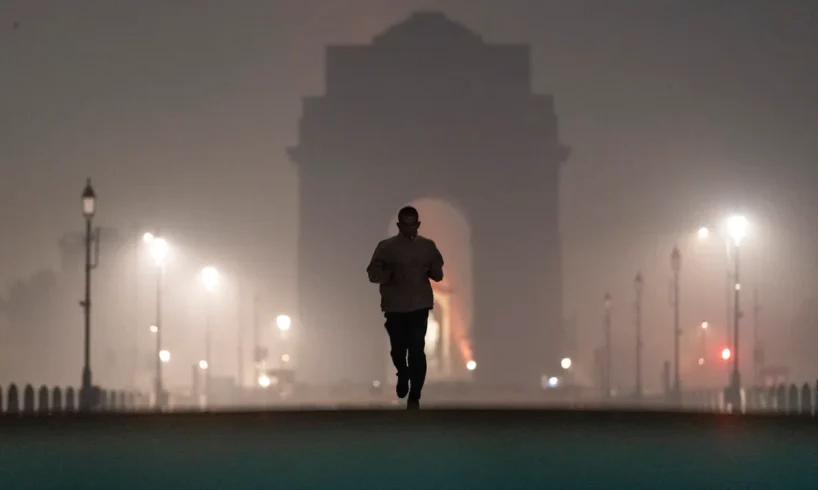
While Bengaluru’s air quality index (AQI) has ranged between 80 and 170 in November – or between moderate and poor – Delhi’s has been swinging within the “severe” range of 250 to 400 in 2025, even touching a catastrophic 900 in early November. In fact, no major Indian city recorded safe AQI levels at any point for the years from 2015 to 2025, according to research consultancy Climate Trends.
As more Indians feel this reality in their lungs, those who can afford it are buying air purifiers – no longer a luxury item, but a necessity.
In 2024, around 1.02 million air purifiers were sold in India, as reported by Mumbai-based research firm Mark & Spark Solutions. This number has risen to 1.2 million in 2025 and is projected to grow substantially to around 4.3 million over the next five years, driven by worsening air pollution and increasing health awareness.
The rush for air purifiers has highlighted two issues: widespread toxic air pollution across the country even as Indians await efficient solutions; and the vulnerability of the poor and the middle class who cannot afford these devices – priced between 5,000 rupees and 70,000 rupees (between S$70 and S$1,000) – leaving them defenceless against dirty air.
Mumbai resident Parita Patel and her husband got a Dyson purifier for their bedroom in 2024, as the skyline became hazier.
“The pollution in Mumbai may not be as bad as Delhi’s,” the book editor said. “But pollution can’t be relative. It’s bad for us here, which is why we use a purifier.”
Book editor Parita Patel began using an air purifier in her bedroom in Mumbai in 2024, amid an increase in construction activity in the city.
PHOTO: COURTESY OF PARITA PATEL
Dr Lancelot Pinto, a pulmonologist at P.D. Hinduja Hospital in Mumbai, told ST that in recent years, there has been a surge in patients experiencing blocked noses, watering eyes, sneezing and respiratory issues. He tells those with asthma and allergic rhinitis to get air purifiers.
He himself has used air purifiers in his bedrooms since 2021, after he noted a deterioration in air quality due to a burst of construction activity in Mumbai. As tunnels, bridges and apartment blocks spring up, the city is coated in dust, accompanied by a constant faint smell of burning in the air.
“In the past week, I could not breathe easily in my living room where I don’t have an air purifier,” Dr Pinto said.
The most concerning pollutant in India is particulate matter 2.5, or PM2.5 – fine, inhalable particles that penetrate deep into the lungs and enter the bloodstream.
Around 60 per cent of India’s 749 districts have breached the national air quality standard of 40 micrograms (mcg) of PM2.5 in every cubic metre of air, according to an assessment of air quality across India by the Centre for Research on Energy and Clean Air.
No district in India meets the World Health Organization’s PM2.5 guideline of 5mcg per cubic metre of air.
Northern cities like Lucknow, Varanasi and Ahmedabad have consistently recorded high, unhealthy AQI levels. Cities such as Kolkata, Mumbai, Chennai, Chandigarh and Visakhapatnam showed moderate but still unsafe AQI ranges, research by Climate Trends found.
The data indicating poor AQI in cities “underscores how India’s air pollution problem remains national, persistent and structural, driven by urbanisation, traffic, industry and seasonal factors – demanding systemic and science-based policy efforts”, the Climate Trends report said.
When Mumbai’s AQI crossed 200 in late November, the city corporation enforced the strictest anti-pollution measures. It has stopped all construction, demolition and dust-generating activities, and deployed flying squads of engineers and policemen to enforce the rules and monitor emissions.
Despite having double the pollutant levels, Delhi has been more lenient, only restricting the use of certain polluting cars, banning lorries in the city and requesting schools to have online classes.
Many residents have mocked the Delhi government for spraying water on air quality meters to artificially record low AQI readings, and for launching a hot-air balloon ride, oblivious to the smog that lies like a grey blanket over the city.
Meanwhile, the authorities in smaller cities like Bengaluru, Pune and Hyderabad have barely registered the worsening air quality.
The Indian government introduced the National Clean Air Programme in 2019, targeting a reduction of air pollutants in 131 cities. But climate experts have said the programme’s focus on PM10, like dust, rather than the tinier, more harmful PM2.5 known to cause severe health issues, is misguided.
“In an urge to be seen to be doing something, the government has spent money and effort on immediate but ineffective fixes, like cloud seeding (that failed because Delhi clouds had insufficient moisture) or installing smog towers in many cities for outdoor air filtration, even though there is evidence they don’t do much,” said Mr Bhargav Krishna, convener of Sustainable Futures Collaborative, a Delhi-based think tank.
The absence of serious, scientific long-term solutions, in a way, is forcing people to depend on purifiers as the only way to breathe clean air for at least a few hours a day, he added.
But most Indians do not have this choice, as the cost of these devices is unaffordable for most.
The popular brands are Dyson and Phillips for premium buyers, and for the budget watchers, the Indian and Chinese brands Eureka Forbes and Xiaomi.
“The market has ballooned. Every electronics company has a purifier out. How many are meeting the requirement of filtration is another question. Many of the top-range purifiers offer frills like Wi-Fi and problematic additions like ionisers that emit ozone, a lung irritant,” said Mr Krishna.
The only feature that matters, experts say, is how quickly a high-efficiency particulate air (HEPA) filter can clean and circulate air in a room. But even a HEPA filter costs between 1,500 rupees and 2,000 rupees.
“It raises important questions of equity, and who has access to clean air. Eventually, it is the people who work outside and (hence are) more vulnerable to toxic pollutants who cannot afford air purifiers,” said Mr Krishna.
To improve access, Delhi-based Breathify offers the country’s cheapest locally made air purifier for under 5,000 rupees. Its inventor Krrish Chawla was 16 and suffering breathing difficulties when he designed a plastic-free, affordable air purifier for the 700 million Indians who earn under 100 rupees a day.
“We started the company to address the lack of affordability, but as governments are not doing much to reduce overall air pollution, our mission has become more urgent – more people than ever need purifiers today,” said Mr Ratan Kohli, co-founder of Breathify.
“As a businessman, I may look at it as an opportunity, but I am also a father and a citizen. I’m also getting old. We are all being poisoned slowly as we breathe in 350 AQI air that’s equal to smoking 44 cigarettes a day,” he added, noting that Breathify is now also creating awareness about air quality.
As the air gets filthier across India, it is clearer than ever that air purifiers have limits.
“Air purifiers work only indoors, in medium-sized rooms, and only when the windows are sealed and the air-conditioning is on so that it’s not stuffy. You can maintain this maybe for eight hours of the day, but for the rest of the day, you’ll be exposed to pollution,” said Dr Pinto, the pulmonologist.
Prof Philip said her purifier is “only a source of partial relief” because she is exposed to polluted air when she takes the tuk-tuk to work, and during the time she lectures at the college.
Said Mr Krishna: “People are spending thousands of rupees and, sadly, it’s still not enough to protect themselves.
“We cannot live in a hermetically sealed bubble. The reality of air pollution is that it’s a complex, challenging problem – we need long, slow governance that takes people’s health seriously.”