Ken BanksNorth east Scotland reporter, Aberdeen
Natasha Lichtarowicz
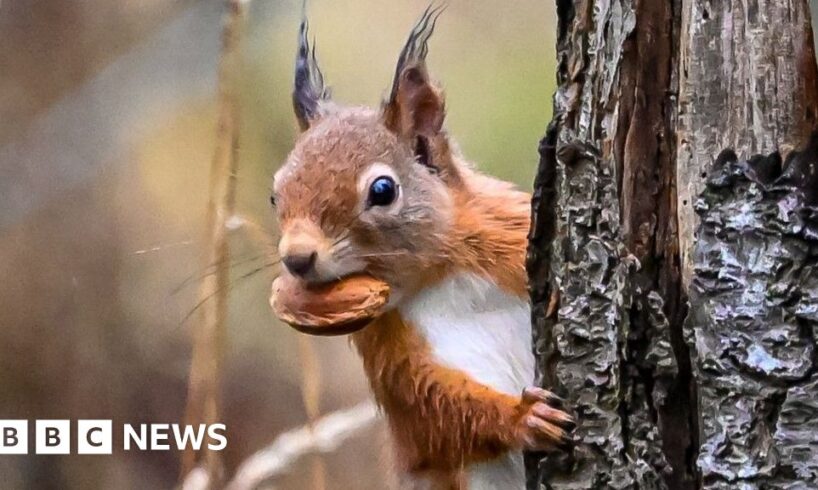
A red squirrel in the north east of Scotland, photographed by Natasha Lichtarowicz
Back in 2009, red squirrels were thin on the ground in Aberdeen – instead grey squirrels were a common sight in the city’s trees and parks.
Today the red squirrel population is thriving thanks to the efforts of a group of volunteers and their “citizen science”.
It is thought the invasive, non-native greys have been almost eradicated locally – and there is now evidence of red squirrel activity yards from the city’s main thoroughfare.
The turnaround is seen as a huge achievement for Saving Scotland’s Red Squirrels (SSRS) – a partnership project led by Scottish Wildlife Trust (SWT) – which has been working to save the species for the past 16 years.
Its north east community co-ordination and outreach officer is former primary school teacher Naomi Bentley, who has dreamed of working in conservation since childhood.
She said there were currently more than 30 volunteers collecting data in the Aberdeen area, ranging from children to the retired.
Thanks to their work, she said they were getting close to “full eradication” of the non-native species from the city, while the reds are “thriving”.
“I think we are down to the last couple of greys,” she added.
Data indicates Aberdeen’s red population has strengthened compared to greys
“It’s down to the volunteers that we have so much coverage,” Naomi said.
“It’s people’s love of nature – citizen science.”
Originally from North America, the larger grey squirrel out-competes red squirrels for food and habitat.
Some carry – but are not affected by – a pox, which is lethal to red squirrels.
Grey squirrels not only replace reds they can also cause damage to woodlands by stripping bark.
Naomi Bentley from Saving Scotland’s Red Squirrels said they are thriving
As the reds were lost from Aberdeen, concerns had grown they could be wiped out.
After the project began in 2009, it took about two years for the first confirmed recording of a red in the city, indicating just how few were still about.
Live-trapping and humane lethal control carried out by trained SSRS staff has reduced the number of greys, allowing the native reds to continue to recover.
It is thought that without the project the red population in Aberdeen could have disappeared, and greys would have expanded in the north east.
PA Media
Grey squirrels, native to North America, carry a pox which is deadly to red squirrels
One of the methods used to survey populations is to set up feeder boxes with sticky tape or pads used to collect hair samples from animals entering the box.
Data seen by BBC Scotland News shows that that were no confirmed grey squirrel samples feeder boxes – placed in areas such as woodland trees – in Aberdeen in the quarter of the year between 1 July and 30 September.
There have also been none so far in the latest quarter, and just a handful of sightings.
In contrast, there were 1,540 confirmed red squirrel samples in the July to September window, and more than 900 so far since October.
Mapping of data between 2021 and 2024 also shows a strengthening of the red population, with greys almost disappearing.
A box off Aberdeen’s main city centre throughfare of Union Street recently had red squirrel hairs on it for the first time.
Joel Sangster is among those helping survey efforts in Aberdeen
Joel Sangster, 23, has been volunteering on and off for two years.
He studied conservation, and saw it as a “great opportunity”.
Joel said: “I fell in love with it, it’s fantastic.
“Folk stop and talk to you and when you tell them what you’re doing they are over the moon.”
Another volunteer, Seshadri, goes out with his daughters Vani, 15, and eight-year-old Avni, to survey seven boxes in the local area.
Vani, right, and her younger sister Avni are among the keen volunteers
He said it was not glamorous work, dealing with slugs, snails, “random insects”, wood lice, and giving the feeder boxes a good scrub but it is worth the effort.
“It’s about being in touch with nature, and restoring nature as it once was,” he said.
“We see a lot more red squirrels now.”
Russell Craig
This squirrel was photographed by volunteer Russell Craig in Aberdeenshire
He added: “There are a lot of jokes and laughs and camaraderie.”
Vani explained: “I wanted to do volunteering for my bronze Duke of Edinburgh award, saw Saving Scotland’s Red Squirrels, and have carried on.”
And young Avni – who her dad described as “my little helper” – said she got involved as “I was just curious”.
The team in Aberdeen now hopes that, thanks to their efforts, the red squirrels are back for good.
Colin Little
A young squirrel photographed in Moray