(function(w,q){w[q]=w[q]||[];w[q].push([“_mgc.load”])})(window,”_mgq”);
Today, there are important updates from the Russian Federation.
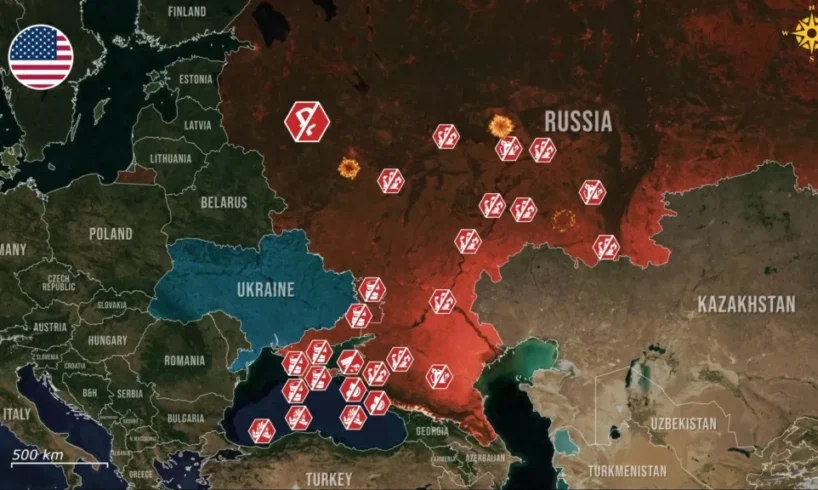
Here, the Ukrainian forces achieved a record level of destruction of Russian oil infrastructure, disrupting it from the Black Sea to the Ural.
With Ukrainian long-range drones striking enemy assets at unprecedented rates, Russia’s financial losses are now threatening to bankrupt the very backbone of its ability to wage war and the stability of the country.
Record strikes deliver Russia’s most damaging month
Ukraine carried out a record number of strikes on Russian oil infrastructure in November, delivering the most damaging month Russia has suffered since the invasion began.
According to Ukrainian intelligence spokesman Andriy Yusov, the key indicator is the volume, and since the beginning of 2025, Ukraine has executed more than 160 successful strikes on Russian oil facilities.
November pushed the total past 180, with at least 14 confirmed strikes on refineries and 4 on Black Sea port infrastructure. Ukraine is on track to exceed 200 attacks this year, with nearly one every single day.
Financial devastation and fuel shortages mount
The cumulative effect is massive: Russia now faces a 20% domestic fuel shortage and has banned gasoline exports through the year-end. Daily refinery capacity has fallen to roughly 5 million barrels, expected to drop further as new damage accumulates.
Russia’s oil-product processing has fallen by 25 percent, a devastating figure for a war economy dependent on these revenues. Even before new US sanctions took effect, Rosneft reported a 70 percent collapse in net income for the first nine months of 2025, down to 3.57 billion US dollars, pushing even such a giant toward bankruptcy due to massive losses. The company blamed interest rates and security expenses, but the true cause was Ukrainian strikes on refineries, depots, and transport terminals.
With new US sanctions now active, Russia’s seaborne crude exports fell to a four-week average of 3.36 million barrels a day, the lowest since August, and export revenues dropped to their weakest point since April 2023.
Southern refineries and Black Sea ports under fire
Ukraine’s deep-strike campaign now stretches across the entire Russian oil-related infrastructure network. Repeated drone hits on the Afipsky refinery near Krasnodar disrupted supplies of gasoline, diesel, and jet fuel for Russia’s military districts.
Ukrainian naval drones disabled an offshore loading pier at the Caspian Pipeline Consortium terminal near Novorossiysk, inflicting critical structural damage and forcing the rerouting of crude exports.
Multiple drone and missile raids on Novorossiysk halted up to 2% of global oil supplies, damaged air-defense systems, and temporarily shut down export operations around the port.
Shadow fleet tankers no longer safe
In the Black Sea, two sanctioned shadow-fleet tankers, Kairos and Virat, were badly damaged off Türkiye in an unprecedented attack. Both were struck while sailing empty to avoid an ecological disaster, signaling that even Russia’s illicit oil fleet is no longer safe and international sanctions are not the only thing they have to worry about.
Major refineries from Saratov to Ryazan hit repeatedly
Rosneft’s Saratov refinery suffered repeated strikes, at one point halting operations after fires gutted core processing units. The Novokuybyshevsk refinery in Samara was also hit twice in November, knocking out major equipment and a nearby substation.
The Ryazan mega-refinery, one of Russia’s largest, was repeatedly targeted, with strikes on secondary processing units and jet-fuel capacity confirmed by Ukraine’s General Staff. The plant produces 840,000 tons of jet fuel annually for the Russian air force, making the strike a significant success in both economic and military terms.
Additional Ukrainian drone strikes hit refineries in Syzran, Ilsky, Nizhnekamsk, Kstovo, Orsk, and Volgograd, each confirmed by footage of explosions and fires.
Tuapse export terminal and tankers ablaze
Tuapse, a major Black Sea export terminal handling 7 million tons of oil annually, has been struck multiple times: a shadow-fleet tanker was hit, port infrastructure damaged, and pipeline links disrupted.
In one attack, 12 drones destroyed a small vessel and set four tankers ablaze, carrying more than 100,000 tons of oil.
Once again, Russian air defenses failed and struck residential buildings while officials claimed all drones were intercepted.
Petrochemical hubs and frontline logistics targeted
Further long-range Ukrainian strikes targeted petrochemical hubs at Stavrolen, Sterlitamak, and Kazan, degrading oil-related production sites essential for Russia’s missile, drone, and ammunition production.
In Russian-controlled Crimea and Donbas, drones repeatedly hit the Feodosia Sea Oil Terminal, Krymneftesbyt depots, Bityumne, Komsomolskoye, Shakhtarsk, and a fuel train at Dovzhansk-Rozkishne, directly strangling frontline logistics of key materials.
War financing crushed from two sides
Overall, Ukraine’s strike campaign is collapsing Russia’s oil income, without signs of stopping, with shadow fleet tankers now starting to become the latest target.
Combined with new and tightening US sanctions, Russia’s ability to finance the war is being crushed from two sides.
Internally, Ukrainian precision strikes are destroying its ability to function, and externally by international sanctions cutting off its remaining global buyers.
In our regular frontline report, we pair up with the military blogger Reporting from Ukraine to keep you informed about what is happening on the battlefield in the Russo-Ukrainian war.
(function(w,q){w[q]=w[q]||[];w[q].push([“_mgc.load”])})(window,”_mgq”);