After a secret ballot, global trade restrictions will not be placed on the species at the heart of Canada’s most lucrative fishery. But trade of American eels is also driving a massive, illegal economy — and advocates say the vote represents a failure to address this serious threat.
On Nov. 27, countries voted against listing the American eel and other eel species at the 20th meeting of the Convention on International Trade in Endangered Species, or CITES, in Uzbekistan. Canada was among the nations who voted against restrictions. At the meeting, the Canadian delegate said populations of American eel have remained stable for the last two decades, and that the proposal did not take into account advances in technology used to distinguish eel species. The vote was followed by an announcement this week that Canada will not list American eel under the Species At Risk Act, following more than a decade of deliberation.
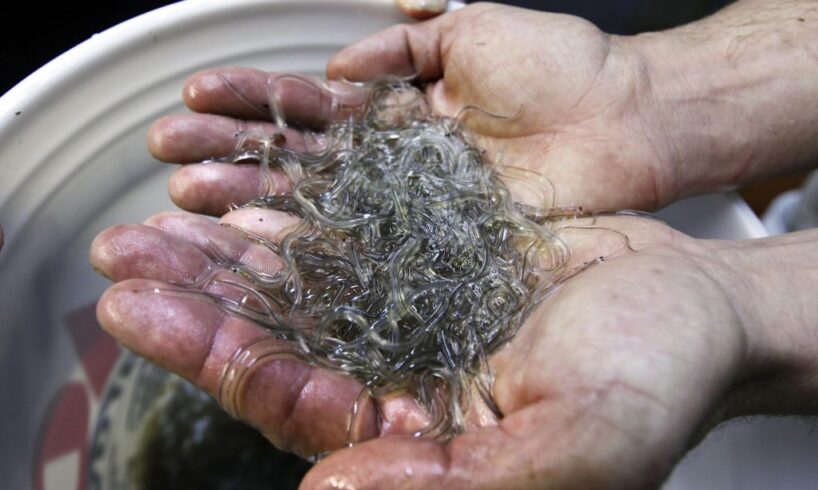
The restrictions would have applied to the trade of 17 eel species, including American eel, which is the basis of a controversial fishery in Atlantic Canada. American eel are harvested as palm-size juveniles from Maritime rivers in the spring, and exported to Asia for rearing in aquaculture facilities. A kilogram of baby eels (called elvers) was fetching nearly $5,000 in 2023.
That price drives not only commercial and Indigenous fisheries, but also a large black-market fishery conducted by organized crime, experts say, making a coordinated response necessary. The Sustainable Eel group, a conservation group based in the U.K., says illegal eel sales are the “world’s greatest wildlife crime.” Despite its vote against the listing, experts say Canada, as a hub for the trade, has a particularly important role to play.
“Canada could have played a role at this meeting, and actually led support for the proposal,” Katie Schleit, fisheries director at Oceans North says. “They’ve come out in all kinds of different arenas as being a champion to fight illegal, unreported, unregulated fishing, [but] … they aren’t taking responsibility for the role that Canada’s actually playing in the global illegal trade of eels right now.”
Illegal fishing, exports put pressure on American eel
Trade poses a significant threat to biodiversity, according to Sheldon Jordan, a wildlife crime consultant who formerly worked on wildlife enforcement at Environment and Climate Change Canada. “When [people] think of endangered species, they’re thinking of all the things in The Lion King, but the biggest threat is actually [to] the consumables. It’s the fish, it’s the wood, the things that we eat,” he says. With eel, “the demand is outstripping the supply. There is a conservation issue.”
The Convention on International Trade in Endangered Species, which has been ratified by 185 parties, is meant to address this. Since 1975, the convention has worked to regulate the trade in wild plants and animals, to maximize their chances of survival.
This year, the European Union, with the support of Honduras and Panama, nominated 17 species of eel to be included under an appendix that regulates trade, but doesn’t prevent it. While the proposal noted Japanese and American eel are particularly at risk, the parties nominated over a dozen freshwater species, noting that eels are often impossible to tell apart, making enforcement a challenge.
The Convention on International Trade in Endangered Species held its meeting in Samarkand, Uzbekistan. The meeting included a crucial vote on whether to place global trade restrictions on eel species, including the American eel. Canada voted against restrictions. Photo: Kyodonews via ZUMA Press
European eel — which has declined by up to 95 per cent in rivers across Europe — shows why this is important, Jordan says.
The export of European eels from the European Union has been banned since at least 2011 (with European eel listed under CITES in 2009), but the ban did not stop the export of juvenile eels to Asia. Jordan says his Environment Canada officers in Vancouver and Toronto intercepted containers of frozen eel meat from Asia as late as 2017, almost a decade after the CITES listing. The meat was labelled as American eel, but genetic testing revealed up to 50 per cent was European eel that had been falsely declared to evade controls.
“In the end, our officers confiscated 186 tonnes of eel meat,” Jordan says. “That was six, seven times more than our previous record when it came to endangered species being seized.”
Jordan says he warned colleagues at Fisheries and Oceans Canada that given the low supply and high price of European eel, it was only a matter of time before demand exploded for North American exports. “And unfortunately, that has come to pass.”
In Canada, the target is American eel, which is also found throughout the eastern United States, the Caribbean and at the northern edge of South America. American eel have a complex life cycle that starts in an area of the Atlantic Ocean known as the Sargasso Sea. Larvae spend up to a year floating around in the ocean, before transparent juveniles swim up rivers in the spring.
The Canadian commercial quota for those elvers has been set at roughly 10,000 kilograms for decades, and in recent years, the fishery has been the subject of bitter conflict as high prices have increased fishing pressure. Meanwhile, as Jordan predicted, exports of elvers have soared; in 2022, imports of live elvers into East Asia from the Americas jumped to 157 tonnes, up from 53 tonnes in 2021, according to a paper published in Marine Policy.
Juvenile eels, known as elvers, are targeted by poachers for their value, which hit $5,000 per kilogram in 2023. In recent years, Fisheries and Oceans Canada has cancelled elver season due to illegal activity, but recently said existing legislation is sufficient to protect the species. Photo: Robert F. Bukaty / Associated Press
Over the last five years, Fisheries and Oceans Canada has cancelled the elver season multiple times, citing illegal fishing and violence. Since then, the federal government has imposed new regulations to increase the traceability of the catch, including possession and export licences.
At this year’s meeting of the endangered species trade convention, Canada’s delegate cited these regulations in its position against listing. The delegate also described recent advances in rapid genetic testing that they said addresses the lookalike problem, though an Environment and Climate Change Canada report from September notes these tests have a 20 per cent false positive rate, and an ideal operating range above 18 C, meaning they can’t be used on frozen meat.
Not everyone agrees on stability of American eel population
Whether harvested as part of the official commercial quota or not, Jordan says elvers are sent to Toronto, where the companies that prepare them to survive export are located.
Jordan says this makes Toronto the intermediate destination for American eel from not just Canada, but also the Caribbean, including places like Haiti where political instability fuels poaching, and the Dominican Republic, which has been asking for help in controlling illegal trade. “Toronto is basically the hub of the legal and illegal elver trade in the Western Hemisphere, with almost all of the eels going through Canada on their way to Asia,” he says.
Being a central hub for the eel trade across the Americas, Canada would have been “in a really strong place to play a positive, constructive role in regulating the international trade,” Jordan says. He thinks a stronger stance would have levelled the playing field for Canadian harvesters, who are currently held to a higher standard than in other countries.
Yet Mitchell Feigenbaum, a commercial licence holder with a fishing business based in New Brunswick and member of an industry group, says while licence holders agree illegal trade is a problem, they were opposed to the listing.
Feigenbaum says initially, he saw a listing as just “more red tape.” But he became concerned when he saw the text of the proposal, which identified American and Japanese eel at serious risk of becoming endangered without regulation. He felt the push for the listing was an attempt by “environmentalists and scientists with a particular predisposition” to call into question the conservation status of eel. “It really just felt like it’s a slap in the face, or … a strategic move by opponents of the fishery to gain a political advantage.”
Feigenbaum suggested American eel are resilient and can recover when their population is depleted, pointing to the U.S. Fish and Wildlife Service’s 2015 decision not to list American eel as threatened. In its statement at the convention, the Canadian government referred to a 2025 Fisheries and Oceans scientific report indicating that populations were stable.
Not everyone sees eel populations that way.
Kerry Prosper, Mi’kmaw Elder and councillor for Paqtnkek First Nation, has been fishing and working with eels most of his life. In recent years, he’s noticed a significant decline in the population of adult eels that community members once fished for food. “It’s quite a contrast that we’re in, and it’s so sad.”
Paqtnkek was offered a licence for the elver fishery by Fisheries and Oceans Canada, but turned it down, Prosper says. “We simply don’t have faith in their management plans.”
In 1990, a Supreme Court case known as Sparrow ruled that First Nations had the right to food, social and ceremonial fisheries, putting that right above commercial and recreational fisheries. Prosper says the ruling is being disregarded, and he worries the harvesting of baby eels harms the adult population, putting food security at risk.
Harvesting and exporting eels for commercial profit shouldn’t come “at the cost of the species itself and the Indigenous people who live near where it comes from,” he says. “It’s just total disregard and disrespect to the animal and to the people.”
Schleit, with Oceans North, points out that stability of the American eel population in recent decades comes after a period of steep decline. In its stock assessment, Fisheries and Oceans noted that the species has likely declined by more than 50 per cent since 1980
Federal government announces American eel will not be added to species at risk
On Tuesday, the federal government announced they would not be listing American eel under Canada’s Species At Risk Act. In a statement, Fisheries and Oceans Canada said it had determined that the Fisheries Act “is most effective for conserving the species while also providing the greatest overall socio-economic benefits to Canadians.”
Not classifying eel as a species at risk could be an acceptable decision from a sustainability perspective, Schleit says, but the government still needs to demonstrate how else they’re effectively managing the species. By not promoting a CITES listing, she says Canada missed a chance to show global leadership.
Katie Schleit, fisheries director at Oceans North and pictured in Samarkland, Uzbekistan where the recent vote took place, says the federal government isn’t “taking responsibility for the role that Canada’s actually playing in the global illegal trade of eels right now.” Photo: Supplied by Oceans North
In a statement, Fisheries and Oceans Canada spokesperson Barre Campbell confirmed that Canada voted against the listing, and said Canada “is committed to the sustainable and orderly management of fisheries for eel and elver.” He also said that the American eel did not meet criteria required for a CITES listing, which requires a 70 percent population decline, and that CITES regulations would create duplication for Canadian harvesters.
Despite their opposition to the listing, many countries, including Canada, recognized the existence of an issue at CITES, and approved a non-binding resolution to work together to address illegal trade. Schleit says it’s possible to build on that momentum to continue to enact stronger protections for eels. In the meantime, she says, these enigmatic species remain at risk.
“European eel basically got traded to the point where it crashed,” she says. “We see a strong chance that that’s going to happen again with American eel.”
This story was updated on Dec. 5, 2025, at 11:05 ET to correct the units of measurement of Canada’s commercial quota for elvers.