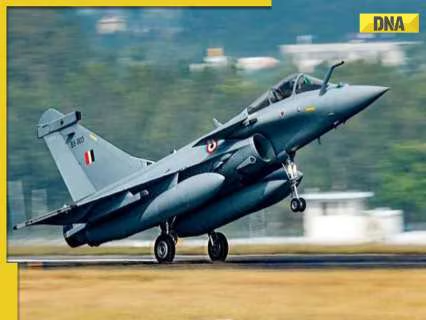
Indian scientists have tested shape-changing wings that bend like a bird’s, making future fighter jets faster, stealthier and smarter in real time. A major leap for India.
Imagine a bird changing the shape of its wings while flying — spreading them wide to soar, folding them tight to dive fast, adjusting every second based on what it needs to do. Now, imagine our Indian fighter jets doing exactly that. This isn’t science fiction anymore. India has successfully tested wings that can actually change their shape during flight, and this breakthrough could completely transform how our aircraft fly in the future.
The Defence Research and Development Organisation (DRDO), India’s premier defence research body, has achieved something remarkable. They’ve tested morphing wings — wings that bend and reshape themselves while the aircraft is in the air. According to Aerospace Global News (AGN), this technology has already been tested on a real flying platform, and it works beautifully. A senior DRDO scientist explained to AGN that they’re now perfecting the hardware, the systems that make the wings move, and the computer logic that controls everything. The ultimate goal? Using this breakthrough in next-generation Indian fighter jets like the Advanced Medium Combat Aircraft (AMCA).
Think about it this way. Normally, aircraft wings are designed as a compromise. They can’t be perfect for every situation. During takeoff, you need one kind of wing shape for maximum lift. During high-speed cruising, you need a sleek, streamlined shape that cuts through air easily. During combat, you need something that helps with sharp turns and quick movements. Traditional wings stay the same throughout, which means they’re never truly ideal for any single moment. But morphing wings solve this problem completely. They change shape constantly, becoming exactly what the aircraft needs at that precise second.
So how does this magic happen? At the heart of this system are special metals called Shape Memory Alloys (SMAs). These aren’t your everyday metals. They’re smart materials that shrink when heated and expand when cooled. When electricity heats up these metals embedded in the wing, they contract, causing the front edge of the wing to bend downward — sometimes by as much as six degrees. This gives the wing more lift or helps with turning. When the metal cools down, the wing returns to its original smooth shape, perfect for fast, fuel-efficient cruising. The beauty is that everything happens without any mechanical hinges or gaps, making the wing surface completely smooth.
This smoothness is crucial for another reason — stealth. Traditional aircraft wings have flaps and slats with joints and edges that reflect radar signals, making the aircraft visible to enemy radar. Morphing wings have no such gaps. They’re continuous and smooth, which means they bounce back far fewer radar signals. In simple terms, the aircraft becomes harder to detect, a massive advantage in modern warfare.
What makes India’s achievement even more impressive is the speed. DRDO’s tests on a small 300-millimeter wing showed it can change shape incredibly fast — bending 35 degrees every single second. When commanded to move from flat to fully bent, it takes just 0.17 seconds. Even when strong wind from the propeller is hitting it, mimicking real flight conditions, the wing responds perfectly. This speed means during actual missions, the wing can adapt instantly — bending for more lift during takeoff, shifting to reduce air resistance during climb, becoming sleek during cruise, and changing rapidly for better control during combat.
Another hidden breakthrough is the smart power system. These shape-changing wings need electricity to heat the special metals, and powering multiple wing sections could drain a lot of energy. The DRDO team solved this brilliantly. Their intelligent control system shares electrical power smartly between different wing sections, ensuring only the part that needs to move gets power at that moment. This doubles the movement speed without putting extra load on the aircraft’s battery. Even under strong airflow pressure, the system needed only 5.6 percent more energy, and the electronics for each section weigh just 6 grams.
Countries like the United States and those in Europe have been researching morphing wings for years, but many projects remained concepts on paper. India, as reported by Aerospace Global News, has built a system that actually flies, is easy to control, and uses very little extra energy. A DRDO scientist beautifully summarized their vision: aircraft should adapt like living creatures, changing their wings based on the sky and mission around them.
This technology isn’t just for fancy demonstrations. It’s being developed for India’s future aircraft — fighters, drones, and carrier-based jets. Wings that sense what’s needed and respond automatically could give Indian forces a significant edge. From concept to reality, India has entered an elite group of nations mastering real-time shape-changing flight. The sky ahead looks very different indeed.
(The author of this article is a Defence, Aerospace & Political Analyst based in Bengaluru. He is also Director of ADD Engineering Components, India, Pvt. Ltd, a subsidiary of ADD Engineering GmbH, Germany. You can reach him at: girishlinganna@gmail.com)
(Disclaimer: The views expressed above are the author’s own and do not reflect those of DNA)