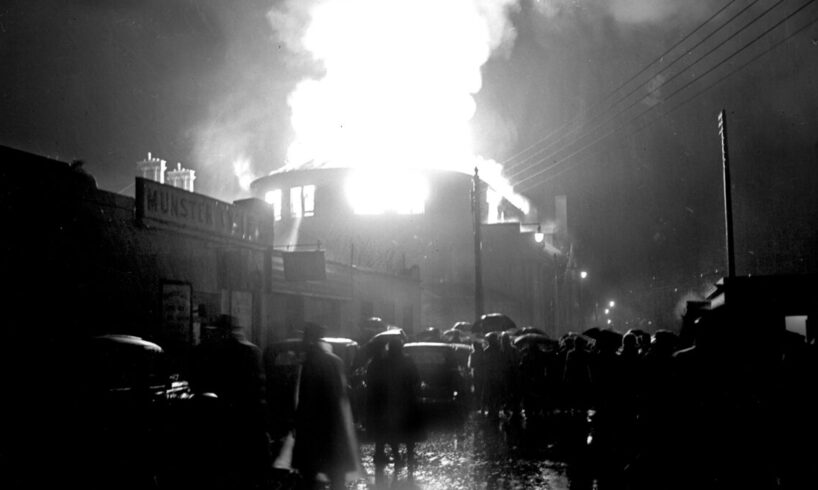
The date was 12 December 1955. It was a cold, miserable night in Cork, made all the worse by torrential rain and an easterly wind howling up from the harbour. And, on this particular night, there happened to be an exceptionally low cloud ceiling which, eerily, reflected the lights of the city back down on the few hardy souls still abroad and hurrying home, some with their early Christmas shopping tucked safely under their oxters. The unusually low clouds had set some older people remembering how, on such a night 35 years before to the very day, the sky over Cork was illuminated by the biggest conflagration experienced since the Siege of Cork in 1690. On a date firmly etched in the collective memory of a generation on the night of 11/12 December 1920, Crown forces had torched great swathes of the city’s principal shopping centre, which burned for days. Now, they could hardly believe their eyes when, for the second time in their lifetime, the whole firmament took on an angry orange-red hue which rolled and boiled, emanating, it seemed, from the very depths of Tartarus itself. The startling news quickly spread throughout the city: the Opera House was on fire!
The Cork Opera House could be described as a by-product of the National Exhibition of 1852, brainchild of the great constitutional Nationalist and founder of the Cork Examiner, John Francis Maguire MP. After the Exhibition ended, the building was transplanted, pre-fab style, across the city from Albert Quay to Emmet Place (then called Nelson’s Place) revamped under City Engineer Sir John Benson, re-erected, and given the rather grandiose name of the Athenaeum.
Some years later, it was remodelled with 700 seats added. The name changed too- to the Munster Hall. Charles Dickens appeared at the venue on two occasions reading extracts from his popular works. In 1877 came another make-over, this time by one C. J. Phipps, and the Munster Hall now became the Cork Opera House.
The celebrated actress Sarah Bernhardt arrived from America by liner and, in true diva fashion, swept up the River Lee by tooting tugboat to arrive at the very steps of the theatre. Subsequent years would see such famous opera companies as Carl Rosa and D’Oyly Carte perform to great acclaim and packed houses. And it was on the stage of Cork Opera House that Charles Stewart Parnell delivered his iconic speech in which he asserted that ‘No man has the right to fix the boundary to the march of a nation’, words later etched in gold on the Parnell Monument on Dublin’s Upper O’Connell Street.
On Monday evening, 12 December 1955, the principals of the forthcoming Christmas panto, Sleeping Beauty, including ‘Billa’ O’Connell, Chris Sheehan, Paddy Cotter, Paddy Coughlan, Josephine Scanlon and Rita Dwane had assembled in the old Circle Bar for rehearsals under James Stack, the producer. On the stage proper was the remainder of the cast, which included the ‘Tiny Tots’ and their teacher, Miss Eileen Cavanagh.
After a while, some of the principals remarked to Mr Stack that they could smell smoke and he organised a search, at the same time notifying Bill Twomey, the theatre manager. They could find nothing, although the smell persisted. Erring on the side of safety, Mr Twomey decided to inform the fire brigade.
At exactly 9.04pm, his first 999 call to Sullivan’s Quay Fire Station was logged.
Explaining the situation to the dutyman, he described the smell as ‘if a cigarette were smouldering’.
At 9pm, ‘A’ Watch was exactly halfway through its 24 hour tour of duty.
Their day, thus far, had been uneventful, punctuated only by the usual run of minor fire and ambulance calls (the fire brigade ran the ambulance service then) with nothing out of the ordinary to make the following day’s newspapers.
At 8pm Station Officer Bill Hosford had taken the final parade of the night, and this was followed by the men assembling for the recitation of the Rosary at the little shrine erected during the previous year, 1954 – the ‘Marian Year’. After the parade, barring emergency calls, the men were on a ‘stand down’ period during which they could (within the confines of the station) pursue a hobby, read, listen to the radio (no TV then!) or play a game of billiards or chess.
Following Mr Twomey’s initial call, at 9.05pm, the alarm bells rang out throughout the fire station – one short ring followed by one long – indicating that the ‘Inspection Crew’ should report at once to the Watchroom, where emergency calls were received.
In those days, the Inspection Crew comprised a junior officer and two firemen and was dispatched to investigate reports of a smell of burning and such like where no actual flames were evident.
Quickly briefed by the duty officer as to the nature of the call, even as the men prepared to respond, the 999 annunciator shrilled out again.
This time there was no ambivalence: the roof of the Opera House was on fire!
In 1955, I was a nine-year-old schoolboy, a pupil at nearby St Nessan’s CBS on Sullivan’s Quay. In those days, some of the fire staff was obliged to ‘live over’ or adjacent to, ‘the shop’, consequently we lived next door to the fire station at 23 Sullivan’s Quay. Now, on this particular night just after 9pm, the General Alarm bells shrilled out all over our house as well – just as they did for every fire – but I was too busy finishing my homework to take any notice of the background cacophony to which I was accustomed all my young life. Within a short time, however, the incessant, resounding knocking on the front door was a different matter that could not be ignored. Hesitatingly, and, I must admit, a little frightened, I opened the door an inch or two to be confronted by a sight that I will never forget. Firstly, there was the wondrous sky – as bright as day, it seemed – menacing, awe-inspiring, beautiful, in equal measure – and then, as my eyes grew accustomed to the unnatural realm, the spectacle of dozens of women, many wearing the traditional Cork shawl, keening and praying on their knees in the teeming rain, convinced that the end of the world was nigh and that the Second Coming was imminent. My nine-year-old imagination went into overdrive as I pondered, and fretted, on my father, Matt, and his comrades and what they were heading out into. Those men were my heroes then – I do not use the term lightly – and I am glad to say, nothing in the intervening 70 years has made me change my mind.
In 1955, the total strength of Cork Fire Brigade was 40, including officers and firefighters, organised in two Watches, ‘A’ and ‘B’. Each Watch comprised a Station Officer, two junior officers, and 14 firemen. The fire engines included a Ford ‘Water Tender’ (1954), a Dennis/Rolls Royce ‘Pump Escape’ (1951) and a Leyland ‘Pump’ (1939). And, although it had been one of the key recommendations of the Public Inquiry into the fire at Grant’s Department Store on the Grand Parade in March 1942, no turntable ladder (an appliance with a rotating steel ladder capable of reaching 30 metres above the ground) was acquired for the brigade. Such a machine was an essential piece of equipment in a large urban area like Cork.
On that stormy, rain-swept night long ago, ten doughty firefighters under Third Officer Jack Crowley, Station Officer Hosford and Sub-Officer Pat Hayes roared off down Sullivan’s Quay in two engines, fire bells clanging, to confront the biggest blaze witnessed in Cork since Booth and Fox’s Bedding Factory (ironically, right across the street in Emmet Place) in 1949. Chief Officer Gerald J. O’Kelly in his official report outlined what happened when the brigade arrived:
On arrival at Emmet Place it was discovered that two-thirds of the roof, and portion of the gallery, was seriously alight, and that the fire was spreading quickly to other sections of the building. Immediately, efforts were made to cut off the fire from the dressing-rooms, but due to the flammable nature of the roof, internal furnishings, stage props, flats and scenery, etc., the effort had to be abandoned and all efforts directed to prevent the fire from spreading to the nearby Municipal School of Art wherein it was stated that approx. £15,000 worth of oil and water colours were on display. Due to the condition of the walls of the building, firefighting operations were confined to the roofs, the ground level and other vantage points surrounding the building. At the peak period a total of nine jets of water were directed on the fire, this water was obtained from the street mains through seven fire hydrants. An east wind of gale-force velocity prevailed and this threatened the buildings in Half Moon Street, and, as a precaution, delivery vans were driven from the Cork Examiner garage and jets of water played on the buildings. In some cases, the glass of the windows broke under the radiated heat.
All sixteen off-duty members were mobilised and units of the County Fire Service at Midleton and Crosshaven responded to the call for reinforcements. Mr Redmond Burke, Works Manager at Harrington and Goodlass Wall, offered the services of the works fire crew and their equipment which then comprised a large trailer pump, a survivor of the London Blitz.
The late Mr Jack Manning, Team Leader of the works brigade, remembered how:
I saw the fire from where I lived in Pouladuff and I drove in, and I was on the quay when I saw this car and a fellow out the window with a helmet on shouting ‘Get out of the way!’ It was Christy Power trying to beat his way through the crowd down Lavitt’s Quay and there was the trailer pump tied on with a rope to the back bumper of a work’s car. We made down the trailer pump to the river – where Christy Ring Bridge is now – and the tide being in full, we were able to lift the water with two lengths of suction hose. I suppose it was a good public relations exercise as the jets were hardly reaching the fire with the wind blowing.
The late Second Officer Donal Crean, then a twenty-four year old fireman, asserted that the unsung ‘hero of the night’ was Inspector John O’Mahony of the City Water Department who, by dextrous and skillful manipulation of the complicated network of valves and cocks on the city-centre piped water system, assured a high volume of water was available. Inside, fighting the blaze in the vicinity of the theatre bar, Fireman (later Station Officer) Jim Quinlan was startled by the noise of what echoed like gunshots above the roar of the fire: the sound of barrels of stout ‘popping’ as they were engulfed in the flames. Fireman Justin Monaghan, backed up by Fireman Ger Farrer, recalled being:
…high over the stage and curling tongues of fire coming at us. The fire had advanced along concealed spaces under the roof, creating its own energy, as every major fire does. The jet of water we were using hit the heat barrier and turned to steam. We were ordered down or we would have been cut off from below and be the subjects of an inquest. My wife told me afterwards that she had seen the flames from where we lived in the Wellington Road area and had been praying for me.
By early morning all points of the fire were under control and weary crews, soaked through, initial surge of adrenalin that had sustained them throughout the battle long dissipated, began the tedious task of rolling up countless lengths of fire hose and retrieving their equipment. Suspicions as to the cause of the fire centered on the building’s electrical wiring.
If the fire had broken out a few weeks later when the theatre was packed – largely with children – the consequences would not bear thinking about.
Far from being the disaster it was perceived at the time, its passing was probably a blessing in disguise.
Messages of sympathy and support flooded in from all points of the compass, including one from Justice Harry McCarthy who predicted, presciently, that ‘Our beauty is not dead but sleepeth’.
The projected cost of rebuilding was estimated at a minimum of £150,000 – a daunting sum.
Unfazed, over the coming years the people of Cork put their shoulders to the wheel in a massive fundraising effort that culminated, ten years later in October 1965, in the launching of the new Opera House by then President de Valera. The opening ceremonies were directed by James Stack.
Cork Opera House in the aftermath of the fire on December 12, 1955.
The final word on Cork’s own ‘Night to Remember’ must go to the late ‘Billa’ O’Connell, doyen of pantomime dames and one of the principals on that unforgettable night. It would have been his first Opera House appearance. In his biography of the actor, author Michael O’Connor transcribed in Billa’s own words how:
It was a personal loss for me. I was married on 20 September that same year, and like all young married couples at the time we had to start from square one; meaning, we had the bedroom furnished and the kitchen. I was about to make my first appearance in the old Opera House and I was booked to play for six weeks. My young and charming wife had put her eye on a nice suite of sitting-room furniture in Roche’s Stores. The money from Sleeping Beauty would pay for the furniture. Everything in the garden was rosy.
I arrived home late on that fateful night and Nell had been wondering why I was so late. I brought her to the window. The sky had a deep red glow, reaching away up towards the stars. I said nothing and my wife, being the romantic that she is, gazed in awe at what she saw; then burst out with the wonderful observation, that has gone done in family history, ‘Oh, Bill,’ she said, ‘isn’t that beautiful? Isn’t that the loveliest Rooley-Booley-Alice [Aurora Borealis] in all the world?’ ‘Rooley-Booley-Alice my arse’, says I, ‘that’s our sitting-room going up in smoke’!
The ruins of Cork Opera House on Lavitt’s Quay viewed from Camden Quay in 1960.
Even as the fire brigade was still on scene ‘turning over and damping down’, an alternative venue was being sought in which to stage Sleeping Beauty.
The City Hall being ruled out for various reasons, the AOH Concert Hall on Morrisson’s Quay was settled on.
Rehearsals began in earnest and preparations were made to finally launch the show.
In the early hours of the morning of Wednesday, 18 January 1956 the AOH Concert Hall burned down. The fire was traced to an electrical fault.
Some present members of Cork City Fire Brigade can trace their lineage back to the very foundation of the organisation in 1877, and beyond.
Officer Kevin Higgins’ service pedigree begins, in the early 19th century, at a time when Insurance Companies maintained their own fire brigades, long before the concept of a public Fire Service for all was accepted.
In an unbroken lineage from that time, Kevin’s grandfather, great-grandfather, great-great-grandfather, and uncle have all been members of the Fire Service. His grandfather, Captain John Higgins of the Irish Army, was the first Assistant Chief Fire Officer appointed to the fledgling Cork County Fire Service in 1953.
When the Opera House went on fire in 1955 Kevin’s cousin, Fireman Billy Higgins, fought the flames.
The Ring family, too, can trace its pedigree back to the early days of the brigade.
During the Cork International Exhibition of 1902-03, extra staff were recruited to man the fire stations at the Exhibition’s grounds on the Mardyke, being taken in six months’ before in order to be trained to an acceptable standard.
Timothy Ring joined at this time and would go on to become Chief Officer in his own right in 1928.
Four sons served in the Fire Service: two in London throughout the wartime Blitz – Frank and Tim, – and two in Cork, Edward and Billy.
At the time of the Opera House fire, Billy was a Sub-Officer.
Today, the link is still maintained by Brian, a serving member. (His father Eddie, a retired member, passed away in the recent past, RIP).
The third member of a ‘fire brigade dynasty’ that served at the time of the Opera House fire was Station
Officer Michael Murphy, who, like the other firefighters mentioned had been on duty on the night of the ‘Burning of Cork’ in 1920.
Mickey’s’ father, grandfather, and uncle all served in the Fire Service in Cork, while his nephew saw service with the London Fire Brigade.
Sadly, the link with that particular family tree in Cork City Fire Brigade is now broken- perhaps only temporarily!
Source
Visited 1 times, 1 visit(s) today