“I think many Lebanese want peace, but they have an issue with regional forces”. That is how senior Lebanese scholar Hussain Abdul-Hussain describes the sentiment in an interview with Israel Hayom.
“They do not want to move ahead and bypass the Saudis”, he explains from Washington, where he is a researcher at the Foundation for Defense of Democracies. “Today the Saudi leadership conditions formal ties with Israel on what it calls a credible path to a Palestinian state”, meaning substantial progress with Ramallah that appears far from reach. Lebanese Prime Minister Nawaf Salam made the point himself recently when he said that normalization between Beirut and Jerusalem depends on the Saudi initiative, which includes an agreement to establish a Palestinian state.
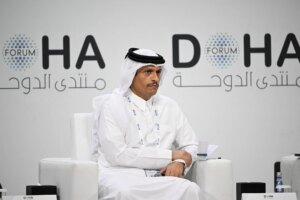
Hussain Abdul-Hussain (center)
Even so, many in Lebanon have expressed optimism about the civilian channel created within the cease-fire oversight committee. “Direct engagement could help prevent escalation, bolster the Lebanese government against Hezbollah and create conditions for future arrangements”, former senior officials in the Coalition for Regional Security told Israel Hayom. “Israel should work with the Trump administration to ensure the talks bolster the Lebanese government and encourage it to fulfill its responsibility to disarm Hezbollah. Doing so will pave Lebanon’s path to joining the Abraham Accords and breaking away from Iranian influence.”
Hussain stresses that although peace still seems distant, there is broad potential for cooperation between Israel and Lebanon even below the threshold of normalization. That includes economic issues but also other areas of mutual interest. “If we can reach understandings on disarming Hezbollah, that would be beneficial”, he says.
What are the Lebanese government’s main obstacles regarding disarming Hezbollah? Analysts say the organization has weakened, yet the state continues to stall.
“Look, in Lebanon there is a profound lack of trust in the US”, he says. “Over the years, two schools of thought emerged in Lebanon about how to deal with Hezbollah. Lebanese politicians are focused on survival and holding on to power. They fear that if they act to dismantle Hezbollah’s arsenal, Iran and the US might suddenly reach an agreement and Washington will throw them under the bus, leaving them exposed to Hezbollah’s return. As long as they doubt the consistency of American policy toward Lebanon, that remains the central obstacle. Statements made in the past by people like Tom Barrack only deepened Lebanese concerns that the US could change its mind.
Lebanese President, Prime Minister and Parliament Speaker. Photo: Social media
“Second, some Lebanese argue that disarming Hezbollah could lead to war, but I disagree, he continues. I do not think the army would fight Hezbollah. My assessment is that Hezbollah would behave toward the Lebanese Armed Forces as it has toward UNIFIL. UNIFIL sent personnel to inspect sites that Israel had identified as suspicious. Hezbollah operatives, disguised as civilians, blocked the roads and confronted them. So UNIFIL, being UNIFIL, withdrew. But the Lebanese army cannot withdraw because it represents a sovereign state. If the army found itself in a situation where it had to open fire and kill a Shiite civilian, that could create momentum for dismantling Hezbollah. That is what the government fears. It is ultimately political.”
Could another Israeli military operation help?
“I think Israel will likely continue intensifying its strikes against Hezbollah, but it will never fully destroy it”, he says. “It is too complicated and too dirty. The Lebanese themselves must make that final mile. It ultimately depends on the Lebanese state. I have heard that Israel may escalate its strikes against Hezbollah. That could persuade the Lebanese that there is no alternative to disarming the group. Lebanon needs these strikes to stop in order to rebuild its economy. As long as they continue, investors from the Gulf will stay away. Unless Lebanon finds a way to halt the attacks, it will remain in distress.”
What do you think about the appointment of a civilian representative to the cease-fire oversight committee?
“Simon Karam spent his life opposing the Assad regime and Hezbollah, so his appointment is positive. You can see how furious Hezbollah’s media outlets are, which only reinforces that it was a good choice. The fact that the talks are now face to face is also encouraging. Everyone in Lebanon believes that what Karam can achieve through direct negotiations cannot be compared to what was possible until now, in military-level discussions. I hope the talks withstands this, despite Israeli strikes and the criticism that follows.”
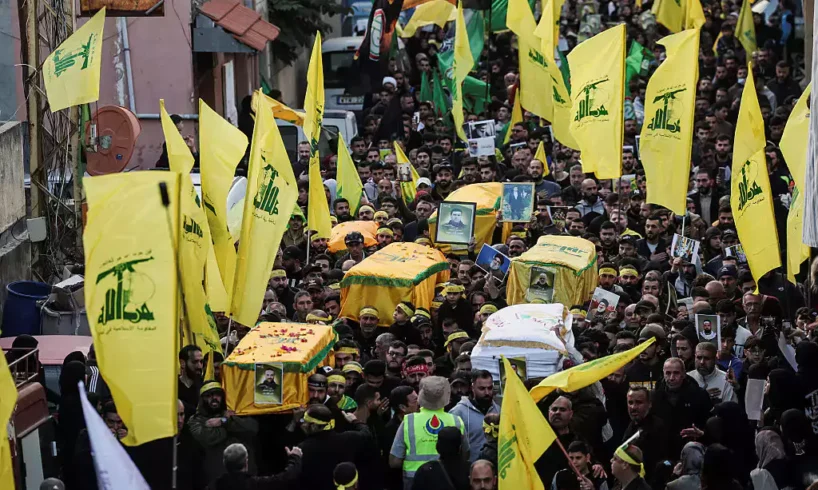
Hezbollah flags against the backdrop of destruction in Lebanon. Photo: AFP AFP
How does the Lebanese public view Hezbollah today?
“Lebanese society is divided, as you know. Shiites are the ones who support Hezbollah. Among Christians and Sunnis, support is at most 10 percent, which is extremely low. Among Shiites, if you look at the 2022 elections, 13 percent voted against Hezbollah. I believe that percentage has grown given the war and the destruction of the past two years.
“The only reason Shiites cling to Hezbollah is their belief that without it, they would be weaker than Sunnis and Christians. It has nothing to do with Israel. When Hezbollah harms them more than it helps them, that will have an impact. Today countless Shiites cannot return to their villages. These people have been displaced for a long time. We are moving in the right direction.”
A recent idea raised in Israel proposes creating a welfare network to compete with Hezbollah in order to weaken it. What is your view?
“We should not think of the Shiites as the only bloc in the country. Lebanon is a big country and its economy must grow. We should not think in terms of alternatives meant to help the Shiites specifically. Before the war, Sunni communities in northern Lebanon were suffering the worst economic conditions. In truth, Shiites received funding from everyone. That is why I believe the focus should be on helping all Lebanese expand their GDP. That is how the issue should be addressed. I oppose approaches based on welfare networks designed as substitutes.”
A bleak reality
The Lebanese scholar grew up in Baalbek in the Beqaa Valley in eastern Lebanon. He later studied at the American University of Beirut and spent years moving between Lebanon, Iraq and the US. From Washington, he watches with sadness the situation of Lebanon’s Christian community.
“Unfortunately, Christian emigration from Lebanon is massive, he says. When I grew up in Baalbek, Catholics made up one third of the city’s population. That was in the 1980s. Today if you go to Baalbek, you will find three Catholics. The Christian share fell from about 35 percent. We know the figures for Shiites and Sunnis because they are updated every few years in elections. That is how we track demographics. Based on that, Christians now make up 28 percent of the population, and in reality probably less.”
To conclude, I ask Hussain about the renewed tensions with Syria. Until the Cedar Revolution almost two decades ago, Syria maintained military forces inside Lebanon. Now, with Ahmed al-Sharaa’s new government in Damascus, old fears have resurfaced among parts of the Lebanese public.
Ahmed al-Sharaa. Photo: Reuters
“Lebanon suffered historically from Syrian dominance”, says Hussain, “and it is now relieved that Syria is weak. That is the main point. Because Hezbollah fought in the Syrian civil war, the al-Sharaa government opposes Hezbollah and is tense toward Lebanon’s Shiite community. Shiites fear Syria and want to distance Lebanon from it. Sunnis, by contrast, welcome the change and want closer ties. Among Christians and within the government, many believe it might be best if each country simply focused on its own affairs.”