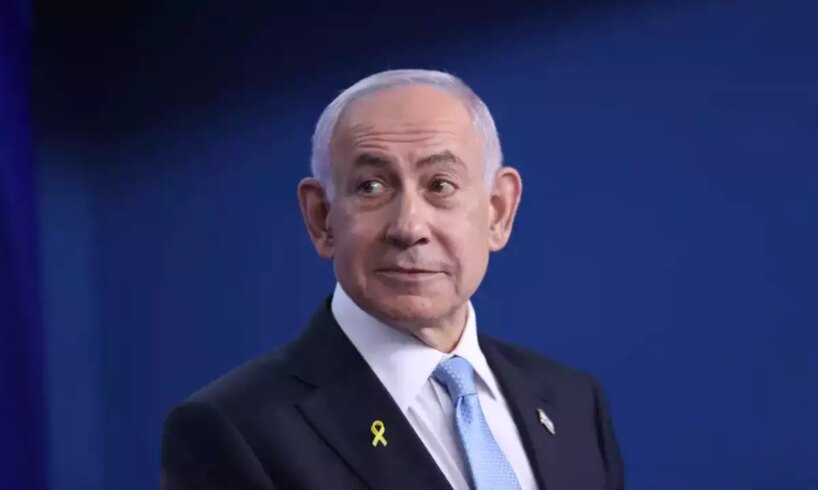
Prime Minister Benjamin Netanyahu and German Chancellor Friedrich Merz, who is currently visiting Israel, held a joint press conference in Jerusalem on Sunday.
Merz’s visit comes amid the completion of a major arms deal for Germany’s purchase of the Arrow 3 long-range missile-defense system, and the lifting of the partial embargo Germany had imposed in response to the war in Gaza.
During the press conference, which focused on Phase B of the Trump plan, Israeli sovereignty in the Judea and Samaria and ongoing efforts to advance wider regional peace, Netanyahu was asked whether he would step away from politics if he were to receive a pardon. Netanyahu responded briefly and firmly, “No,” then turned to Merz with a smile and remarked about the Israeli press, “They are very worried about my political future.”
Prime Minister Benjamin Netanyahu meets with German Chancellor Friedrich Merz at the Prime Minister’s Office on Sunday. Photo: Amos Ben Gershom / GPO
“We must not forget that Hamas is the aggressor”
Opening his remarks, Merz said he began the visit at Yad Vashem. “The trauma of the Holocaust is an essential part of Israeli identity and also shapes German identity. Israel has both the right and the duty to protect its people. No country can accept its citizens being kidnapped and murdered, as happened in the kibbutzim. That is why we stood with you when others turned their backs.”
“A dilemma emerged,” Merz continued. “Germany is committed to Israel’s security, but also to human rights and the rule of law. Israel must uphold international law, but it is crucial to understand who the aggressor is. Thanks to President Trump, an agreement was reached and hostages were returned.”
Prime Minister Benjamin Netanyahu with German Chancellor Friedrich Merz
“As a country at war and as a democratic state governed by law, Israel must be measured by international legal standards in its military actions. At the same time, we must never forget who initiated the aggression: Hamas, which disregards human life and international law.”
Merz added that “the second phase in Gaza must now move forward. We will help build a path to peace. Hamas cannot have any role in Gaza. Israelis and Palestinians have suffered, and a new order is needed. A two-state solution will come after negotiations. The Palestinian Authority can be criticized, but we now see attempts at reform that must be supported.”
“We expect to move soon to the second phase”
Netanyahu said that disagreements between the countries are those “between friends who respect each other.” He added, “Generations after the Holocaust understood the moral obligation to allow the Jewish people to recover, and Germany assumed a commitment to Israel’s security. Advancing together will benefit the entire world.”
“There are opportunities for peace. The Iranian axis has been dealt heavy blows,” he said. “I will discuss with President Trump later this month how to bring about the end of Hamas’ role in Gaza, an essential condition for ensuring a different future for both Palestinians and Israelis. We completed the first phase; we are nearly there. One hostage remains—Ran Gvili, a hero of Israel—who must be brought home.”
“We expect to move soon to the second phase, which is at least as difficult as the first: achieving the disarmament of Hamas and the demilitarization of Gaza. Then comes Phase 3: the de-radicalization of Gaza. This has been done before in Germany, in Japan and in Gulf states.”
A broader meeting held earlier at the Prime Minister’s Office in Jerusalem included the defense minister, the foreign minister, the acting national security adviser, the Defense Ministry director-general, the military secretaries to the prime minister and defense minister, Israel’s ambassador to Germany and Germany’s ambassador to Israel.
Netanyahu added, “We changed Jewish history by pushing back those determined to destroy us. This truth will prevail. We still have work to do to explain that what we are doing is not only for our own defense, but also for the defense of Germany and the moderate Arab states.”
German Chancellor Friedrich Merz meets with Prime Minister Benjamin Netanyahu, ministers and ambassadors in Jerusalem. Photo: Amos Ben Gershom / GPO
Addressing calls for a Palestinian state, Netanyahu said, “There are disagreements on this. The purpose of establishing such a state would be to destroy the Jewish state. They had a state and used it to try to destroy Israel. There is a path to peace with Arab states and to establishing peace with Palestinian partners, but we cannot allow a state committed to our destruction to be at our doorstep. What we will always insist on is that security control from the Jordan River to the Mediterranean Sea remain in Israel’s hands.”
Responding to a German reporter’s question about annexation in the West Bank and Merz’s desire to avoid steps that could escalate tensions in the region, Netanyahu said, “There is no change to the status quo. Israel maintains security control… this is unrelated to legal annexation.”