The US government’s new strategy paper is putting pressure on NATO countries, and has added a sense of urgency to Germany’s attempts to invest more into its own defense.
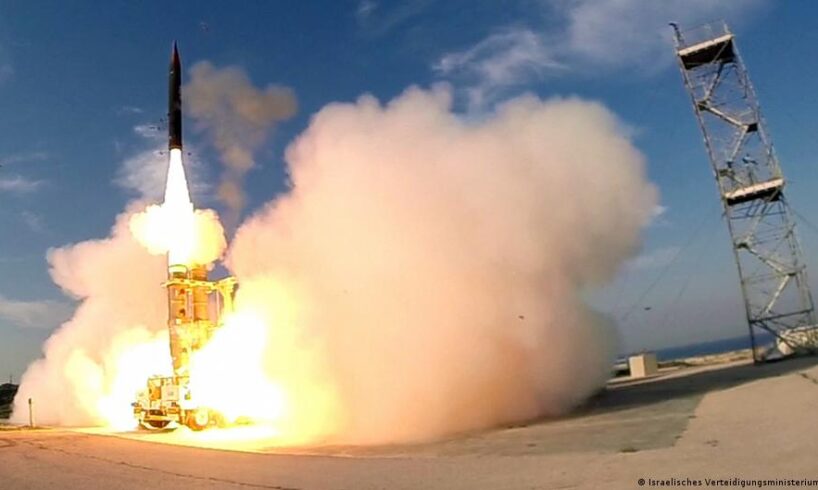
Last week, just before Chancellor Friedrich Merz’s inaugural visit to Israel, Germany saw a major step forward in the introduction of the Arrow 3 missile defense system, which was developed jointly by Israel and the US. It is one of the most advanced systems in the world when it comes to defending against intercontinental missiles.
In the event of a missile attacking from high altitude, the Arrow 3 is designed to take it out well before it re-enters the Earth’s atmosphere. This new defense system has now entered its first operational phase. This makes Germany the first country outside Israel to integrate the Arrow 3 into its defense system.
German Chancellor Merz reaffirms support for Israel
To view this video please enable JavaScript, and consider upgrading to a web browser that supports HTML5 video
The introduction of this system is seen as a direct response to Russia’s war of aggression against Ukraine and the growing threat posed by modern long-range missiles. The Arrow 3 is now a key component of Germany’s new security policy, which, since 2022, has constituted a turning point for the country. This policy involves a significant increase in defense spending and the development of a multi-layered European air defense system.
Pistorius: Arrow 3 safeguards Germany and Europe
“For the first time, this gives us the ability to provide early warning and to protect our population from long-range ballistic missiles,” explained Defense Secretary Boris Pistorius. “This means we are not only protecting ourselves, but also our partners.”
The press release from the Ministry of Defense goes on to say: “In the event of a potential conflict, Germany’s central geographical location means it is potentially threatened by long-range ballistic weapon systems. Russia, for example, has long-range missiles that can reach extreme altitudes and could pose a serious threat in the event of a crisis.”
Previously, Germany had no way to respond to such threats. For a long time, NATOanalyses have warned about this vulnerability in Europe’s defense. The Arrow 3 is meant to close that gap.
The German Armed Forces presents an Arrow 3 missile defense system at the Holzdorf Air BaseImage: Ralf Hirschberger/AFP
Hit-to-kill: Precision instead of explosion
The IRIS-T air defense system covers short distances of up to approximately 15 kilometers (9.3 miles), while the Patriot air defense system covers medium ranges of up to around 50 kilometers. Together, these defense systems can reach altitudes of up to approximately 50 kilometers.
The Arrow 3, on the other hand, can intercept attacking missiles at altitudes of up to 100 kilometers — beyond the Earth’s atmosphere — and has a range of up to 2,400 kilometers. These three systems form a multi-layered missile defense system.
The Arrow 3 is known for its cutting-edge technology, but it comes at a high price: a single Arrow 3 interceptor missile is estimated to cost several million euros. Patriot and IRIS-T are significantly less expensive and can be deployed in larger numbers in an emergency.
The Arrow 3 operates according to the so-called hit-to-kill principle: the incoming missile is destroyed not by explosives, but by direct impact. The interceptor missile hits the target during its flight path before it re-enters the Earth’s atmosphere.
This creates less debris than would be produced by an explosion, which means it is safer to use over populated areas. To do this, the defense system requires precise control. The warhead also has its own sensors for target correction as it approaches.
Patriot missile defense systems during a German Armed Forces exerciseImage: Bernd Wüstneck/dpa/picture alliance
Protection against fast ballistic missiles
Similar to the Patriot, the Arrow 3 consists of three main mobile components: an early warning radar for rapid detection of trajectories, a combat control system for analyzing threats in order to decide on interception procedures and a mobile launch system that carries the interceptor missiles.
The system is primarily designed to intercept ballistic missiles. These are weapons that, after launch, largely follow a trajectory determined by gravity. They are initially accelerated by the rocket engine, then climb to high altitudes and can sometimes even reach space. Finally, they plummet down onto their target.
Unlike cruise missiles, which are actively controlled throughout flight, ballistic missiles are only guided during the launch phase. They are particularly difficult to intercept because they fly extremely fast, cover long distances and climb high into the atmosphere. Modern intercontinental missiles such as the Russian “Sarmat,” for example, reach speeds of more than 20,000 kilometers per hour.
Holzdorf: Germany’s first Arrow 3 site
The first site for the missile defense system is the Holzdorf military airfield near Schönewalde, south of Berlin, on the border between the three German federal states of Brandenburg, Saxony-Anhalt and Saxony. Here, personnel, procedures and integration into the NATO air defense network are being tested.
Holzdorf will serve as the springboard for setting up a nationwide shield against long-range missiles. Two further sites are planned in Bavaria and Schleswig-Holstein. Full protection capability through the Arrow 3 system is expected by 2030. Distributing the facilities across several sites should ensure that protection remains in place even if individual components fail in an emergency.
Arrow 3 was officially deployed by Israel in early 2017. Complementing the well-known Iron Dome missile defense system, which primarily defends against attacks from the Gaza Strip and Lebanon, the Arrow 3 was developed to defend against long-range missiles.
With this deployment in Germany, it is now part of the European air defense system European Sky Shield Initiative (ESSI), which Germany helped to launch in October 2022.
2023: Israel’s then Defense Minister Yoav Gallant (left) and his German counterpart Boris Pistorius signing the contract for the Arrow 3 delivery.Image: Tobias Schwarz/AFP/Getty Images
Germany and Israel’s biggest arms deal
At the end of September 2023, Germany and Israel signed a deal in Berlin for the purchase of the Arrow 3 system — Israel’s biggest arms deal to date. According to the German Ministry of Defense, the deal is worth over €3.6 billion ($4.2 billion). Part of this will go towards maintenance and support packages designed to ensure the system remains operational for decades to come.
However, the agreement is more than just a billion-euro deal. It strengthens the security partnership between Germany and Israel. For Europe, the Arrow 3 is also a step toward greater independence from US defense systems.
This article was originally written in German.
While you’re here: Every Tuesday, DW editors round up what is happening in German politics and society. You can sign up here for the weekly email newsletter, Berlin Briefing.