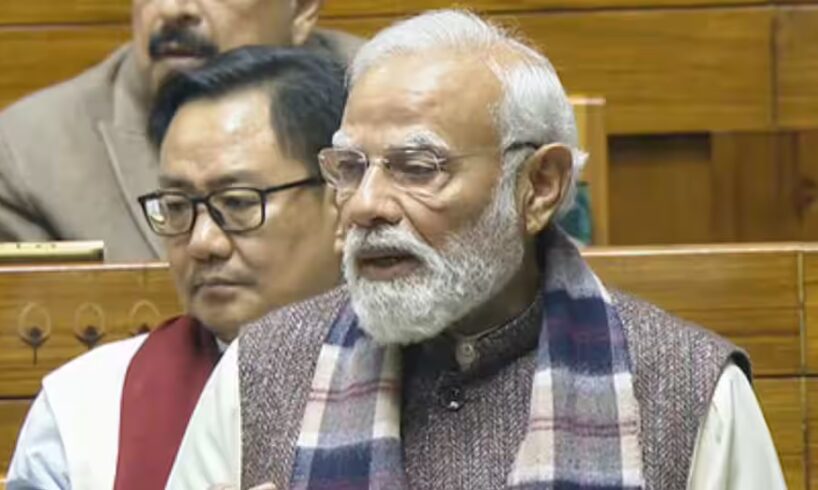
New Delhi: During the Lok Sabha session marking 150 years of Vande Mataram, Prime Minister Narendra Modi criticised the Congress, saying the party had previously split the national song under pressure from the Muslim League and had “knelt before them”. He said such actions in the past reflected political compromises that weakened national unity.
PM Modi said the British had relied on a divide-and-rule strategy for years, and Bengal became their first focus. He noted that Bengal’s spirit once energized the entire nation. Recalling the events of 1905, he said Vande Mataram became a powerful force of resistance when the British partitioned Bengal. “Street to street” was the call for unity, he said, and that message continued to inspire people across the country.
Quoting Mahatma Gandhi’s 1905 writings in ‘Indian Opinion’, PM Modi reminded the House that Gandhi had described Vande Mataram as “our national anthem” and “more melodious than the songs of other nations”.
Add Zee News as a Preferred Source
He asked why such a revered hymn was later subjected to “injustice” and sidelined.
“Today, as we celebrate 150 years of Vande Mataram, we must tell new generations the truth — that Congress once split this hymn, succumbing to the pressure of the Muslim League and its everlasting appeasement policy. This should never be allowed to happen again,” PM Modi declared, urging Parliament to restore pride in the song that once united the nation against colonial rule.
The Prime Minister recalled the powerful role Vande Mataram played during the freedom struggle, noting how Bankim Chandra Chattopadhyay’s hymn became a symbol of resistance against British rule. Even though the colonial government imposed bans and punishments for speaking, writing, or printing the words Vande Mataram, the song continued to inspire people across the country.
He mentioned the sacrifices made by women in Sindh and Barisal, including Sarojini Bose, who vowed not to wear bangles until the ban was removed as well as the bravery of children who endured beatings for chanting the song.
PM Modi also honoured revolutionaries like Khudiram Bose, Madanlal Dhingra, Ashfaq Ullah Khan, Roshan Singh, and Rajendra Nath Lahiri, who faced martyrdom while chanting Vande Mataram, highlighting how deeply the song was woven into India’s struggle for independence.
He recalled Master Surya Sen’s poem echoing the hymn before his execution in 1934, noting how the mantra of sacrifice and unity inspired movements from Chattogram to Nagpur. Tracing its global reach, PM Modi pointed to Veer Savarkar singing Vande Mataram at India House in London — then an epicentre of the freedom movement, Bipin Chandra Pal naming his newspaper after it, and Madam Bhikaji Cama publishing Vande Mataram abroad despite bans.
He said the hymn became the mantra of Swadeshi, inscribed even on ships built by PO Chidambaram Pillai in 1907, and celebrated in the works of Tamil poet Subramania Bharati.
“Why was injustice done to Vande Mataram?” PM Modi asked. He recalled that after Mohammed Ali Jinnah’s objections in 1937, Jawaharlal Nehru wrote to Subhas Chandra Bose, warning that the song’s background could spark anger among Muslims.
PM Modi said that the Congress later held a meeting in Kolkata to reconsider how Vande Mataram should be used. He noted that despite strong protests from people across the country, the party eventually decided in October 1937 to limit the hymn to only its first two stanzas, presenting the move as an effort to maintain secularism and communal harmony.
“History is testament to the fact that Congress knelt before the Muslim League and did this under pressure. This was the politics of appeasement. Because Congress bowed to the division of Vande Mataram, it later bowed to the division of India,” PM Modi said, adding that the party continues the same politics of appeasement today.
(From the Inputs of IANS)