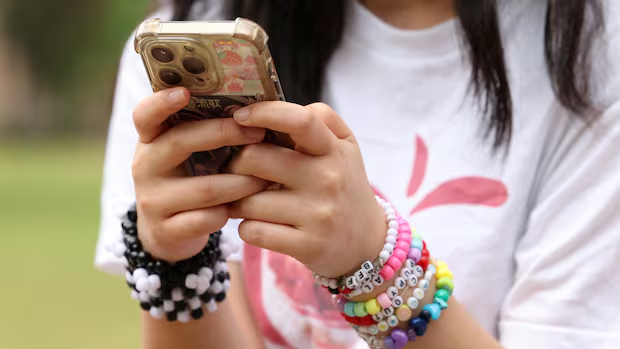
Eyes around the world are turned to Australia as its world-first ban on social media for users under age 16 takes effect. The tough new law aims to block Australian children and younger teens from addictive social platforms and harmful content online.
As the country awakens on Dec. 10, the platforms the Australian government has singled out in its initial list — Instagram, Snapchat, TikTok, YouTube, Twitch, Facebook, Reddit, Threads, X (formerly Twitter) and Kick — must have deactivated or removed accounts of its users in this age cohort and ensured they cannot set up new ones, a process that some of the companies began last week.
The process won’t proceed perfectly right away, Australian Prime Minister Anthony Albanese and others in his government have admitted, having said that about 86 per cent of Australian kids between eight and 15 years old are on social media.
“But the message this law sends will be 100 per cent clear,” Albanese noted in an op-ed published over the weekend, in which he harkened to when Australia set its legal drinking age to 18. “The fact that teenagers occasionally find a way to have a drink doesn’t diminish the value of having a clear, national standard.”
The social ban arrives just ahead of schools letting out for about six weeks for the summer break in the Southern Hemisphere, with young Australians saying the measure cuts off vital connections to friends and community supports, especially for remote and marginalized youth.
“I don’t think the impact will be very positive for us. We don’t have a lot out here to get in contact with each other,” 15-year-old Riley Allen, who lives on a sheep ranch outside of the small South Australian town of Wudinna, told The Associated Press.
“I’m not sure how we’re going to keep in touch over the holidays with each other.”
‘I’m not sure how we’re going to keep in touch over the holidays,’ said 15-year-old Riley Allen, who lives on a sheep ranch outside the small South Australia town of Wudinna. (Jason Allen/The Associated Press)
Young users find workarounds
Some young users have shared ways they’re bypassing the ban, for instance using filters or masks to disguise their faces, or older users (including willing parents) to trick the artificial intelligence apps estimating their age via selfies. Online forums abound with advice on how to set up a Virtual Private Network (VPN) to hide their location, one way of getting around the processes inferring age by tracking how young users behave online.
Young people are also migrating elsewhere. For instance, Lemon8, an app owned by TikTok parent ByteDance, and a photo sharing app called Yope have surged in popularity.
With Australian social media users under 16 seeing accounts deactivated or locked due to the new ban, some are already finding ways around age verification or migrating to other platforms. (AFP/Getty Images)
The Australian government has warned, however, that more tech companies could be added in subsequent waves. Platforms found in breach of the new law face fines of up to about $45.4 million Cdn, with monitoring and enforcement coming from Australia’s eSafety Commission, the country’s online safety regulator.
“This is not set and forget,” Communications Minister Anika Wells told the National Press Club last week. “If LinkedIn becomes a secret online meeting place for under 16s, I will not hesitate to act.”
Given the fast pace of technology, how adeptly teens move online and how integrated social media is to adult life, efforts to address the dangers of social media should take a multi-pronged approach beyond a ban and be a shared effort between governments, educators, parents as well as tech companies, says Toronto-based tech journalist Takara Small.
“Education is so critical because young people can just move to another social media platform. They may pivot to another space that perhaps doesn’t have the same processes for takedowns,” she said.
Tech journalist Takara Small says many young people are agile enough to find ways around a social media ban, including migrating to less regulated online spaces. More education about online harms must be part of the overall approach, she says. (Takara Small)
“With this Australia ban, there are young people who are setting up anonymous accounts. When we use facial recognition to determine someone’s age, it’s not always accurate. And so what are we doing … to teach young people why it’s important for them to understand how the internet works, how social media works, and to protect them?” asked Small, who thinks a similar ban could potentially be introduced in Canada.
Similar measures coming elsewhere
Australia’s ban is being touted as the strongest measure yet to curb young users’ social media access, but others are following suit, whether by enacting or pledging a similar ban (like in Malaysia, Denmark and France) or legislating tougher standards for social platforms (as in the U.K.)
Canada’s most recent attempt to tackle harmful online behaviour — the Online Harms Act, Bill C-63 — died on the order paper this spring when a federal election was called.
WATCH | Platforms start limiting social media for Australians under 16:
Meta deactivating users under 16 ahead of Australia’s social media ban
Meta, the parent company of Facebook and Instagram, has begun deactivating social media users under age 16 in Australia ahead of a first-of-its-kind ban. Some advocates are calling for similar protections to be enacted in Canada.
However, the plan is to introduce new legislation before the end of the year that would target online exploitation of children, a justice ministry spokesperson told CBC News last Thursday. A representative for the heritage ministry subsequently echoed that Canadians would see something soon.
“We all want our children to be safe as they navigate the digital world, and platforms have an important role to play,” a heritage spokesperson said in a statement.
“Our government intends to act swiftly to better protect Canadians, and especially children, from online harm.”
Seeing a ban roll out in Australia gives Vancouver parent Jenny Perez hope. As founder of Unplugged Canada, a grassroots group that advocates delaying smart phones and social media for kids, she’s been lobbying the federal government for timely action.
Jenny Perez, a Vancouver mom with a school-aged child, is the founder of Unplugged Canada, a grassroots parental group advocating for delaying the introduction of smartphones and online spaces to children. (CBC)
“Definitely we should follow the lead of Australia and also of other countries across the world [where] governments are stepping up to protect their children better,” Perez said.
“Many parents felt defeated…. They felt it was too late to change the norm, but what Australia is proving is not only that it can be done, but also that it can be implemented effectively because we are already seeing social media companies complying.”
Quentyn Archer, a high schooler in Montreal, says Canada enacting a social media ban for youth would be ‘excessive.’ But he does see benefits to some social media restrictions for younger users. (CBC)
Montreal student Quentyn Archer admits he spends lots of time on social media chatting with friends and seeking entertainment, though thinks Canada introducing a ban would be “excessive.”
That said, he does see benefit in restricting social media for youth. “Kids these days, they’re on screens a lot … and I feel like it’s not really good for them,” said the 16-year-old.
“They could definitely limit the amount of hours that people can use social media. I think that would be good for younger people.”