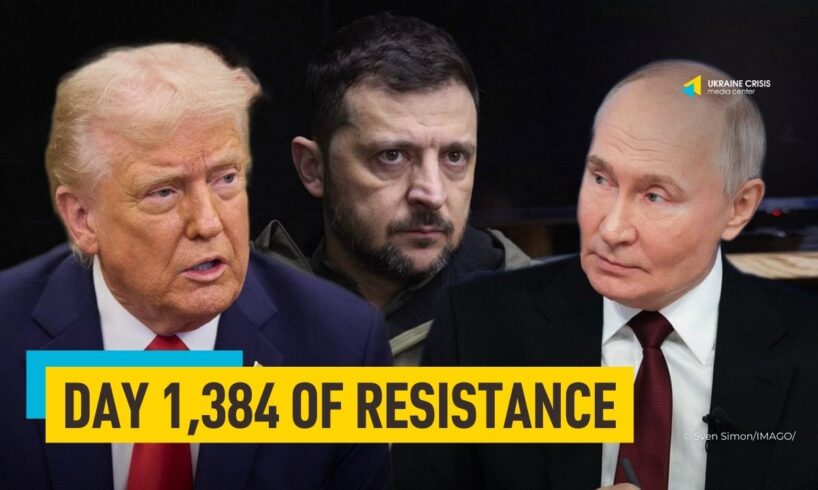
The U.S., Russia and Ukraine don’t have a unified view on Donbas, Zelenskyi tells Bloomberg News. Europe only has itself to rely on, a Politico column states. Zelenskyi meets with the leaders of the UK, France and Germany in London.
U.S., Russia, Ukraine don’t have unified view on Donbas, Zelenskyi tells Bloomberg News
Ukrainian President Volodymyr Zelenskiy said negotiators discussing a U.S.-brokered peace initiative remain divided over territory as President Donald Trump expressed disappointment in Kyiv’s handling of the deal, Bloomberg News said on Monday. The paragraphs below are quoted from the article.
Elements of the US plan require further discussion on a number of “sensitive issues,” including security guarantees for the war-battered nation and control over eastern regions, Zelenskiy said in a phone interview. The Ukrainian leader said talks have yet to yield agreement on Ukraine’s Donbas, including the provinces of Donetsk and Luhansk.
“There are visions of the US, Russia and Ukraine — and we don’t have a unified view on Donbas,” Zelenskiy told Bloomberg News early Monday before his departure to London to meet leaders of the UK, Germany and France. He said Kyiv is pushing for a separate agreement on security guarantees from Western allies, above all the US.
Zelenskiy spoke hours after Trump criticized him — in contrast with comments in recent days about President Vladimir Putin’s reaction to the proposal — saying he was “a little bit disappointed” in the Ukrainian leader, who he claimed hadn’t yet read the proposal. Moscow, on the other hand, was “fine with it,” Trump told reporters in Washington on Sunday.
In London [on Monday], Zelenskiy will meet his top security official, Rustem Umerov, who held a meeting with Witkoff and Kushner over the weekend, for a detailed briefing.
Europe only has itself to rely on, a Politico column states
If the continent is to survive a future attack by Russia, its big players must behave in a way they haven’t done before. They must be joined at the hip, John Kampfner said in a column for Politico published on Monday.
John Kampfner is a British author, broadcaster and commentator. He is a regular Politico columnist. The paragraphs below are quoted from the article.
When it comes to the war in Ukraine, predictions don’t last long. One minute U.S. President Donald Trump’s acting like his Russian counterpart Vladimir Putin’s emissary, the next he’s giving Ukrainian President Volodymyr Zelenskyy a reasonable hearing, and then it’s back again to the Kremlin camp.
With the U.S. administration increasingly taking on the role of unreliable broker over a staunch ally, Europe is in a parlous position. And what has struck me most during a series of security briefings and conferences I’ve attended in Berlin and elsewhere this autumn, is the extent of the alarm.
One of the few crumbs of comfort is that the E3 nations of Germany, France and Britain are seeking to confront this cold reality in unison.
If Europe is to survive a future attack by Russia — and that is the kind of language being used — its big players must behave in a way they haven’t done before. They must be joined at the hip.
As more than a dozen officials have made clear in a series of discussions, the cost of inaction would be far greater than the cost of supporting Ukraine has been so far. Not only would Putin be emboldened to go even further, Europe would also be engulfed by a wave of Ukrainian refugees far greater than anything experienced before.
As another German military figure, also granted anonymity to express their views, put it: “The harsh truth is that Europe’s readiness level to combat any Russian aggression doesn’t yet exist. Until that time, we are reliant on the U.S. to act as a backstop.”
Their alarm [of security planners in Germany or the U.K.] will have been reinforced by the second Trump administration’s first National Security Strategy. Published only a few days ago, it condemns many of the liberal values underpinning European democracy, while praising the nativist, nationalist rhetoric of the far-right — and implicitly of Putin.
And while opinion polls vary from country to country and depending on how questions are phrased, the growing concern among many defense officials is that if Ukraine is pressured enough to accept some form of Trump-Putin dirty deal, public support for military spending will decrease. “Job done” will be the sentiment — except, of course, it won’t be.
But the original 28-point plan for Ukraine — which the U.S. initially denied came directly from the Kremlin — represents Europe’s worst nightmare. And if a spurious “peace” is imposed by any deal approximating that one, Germany, the U.K., France and their other European allies, including Poland, Finland, the Baltics, Nordics and (more cautiously) Italy, will know they’re out on their own.
It would mark the return of big-power politics, a Yalta 2.0. It would enshrine NATO’s de-Americanization, a structural incapacity for Ukraine to defend itself, and confirm that, as far as the U.S. is concerned, Russia enjoys a veto on European security.
The task for Merz, Starmer and Macron is then to accept — and admit to their publics — that they only have each other to rely on.
Zelenskyi meets with leaders of UK, France, Germany in London
On Monday Ukrainian President Volodymyr Zelenskyi met with British Prime Minister Keir Starmer, French President Emmanuel Macron and German Chancellor Friedrich Merz in London to discuss the latest U.S.-authored peace proposal aimed at ending Russia’s war in Ukraine. Starmer and Zelenskyi are supposed to later have a one-on-one meeting, the Ukrainian president’s spokesperson Serhiy Nykyforov said, according to Ukrainian media. At the time of writing, the meeting has not yet happened.
Zelenskyi is expected in Brussels on Monday evening, Nykyforov also said. He is supposed to meet with NATO Secretary General Mark Rutte, President of the European Council António Costa and European Commission President Ursula von der Leyen.
Key European leaders including UK Prime Minister Keir Starmer will huddle with Ukrainian President Volodymyr Zelenskyi in London in a bid to steer US-led peace talks toward a resolution that protects Ukraine from the prospect of future Russian aggression, Bloomberg News said on Monday. UK Foreign Secretary Yvette Cooper, meanwhile, will head to Washington for the first time in her present role to meet with Secretary of State Marco Rubio and other officials, it added.
According to notes from a conference call published by the German magazine Der Spiegel on December 4, German Chancellor Friedrich Merz and French President Emmanuel Macron used drastic words in a conversation with Ukrainian President Volodymyr Zelenskyi and several other top European politicians to warn that the U.S. could betray Ukraine and Europe. These and other statements reproduced in the notes of the conversation illustrate the Europeans’ deep distrust of the two Trump confidants, Der Spiegel said.