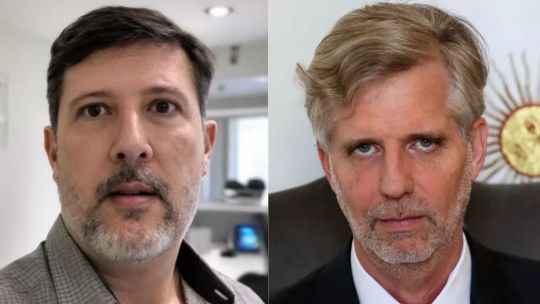
Argentina’s Official Gazette, Decree 852/25: “Mr Sergio Darío Neiffert is hereby removed from the post of State Intelligence Secretary of the Office of the President.” That was how the Government dismissed the head of the Secretaría de Inteligencia de Estado (SIDE), formerly the AFI federal intelligence agency, formerly the Intelligence Secretariat, originally SIDE and now back to its original name. A series of rebrandings aimed at glossing over what has been a cursed office under every administration.
Reports this week described the chain of events that left Neiffert out of a job. Some were laughable or, rather, shameful. One involved the former chief being approached at midnight at his home in his underwear and told by subordinates, including the man who would replace him, that the axe was about to fall. Journalists Alejandro Rebossio and Pedro Lacour revealed the incident in elDiario.ar.
Neiffert fell under the weight of libertarian infighting, a saga so exhausting that it is impossible to identify the good guys. Linked to presidential advisor Santiago Caputo, the departed SIDE chief appears to have tried switching to the winning camp of Karina Milei, shuttling information back and forth. It did not go down well – there are other factors, but the upshot is that Neiffert is being replaced by another trusted Caputo ally, Cristian Auguadra, previously in charge of the secretariat’s internal affairs office, as the decree indicates.
‘Confusion and disorientation’
Jorge Liotti’s report in La Nación last week captured part of the picture: “While the SIDE infighting raged, the agency was paralysed. A man familiar with its workings describes a state of confusion and disorientation so severe that no-one wanted to take decisions because no-one knew whom to report to.” He adds: “In this line of work it is crucial to have a clear chain of command and in recent months that structure was completely broken.”
This is the agency that coordinates all components of the Sistema de Inteligencia Nacional (National Intelligence System, SIN), including the National Directorate of Criminal Intelligence, which is responsible for complex crime and organised crime under the Security Ministry, and the National Directorate of Military Intelligence, placed under the Defence Ministry. According to the government’s website, SIDE “systematises the information obtained, gathered and analysed by the SIN on concrete or potential events that pose a risk to domestic security, national defence and Argentina’s position in the world.”
Abroad, Argentina faces no challenges involving neighbouring states. Despite being practically defenceless after decades of underfunding of its defence system since the Malvinas conflict in 1982, hypothetical clashes with Brazil and Chile are a thing of the past. They vanished with the return of democracy, thanks to Raúl Alfonsín and Carlos Menem.
Yet there are issues that the intelligence services should be focusing on.
Vulnerabilities
Under President Donald Trump, the United States has been carrying out military operations for months in the southern Caribbean and the Pacific Ocean. The stated aim is to disrupt drug routes from South America. Attacks by the US Navy on boats it alleges are drug-traffickers have left more than 80 dead. Many analysts see them as extrajudicial killings or war crimes. The scandal continues to grow.
Washington has a parallel objective, if not a main one. It is seeking to force Nicolás Maduro out of Venezuela and bring down the Chavista regime. A land operation on Venezuelan soil is not ruled out. Trump informed Maduro of this possibility by phone weeks ago. Any such action would have unpredictable consequences for population movements and could trigger a new humanitarian crisis in the region.
Another issue of concern for SIDE should be Iran’s decision to put Argentina on its list of ‘enemy’ states. The move became public in July in an editorial in the Tehran Times. It followed the so-called Twelve-Day War, in which the United States struck and disabled parts of Iran’s nuclear programme during the Middle East conflict. Argentina had supported that initiative and earlier Israeli Defence Forces strikes on those facilities.
“Tehran will not forget Buenos Aires’ anti-Iran policies and will make it regret its hostility,” the Tehran Times wrote. Career diplomat Roberto García Moritán called it “a covert terrorist message from the highest authorities of the Islamic Republic of Iran.”
Days earlier, Ali Larijani, an adviser to Supreme Leader Ali Khamenei and member of Iran’s National Security Council, had threatened Rafael Grossi, the Argentine diplomat seeking to be next UN secretary general. Grossi currently heads the International Atomic Energy Agency (IAEA), which is responsible for monitoring Iran’s nuclear programme. “When the war is over, we will deal with Grossi,” Larijani said. The conservative daily newspaper Kayhan, representing Khamenei’s line, even labelled him an “Israeli spy” and called for his arrest and execution.
New guidelines
The Milei government last week released a document outlining the reform of the National Intelligence System, which was introduced by emergency decree in July 2024. It acknowledges a deterioration of more than 30 years, which, it says, has damaged democratic institutions and “left Argentina vulnerable to various risks and threats.”
A more detailed analysis is warranted. But broadly, the text sets out what the government considers to be the country’s strategic interests and the general guidelines shaping the intelligence system.
The document aims to position Argentina internationally, preserve national sovereignty and strategic autonomy, protect strategic resources and critical infrastructure, prevent and combat terrorism and organised crime, anticipate and counter threats in cyberspace and counter foreign intelligence activities that threaten national interests.
The operatives
There is extensive information about the outgoing and incoming SIDE chiefs.
Neiffert sat on the board of the Matanza Riachuelo Basin Authority (ACUMAR) as the representative of the Executive Branch. He previously worked in the private office of the mayor of Malvinas Argentinas, then run by Jesús Cariglino. In the private sector, he represented athletes, also with Cariglino.
He will be remembered for a decree allocating 100 billion pesos to the Secretariat, which was rejected by Congress, and for the National Intelligence Plan, which was leaked to the press in June. The plan targeted civil society figures including political leaders, economists and journalists, forcing him to brief the bicameral intelligence committee on the plans. The day before he was dismissed, an emergency decree assigned nearly 27 billion pesos in extra funds to SIDE. On the day of his removal, Milei’s government published the aforementioned document.
Cristian Auguadra, Neiffert’s replacement, joined SIDE through the Internal Affairs Department in late 2024. An accountant for the Caputo family, he founded a transport company, West Transfer SRL, with Ángel Stafforini, former deputy head of the Belgrano Cargas railway.
Stafforini is currently on trial before Federal Oral Court 8 for allegedly paying bribes to steer the investigation into the 2010 killing of Mariano Ferreyra, according to the Centre for Legal and Social Studies (CELS) rights group, which is a plaintiff in the case.
Página/12 reported on Thursday that a son of the new SIDE chief had joined a delegation attending the Formula 1 Grand Prix in Baku, Azerbaijan, in September while the International Security Forum was taking place in parallel.
One cannot help but question the suitability of these gentlemen for their roles.
related news