Shafaq News
As Shiite and Sunni blocs in Baghdad
navigate post-election negotiations following the November 11, 2025,
parliamentary vote, the Kurdish house enters this decisive round in one of its
weakest and most fractured moments since 2003—despite the Kurdistan Democratic
Party (KDP) emerging with one of its strongest electoral performances
nationwide.
The crisis in Kurdistan today extends far
beyond politics. It is a web of pressures stretching from stalled power-sharing
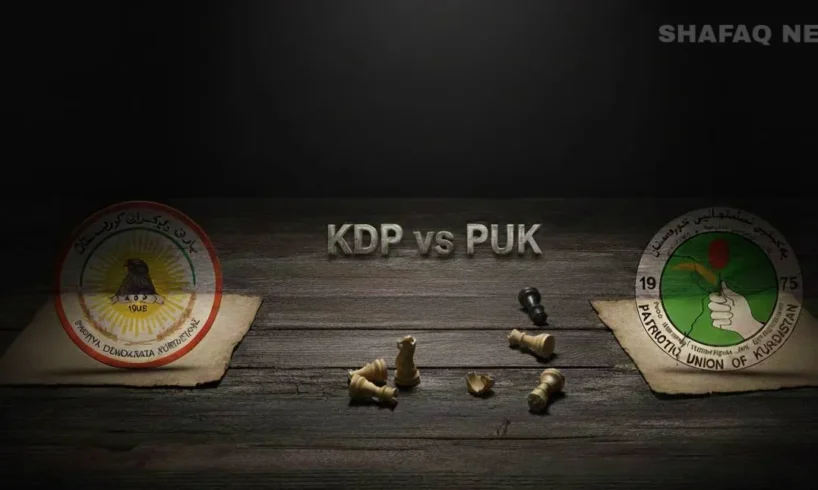
talks between the KDP and the Patriotic Union of Kurdistan (PUK) to long queues
of employees and retirees waiting outside banks amid a prolonged salary crunch.
The divisions that deepened in the 1990s
have solidified over time into a structural imbalance—one that resurfaces economically
and socially with every political rupture. Kurds now approach one of their most
sensitive rounds of Baghdad negotiations since 2003, while internally at their
most fragile.
From Election Results to a New Battle
The latest elections produced a decisive
lead for the KDP, which secured more than 30 seats (including scattered wins
and quota seats), doubling the PUK’s 18-seat share. This reaffirmed within the
KDP a growing sense that it is the rightful Kurdish claimant to Iraq’s
presidency—challenging a two-decade tradition that has left the post in PUK
hands since 2005.
For its part, the PUK continues to rely on
its legacy in Baghdad and its view of internal balance within the Kurdistan
Region.
On the ground, the vote confirmed the
familiar pattern of polarization: the KDP scored sweeping victories in Duhok
and Erbil and notable gains in several disputed districts, while the PUK
preserved its weight in Al-Sulaymaniyah and surrounding areas. But this
electoral map did not translate into a unified political agenda. The two
parties arrived in Baghdad divided over the most critical Kurdish file on the
table: the identity of the next President of the Republic and how the Kurdish
bloc should leverage its electoral weight in shaping Iraq’s next government.
Since 2003, an unwritten political
understanding has placed the presidency in Kurdish hands—most often with a PUK
figure. Over the years, this arrangement gave the PUK symbolic and practical
leverage in Baghdad, while reinforcing a sense of internal parity between
Kurdistan’s two main forces.
The KDP’s strong showing in 2025 revived
an old question with new insistence: if the party is now the largest Kurdish
force and carries the heavier burden of governing the Region economically and
security-wise, why should it not claim the presidency?
Yet this dispute unfolds against a
paralyzed political landscape in Erbil and Al-Sulaymaniyah. Kurdistan has yet
to form a Regional government or elect a new parliament speaker more than a
year after the last regional vote. This means that even as Kurdish parties
negotiate over Iraq’s highest ceremonial office, their own institutions at home
remain without a functional leadership framework.
A Lost Opportunity?
Farhad Tawfiq, spokesperson for the
Kurdistan Socialist Party, believes the election outcome could have become a
source of strength for Kurds in Baghdad—but risks turning into a missed
opportunity.
Speaking to Shafaq News, he recalls his
party’s pre-election call for a unified Kurdish coalition, saying it is now
“more realistic and urgent than ever.” Tawfiq notes that the moment is not
merely about distributing ministries or posts, but about determining the
Kurdish place at the top of Iraq’s political pyramid—where the most sensitive
files, from oil to budgets to federal relations, are shaped.
He warns that positions traditionally seen
as Kurdish—especially the presidency—could become bargaining chips if Kurdish
parties remain divided.
Going to Baghdad with conflicting maps, he
says, gives other forces an advantage in shaping the next government and its
sovereign architecture.
Read more: The Kurdish spine of Iraq’s elections: Unity tested by division
Governance Paralysis in Erbil and
Al-Sulaymaniyah
Kurdish academic Arslan Mohammed
highlights the institutional dimension of the crisis. More than a year has
passed since the Kurdistan parliamentary elections without a new government or
elected presidencies.
This, he argues, is not a routine delay
but a “structural failure that weakens the Kurds’ negotiating posture.” Parties
unable to manage their own political house, he says, inevitably enter Baghdad
weakened when demanding rights related to salaries, federal budget shares, or
implementing Article 140.
The lack of a shared vision, he warns,
threatens not only salary flows and budget allocations but also the Kurdish
share in Iraq’s three top state offices, especially amid the explicit KDP-PUK
dispute over the presidency. Meanwhile, ordinary Kurdish citizens pay the
price: delayed salaries, economic strain, and faltering services make the
Baghdad power struggle feel detached from daily realities.
A Conflict Rooted in History
For Kurdish politician Mohammed Raouf,
today’s tensions are not an anomaly but the latest episode in a long continuum
of rivalry between the Kurdistan Region’s two dominant parties.
He notes to Shafaq News that the roots
extend far into the last century, evolving over time into entrenched divisions
in governance, geographic zones of influence, and administrative authority.
“These faults have had a direct impact on public life—from the salary crisis
and budget management to lack of transparency and irregular parliamentary
oversight.”
The continuing rift, Raouf says, has
eroded Kurdish political weight in Baghdad to the point of weakening any
unified national position on constitutional entitlements. With further crises
approaching—both in forming Iraq’s next government and in negotiating Kurdish
rights—he warns that the status quo risks new political and legal setbacks,
even if some Kurdish parties scored strong electoral victories.
The Presidency as a Mirror of Kurdish
Struggles
Political analyst Kamran Khurshid views
the presidential contest as a reflection of a deeper struggle for leadership
within Kurdistan rather than a competition for a protocol-heavy office.
He tells Shafaq News that the KDP sees
itself as the first force politically, economically, and security-wise, and
believes that securing the presidency would formalize its central role in
Iraq—given its responsibility for large parts of the Region and key portfolios.
The PUK, meanwhile, draws on its long
Baghdad presence and long-standing ties with major Shiite parties, arguing that
relinquishing the presidency would disrupt a delicate balance that sustained a
form of partnership in the Region for two decades.
“This tension makes any compromise more
costly: each concession sends a difficult internal message. In the background,
Shiite and Sunni blocs closely watch Kurdish dynamics, viewing them as leverage
in power-sharing talks—by backing one side against the other or exploiting
divisions to lower Kurdish demands.”
Revisiting the Constitution
Analyst Burhan Sheikh Raouf returns to the
constitutional dimension. He cautions that entering Baghdad without a cohesive
Kurdish bloc risks the gradual erosion of gains secured since 2005.
The presidency, he stresses, is not merely
symbolic. It shapes critical files ranging from the Federal Supreme Court law
to the long-awaited Federal Council, and influences Iraq’s sovereign decisions
and international agreements. “With rising calls in Baghdad to revisit
power-sharing and resource distribution mechanisms, the identity of the next
president—and whether he aligns with a unified Erbil-Sulaymaniyah vision—could
shape the region’s relationship with Baghdad for years.”
Sheikh Raouf proposes treating the
presidency as part of a broader negotiation package that includes salaries,
budgets, oil policy, and disputed territories. He also calls for a joint
Kurdish operations room with constitutional and economic advisers to define red
lines before engaging in negotiations—preventing incremental retreats on
Kurdish rights.
Beyond Victory and Defeat
Independent Kurdish politician Dr. Karzan
Murad links internal Kurdish tests to wider regional and international shifts.
With mounting pressures on oil, budgets, borders, and crossings—and increased
regional involvement in Iraqi politics—he argues that Kurds need a cohesive
Baghdad team more than ever.
The KDP’s strong electoral performance, he
says, could become the foundation “for a powerful Kurdish front in the
capital—or a deeper fracture if used to sideline the PUK rather than form a new
intra-Kurdish settlement.”
Murad also highlights the “limited
legislative and negotiating experience” of some Kurdish representatives, which
leaves them “vulnerable” to short-term crises and transactional deals instead
of long-term strategic management.
Thus, the issue is not only who signs
presidential decrees, but who can shape the laws and frameworks governing
Erbil-Baghdad relations in the years ahead.
A Quiet Memory of Conflict
Behind today’s disputes lies an unresolved
historical shadow: the intra-Kurdish conflict of the 1990s.
Although the language has changed and
institutions have evolved, many communities still recall a time when rivalry
between Erbil and Al-Sulaymaniyah turned violent.
Today, the struggle is fought through
negotiations, parliamentary blocs, and power-sharing formulas. But rising
tensions revive old anxieties about whether political competition could again
harden into deeper fractures if not managed with restraint and a commitment to
prevent reopening the wounds still etched in Kurdish collective memory.
Read more: Can a Kurdish framework emerge? Iraq’s new political alignments test the Kurdish house
Written and edited by Shafaq News staff.