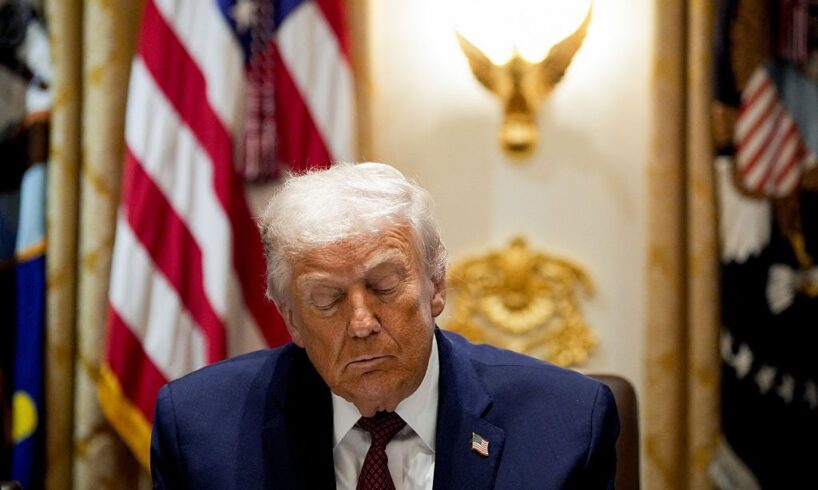
U.S. President Donald Trump during a roundtable in the Cabinet Room of the White House in Washington, DC, US, on Monday, Dec. 8, 2025. (Yuri Gripas/Abaca/Bloomberg via Getty Images)
The new U.S. National Security Strategy stunned Washington’s allies, casting doubt on the entire post-Cold War security order in Europe.
The document takes a direct shot at the EU and questions some of the main principles of NATO, two pillars of Europe’s political and security architecture. It also signals a retreat from the U.S.-led unipolar world while refocusing on the Western Hemisphere.
Despite the ongoing war in Ukraine, the document notably avoids criticism of Russia, which has already praised it as “consistent” with its own vision.
The document’s tone fits well with the Trump administration’s open disdain for Europe’s current leadership. U.S. President Donald Trump recently mocked European leaders as “weak” people who “don’t know what to do” — to the applause of Russian officials.
“First and most simply, Moscow will appreciate how little of an emphasis the strategy places on Russia and its invasion of Ukraine,” says Jorn Fleck, a senior director with the Europe Center at the Atlantic Council.
Secondly, Moscow can see clear benefits in the U.S. framing its priorities through “national sovereignty, non-interference, and a de-prioritization of European security,” he adds.
The document outlines Trump’s vision for the continent, says Constanze Stelzenmuller, an expert on transatlantic relations at Brookings Institution, as “Europe without the EU, and with hard right governments in key capitals — especially London, Paris, Warsaw, and Berlin.”
Vision of a fractured Europe
The new U.S. strategic document lambasts the EU and “other transnational bodies” while celebrating the surge of “patriotic” parties — a clear reference to far-right, Euroskeptic parties like the Alternative for Germany (AfD) that those like Vice President JD Vance clearly favor.
Some European observers acknowledge that the criticism of Europe’s weakness is not completely off the mark. For decades, Europe’s armies have been underfunded as governments have learned to rely on Washington for their security.
“The more that Europe shows itself a capable ally, the less it will need the U.S. and the more influence it will have in the U.S,” says Edward Lucas, a British journalist and a senior fellow at the Center for European Policy Analysis (CEPA), a Washington-based think tank.
British Prime Minister Sir Keir Starmer (2L), President Volodymyr Zelensky (L), French President Emmanuel Macron (R) and German Chancellor Friedrich Merz outside 10 Downing Street after a meeting in London, United Kingdom on Dec. 8, 2025. (Wiktor Szymanowicz/Future Publishing via Getty Images)
Despite its size and strength, Europe does nothing to “impress” the U.S., the expert says, adding that “to fuss and bluster and complain about how terrible the Trump administration is… is a waste of time.”
Similarly, Stelzenmuller stresses the U.S. strategy should accelerate the “timeline for shifting the burden of European defense to Europe.”
However, while the U.S. document advocates for Europe to “stand on its own feet” and assume responsibility for its defense, it also — in a glaring contradiction — envisions the continent as a fragmented group of “sovereign nations.”
Fleck underscores this paradox, saying that the “strategy takes direct aim at the EU as an antagonist to European success.”
“So if the EU were to step up, as it should do, the administration may take unkindly to that,” he adds.
This was apparent just a few days ago during a public scuffle between U.S. and EU officials over Brussels fining X, a social media platform owned by Trump’s former advisor, billionaire Elon Musk.
Ukraine, EU partners finalize revised peace proposal, ready to present plan to US
NATO’s uncertain future
Since the end of the Cold War, U.S. administrations have backed NATO’s enlargement as a means of strengthening common security across the European continent.
The new document backpedals on this paradigm, rejecting the idea that NATO should be “a perpetually expanding alliance.”
This wording is a cold shower for Ukraine, which applied for membership in 2022 but has failed to receive a formal invitation.
In turn, it is just what Moscow wants to hear. The Kremlin has often declared NATO’s eastward expansion — namely toward countries Russian forces have invaded — as its chief security concern.
But the document goes even further: it directly questions the future ties with standing NATO members, suggesting that migratory pressures may render them unreliable allies in the coming decades.
Against the backdrop of U.S. plans to reduce military presence in Europe and Trump’s ambiguous stance on Moscow, the wording raises doubt about the U.S.’s commitment to defend its European partners militarily.
Notably, the strategy came out around the same time as a poll showing record support for NATO among the American public, and a U.S. Congress defense bill solidifying Washington’s posture in Europe, suggesting that Trump’s strategic vision is not widely shared in the U.S.
Russia not a threat
Trump’s antagonism toward Europe as an independent actor is particularly visible in the section about the Russia-Ukraine war.
The strategy names Moscow as a “perceived” existential threat to Europe — but not to the U.S. Washington’s role is simply to engage through diplomatic channels to “stabilize” the strategic relations with Russia.
The paper also claims that the European leadership does not take into account that a “large European majority wants peace,” even though polls show continued public support for aiding Ukraine.
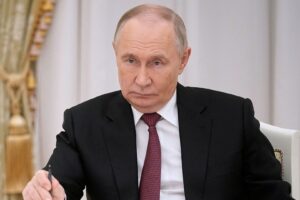
Russian President Vladimir Putin arrives to the Rashtrapati Bhavan Presidental Palace, on Dec. 5, 2025 in New Delhi, India. (Contributor/Getty Images)
Trump’s team has not taken kindly to European allies’ efforts to support Kyiv, suggesting that this approach hinders peace efforts.
As Fleck notes, the U.S. security strategy paints Europe as a “bellicose party.”
While European leaders reacted to the document by cautiously reminding Trump who the ally is, Russia has welcomed it.
Dmitry Medvedev, Russia’s former president known for his inflammatory rhetoric toward Ukraine and the West, praised its “realistic assessment of many modern challenges.”
“The adjustments we’re seeing… are largely consistent with our vision,” Kremlin spokesperson Dmitry Peskov said.
There are clear parallels with Russia’s 2021 national security strategy, particularly in their shared skepticism toward the post-Cold War liberal order and their implicit or overt embrace of a multipolar world in which major powers prioritize their own spheres of influence.
Overall, the document spells dim prospects for Ukraine.
Potential membership in NATO and the EU has been Kyiv’s key geopolitical goals since the EuroMaidan Revolution. Now, Trump’s strategy appears to be weakening the EU and halting NATO enlargement.
Trump’s vision also fails to challenge Russia’s imperialist ambition and is content to pursue “stable” relations. With the U.S. withdrawn and Europe weakened and fractured, Kyiv would find that few allies remained at its side.
Peace deal, security guarantees, reconstruction — Zelensky unveils 3-track plan as talks intensify
Note from the author:
Hi, this is Martin Fornusek.
I hope you enjoyed this article. In our team, we believe fact-based and truthful reporting should be available to all — that’s why we don’t use a paywall.
If you’d like to help us provide you with more in-depth coverage of Ukraine’s struggle against Russian aggression and other topics, please consider joining the Kyiv Independent community.