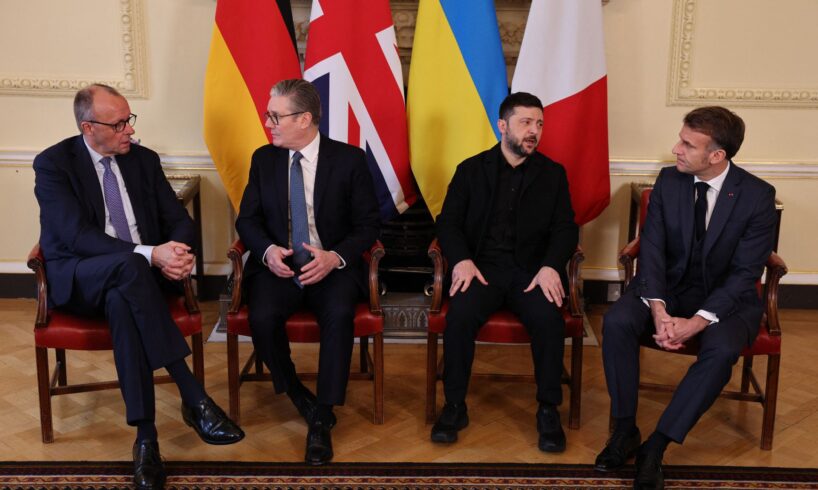
President Volodymyr Zelensky met British Prime Minister Keir Starmer and other European leaders for talks in London on Dec. 8 amid renewed efforts to settle the Russia-Ukraine war.
Zelensky said after the talks that there is not yet consensus among Ukraine, Russia, and the U.S. on the status of Donbas and emphasized that Ukraine has no legal or moral grounds for surrendering its territory.
French President Emmanuel Macron and German Chancellor Friedrich Merz joined Zelensky and Starmer at Number 10 Downing Street as Kyiv’s European partners seek to coordinate strategy in the face of the latest U.S. push for a peace deal — a push that has included proposals for Ukraine to give up land it still controls.
“Guaranteeing real security is always a shared challenge and a shared effort. Thank you for your support!” Zelensky said on X after the meeting.
The leaders “held a detailed discussion on our joint diplomatic work with the American side, aligned a shared position on the importance of security guarantees and reconstruction, and agreed on the next steps,” he added.
Europe’s leaders have privately expressed concerns that they are being sidelined from the negotiations, as the original 28-point peace plan, drafted by Russia and the U.S. and unveiled last month, imposed harsh conditions on Ukraine.
While the original proposal has been revised in subsequent talks that the U.S. held separately with Ukraine and Russia, Zelensky told Bloomberg that “sensitive issues,” such as security guarantees and the status of the eastern Ukrainian regions, remain to be agreed upon.
British Prime Minister Keir Starmer (L) welcomes Ukraine’s President Volodymyr Zelensky (R) upon his arrival as Larry the Downing Street cat (back L) waits to go inside, at Number 10 Downing Street in central London on Dec. 8, 2025. (Chris J Ratcliffe / AFP via Getty Images)
“There are visions of the U.S., Russia, and Ukraine — and we don’t have a unified view on Donbas,” Zelensky told Bloomberg in a phone interview. The president said he aims to reach separate agreements on security guarantees with Western partners, specifically Washington.
During the talks at Downing Street, Starmer commented that the negotiations are at the “critical stage of the push for peace.”
“Things that are very important for today are… unity between Europe, Ukraine, and the U.S.,” Zelensky noted.
Merz, in turn, said he is “skeptical about some of the details in documents coming from the U.S.,” adding that “this could be a decisive time for all of us… the destiny of this country (Ukraine) is the destiny of Europe.”
Last week, National Security and Defense Council Secretary Rustem Umerov visited the U.S. to continue discussions on the peace plan with the American side.
U.S. President Donald Trump’s envoys, Steve Witkoff and Jared Kushner, also met Russian President Vladimir Putin in Moscow on Dec. 2, although the meeting failed to produce a breakthrough.
Russia has repeatedly refused to compromise on its key demands, which include a ban on Ukraine joining NATO and a full Ukrainian withdrawal from the partially-occupied Donetsk Oblast in the east — conditions rejected by Kyiv.
Zelensky said that Umerov and Chief of the General Staff Andrii Hnatov are heading to Europe to brief him on the results of the latest negotiations.
“I expect detailed information from them on everything that was said to the American envoys in Moscow, and on the nuances the Americans are prepared to modify in negotiations with us and with the Russians,” Zelensky said on his social media on Dec. 7.
Keith Kellogg, Trump’s envoy for Ukraine, claimed a peace agreement appears to be nearing completion, naming the status of eastern regions and the Russian-occupied Zaporizhzhia nuclear power plant as the last outstanding issues.
However, Trump implied that Zelensky is holding up the peace effort, claiming that the Ukrainian president “hasn’t yet read” the peace proposal.
“Russia’s fine with it. You know, Russia would rather have the whole country, when you think of it,” Trump told reporters at the Kennedy Center in Washington, D.C., on Dec. 7.
Separately, Zelensky said that Umerov and Hnatov will provide a comprehensive report on the peace talks upon their return to Europe, as “some issues can only be discussed in person.”
Speaking to journalists later on Dec. 8, Zelensky reiterated that Ukraine has no right, “according to its Constitution, or international and moral law,” to give up on its territories, even though the U.S. seeks to find a compromise between Kyiv and Moscow.
The president also said that Trump has “his own vision” on resolving the war, which differs from the Ukrainian perspective. He noted that the original 28-point peace plan has been reduced to 20 items, with the “openly anti-Ukrainian points” removed.
Ukraine and its European partners are expected to finalize their peace proposal by Dec. 9 and deliver it to the U.S., he noted.
After his trip to London, Zelensky arrived in Brussels later on Dec. 8 to meet NATO Secretary General Mark Rutte, European Commission President Ursula von der Leyen, and European Council President Antonio Costa.
According to Zelensky, the talks with European partners would also concern air defense support and long-term financial assistance, as the war-torn country braces for a challenging winter.
“As peace talks are ongoing, the EU remains ironclad in its support for Ukraine. Our financing proposals are on the table,” von der Leyen said in a post to X after the discussions.
“The goal is a strong Ukraine, on the battlefield and at the negotiating table. … Ukraine’s security must be guaranteed, in the long term, as a first line of defense for our Union.”
Russia has ramped up attacks on the Ukrainian power grid in recent months, prompting emergency shutdowns across the country as temperatures drop.
Kyiv also faces a massive budget gap next year, which the EU seeks to bridge through the so-called “reparations loan,” worth close to $200 billion and backed by frozen Russian assets.
Belgium, where most of the assets are held, has resolutely opposed the plan. Merz and von der Leyen said they held “constructive” talks on the matter with Belgian Prime Minister Bart De Wever on Dec. 5, though it remains unclear whether they managed to shift Belgium’s stance.
Ukraine war latest: Ukrainian drones score ‘successful hit’ on Russia’s Ryazan Oil Refinery, General Staff says