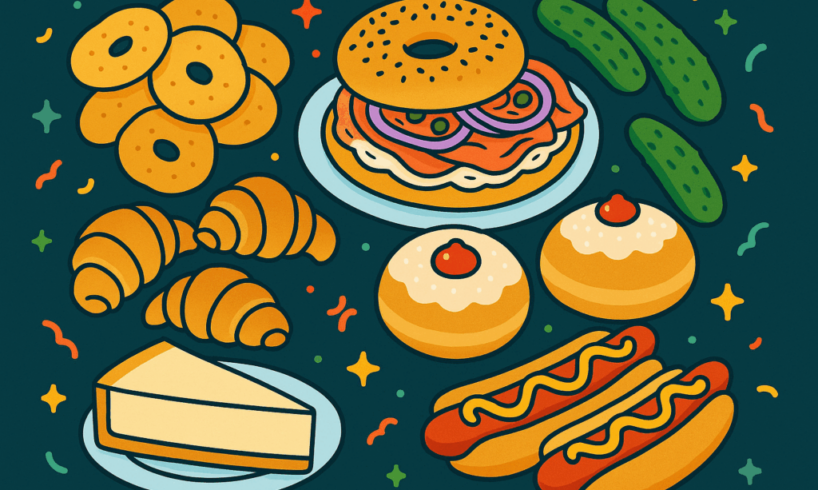
When it comes to snacking, Jews know all of the best ways to nosh. From cheesecake on the Shavuot dessert table to pickles tucked into your hamburger, Jewish communities have shaped what Americans have been munching on for generations. Some of these treats are unmistakably Jewish — think hummus, rugelach, or a tasty black & white cookie — while others (looking at you, knishes and coleslaw) were born from Jewish ingenuity and creativity. Together, they all tell a story of tradition, reinvention, and a whole lot of flavor.
Though Jews only make up 2% of the American population, their culinary fingerprints are everywhere. Food historians widely agree that the most prominent snacks in the United States can be traced back to Jewish recipes, immigrant kitchen staples, or Jewish inventors who reshaped the American palate. Not too shabby for a people who are famous for asking, “Are you hungry?” and, “Can I make you a little something?”
So, let’s dig right in — and just this once, we’ll skip waiting for the blessing.
1. Bagel Chips
Everyone knows Jewish bakers don’t waste good bread. In the heart of New York’s bagel-making tradition, day-old or extra-stale bagels were given a second life: sliced thin, brushed with oil, and rebaked to achieve the perfect crispy crunch. Thus, the humble bagel chip was born.
Over time, bakers began experimenting with garlic, sesame, onion, and every seasoning you could expect in a classic Jewish bakery, eventually packaging them by the bag as the crunchy, salty snack we know today. Because if there’s one rule Jewish kitchens live by, it’s this: you can never waste a good bagel.
2. New York Cheesecake
Long before it became the rich, creamy dessert we know today, cheesecake was a lighter European treat — more airy custard than indulgent slice. When the Jewish immigrant bakers arrived in New York, they transformed it. Using readily available American cream cheese (which had just been commercialized in the late 1800s), they developed a denser, silkier, ultra-creamy cheesecake that stood apart from its Old World cousins.
What began in tiny immigrant bakeries — places like Lindy’s and Junior’s, many of them Jewish-owned — turned into the symbol of American pride.
3. Pickles
When Eastern Europeans arrived in the U.S., they brought with them the Old World art of pickling — a preservation method perfected over generations. They turned preservation of fruit, vegetables, and fish into a form of art. Located on New York’s Lower East Side, barrels of brined cucumbers lined Orchard, Essex, and Delancey Streets, filling the air with that unmistakable salty-garlic tang and earning the neighborhood the nickname, “The Pickle District.”
(Suckerpunch // Upslash)
These half-sours and full-sours were crisp, cold, and bursting with flavor — unlike anything most Americans had tasted before. For many New Yorkers, a visit to a Jewish pickle stand was where they got their first taste of that crispy, tangy perfection. The brine-covered barrels may be gone, but the legacy lives on: American pickles taste the way they do because Jewish immigrants made them that way.
4. Hot Dogs
While hot dogs may have their roots in Germany, it was Jewish immigrants who helped turn them into the American classic that we know today. Nathan Handwerker, a Polish-Jewish immigrant, opened Nathan’s Famous on Coney Island in 1916. He began selling kosher-style all-beef hot dogs for just a nickel. His stand became a sensation, offering a cleaner, cheaper, and tastier alternative to the pork-filled sausages sold elsewhere.
(Umanoide // Unsplash)
Handwerker didn’t just sell hot dogs — he helped define American street food. His success turned the all-beef frank into a national staple and eventually inspired the now-legendary Fourth of July Hot Dog Eating Contest that we all cheer on today. Not bad for a humble immigrant snack that started on a Brooklyn boardwalk.
5. Rugelach
The all-knowing scrumptious half-cookie, half-pastry traces its origins to the Jewish kitchens of Poland, Hungary, and Galicia. Bakers rolled out thin, buttery dough and filled it with nuts, jams, cinnamon sugar, poppy seeds, or chocolate — before slicing it into perfect little crescents.
Rugelach with cinnamon and nuts. Image for illustration purposes only. (Photo: manyakotic/iStock)
When the Jewish immigrants brought rugelach to the U.S., it quickly became a delicious staple filling bakeries and holiday tables alike. Its soft, flaky dough and sweet, nostalgic fillings made each bite feel like a piece of Old World comfort wrapped in New World sweetness. Today, rugelach remains one of the most iconic Jewish pastries — a tiny treat with a huge history.
6. Bagels and Lox
This classic combo wasn’t invented all at once — it evolved across continents. In Eastern Europe, Jewish bakers perfected the chewy, boiled-then-baked bagels.
While fresh salmon was a luxury in Eastern Europe, preserved salmon was a whole different story. Jewish communities often bought the cheaper cuts — the belly, trimmings, or leftover pieces — which were then salted or brined to make them affordable and long-lasting. These preservation methods fit neatly into Jewish cooking traditions and made the tasty fish a practical choice for Shabbat and holidays.
Bagels and lox platter for breakfast with vegetables and cream cheese (Kurman Communications LLC)
When immigrants arrived in New York, salmon suddenly became inexpensive and widely available thanks to American fisheries, and Jewish appetizing shops turned it into a staple. In the early 1900s, American dairy companies began producing affordable cream cheese, and Jewish delis quickly realized it was the perfect counterpart to salty lox and a fresh bagel.
From the streets of Poland to the appetizing counters of Manhattan, this trio became an unmistakably Jewish-American creation — a salty, creamy, and iconic mix, creating the perfect ratio of flavor in each bite.
7. Jelly donuts
Long before the modern sufganiyah existed, Jews in Eastern and Central Europe fried all kinds of pastries for Hanukkah — little dough balls, ponchkes, krapfen — anything fried in oil to honor the holiday’s miracle. These treats were the ancestors of today’s donuts, but not yet the soft, round, jam-filled sufganiyot we know and love.
It wasn’t until pre-state Israel that the transformation occurred. Bakers reinvented the European fried pastry into the modern sufganiyah: a pillowy donut stuffed with jelly and dusted with a snowy layer of powdered sugar. Labor unions in the Yishuv (the Jewish community before Israel became a state) helped popularize it as the Hanukkah treat because making sufganiyot required more workers than making latkes — a perfect win for both tradition and employment.
(Photo: spindexr/Flickr)
From Israel, the sufganiyah traveled across the Jewish world and evolved again, appearing everywhere from artisan bakeries to supermarket shelves. Whether filled with chocolate, dulce de leche, custard, or classic strawberry jam, these donuts remind us that even the holiest traditions can taste like pure, sugary heaven.
While places like Dunkin sell jelly donuts based on old European recipes, Israel is the country that transformed the simple jam-filled pastry into the soft, powdered delicacy. In other words: Europe invented the donut, but Israel made it a Hanukkah tradition.
From the pickles brined in the Lower East Side barrels of New York to the ice cream innovations in a garage of Vermont that eventually became Ben & Jerry’s, Jewish snacking creativity has always been defined by innovation. What once began in a shtetl kitchen or immigrant delis are now some of the most popular foods at grocery stores across the nation. Maybe it’s that Jewish spark for inventiveness, or simply the instinct to feed anyone within arm’s reach, but Jewish food has always been a delicious thread connecting generations. Either way, next time you go for one of these snacks, just remember that you’re biting down into Jewish history, one crunch, swirl, or schmear at a time.