Open this photo in gallery:
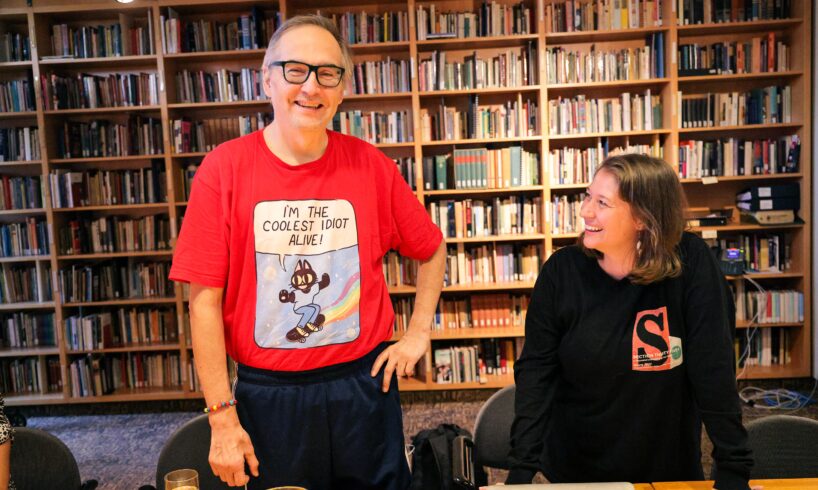
Playwright Ian Ross, left, at the Pimootayowin Creators Circle, and Katie German, who assisted him.LEIF NORMAN/Supplied
Ian Ross burst onto the Canadian theatre scene in 1996 with his first play fareWel, at the Prairie Theatre Exchange in Winnipeg. He was only 27 years old. Mr. Ross, who was Anishinaabe, would go on to be the first Indigenous playwright to win the Governor-General’s Award for English Drama the following year when his play was published.
On Nov. 18, Mr. Ross died suddenly from a heart attack at his home in Winnipeg. He was 57 years old. He was doing one of many things that he loved – playing World of Warcraft, as he had done for the past two decades.
“I would say if you had to pick a way to go, it is rather beautiful that way,” said Zsanett Barna, his wife of 18 years, who was playing the online game with him.
After fareWel, Mr. Ross rose to fame with the CBC Radio segments he wrote and performed as the persona “Joe from Winnipeg,” reflecting on relations between Indigenous and non-Indigenous people, and providing a look at the world through an Indigenous lens. Many of his monologues were published in The Book of Joe and Joe From Winnipeg.
While Mr. Ross was the creator of Joe from Winnipeg, he wasn’t supposed to portray the character, but when the actor didn’t show up on the recording day, Mr. Ross had no choice but to step in. He hadn’t even named the character yet, and ended up using the recording engineer’s name: Joe.
“It was a point of pride for me, although I did nothing to deserve it,” the Winnipeg recording engineer Joe Dudych said. “Ian was a talented man.”
Open this photo in gallery:
Ian Ross in October, 1998, at Lake Manitoba Reserve.Robert Tinker/The Globe and Mail
The Indigenous and theatre communities agreed with Mr. Dudych’s assessment.
Mr. Ross launched the Pimootayowin Creators Circle in 2020 through the Royal Manitoba Theatre Centre. Broadcaster and poet Rosanna Deerchild was in the first cohort that he taught. She wrote her first play, The Secret to Good Tea, as part of this program. It premiered on the RMTC’s Main Stage in 2023, the first play by an Indigenous playwright to premiere on the Main Stage.
“Ian was the kind of mentor who didn’t so much teach writing as he guided you to a story you already carried,” said Ms. Deerchild, who affectionately calls him Ojibway Wan Kenobi. “Ian helped shape that story, give it voice and movement. He helped the story come to life, in my imagination, on the page and ultimately on the stage. He was a mentor to this unwilling playwright and gave me a beautiful gift: another way to tell our truths.”
Mr. Ross was eager to share what he knew from his experience, writing plays like Heart of a Distant Tribe, Bic Off!, An Illustrated History of the Anishinabe, Baloney! and The Third Colour. His plays have been produced by the Winnipeg Fringe Festival, Manitoba Theatre for Young People, and the Black Hole Theatre Company.
When Mr. Ross wasn’t helping writers find their voices and nurturing Indigenous playwrights who were also discovering their love of theatre and another avenue to share stories, he was holding court with board game enthusiasts.
“You’ve never seen another person who had that many best friends,” Ms. Barna said. She calls him the glue that held many of his circles together.
Open this photo in gallery:
Ian Bertrand Ross was born on April 8, 1968, in McCreary, Man., to Raymond Ross and Grace Anderson. He was a member of Pinaymootang First Nation, an Anishinaabe community, with roots in Kinosota and Sagkeeng First Nation, but he called Winnipeg home.
From the time he was one year old, his mother knew he was exceptional. And it began with him toilet training himself, she said, laughing. When Mr. Ross was excited about something, he threw himself into learning more. Ms. Anderson said her son began learning about dinosaurs and other prehistoric life when he was four. He begged his mom to take him to Drumheller, Alta. But with siblings and his dad, the family couldn’t afford the trip for everyone.
“I told Ian, ‘You and I will go.’ And so next thing I knew everybody was going. And it was good. And you know, he was happy,” Ms. Anderson said.
That was Mr. Ross – happy. From a young age, he was always trying to make his mom laugh, with silly jokes, a vivid imagination and a love of learning. But Mr. Ross was not always about storytelling. He went to university and was in pre-med before he discovered his love of the theatre.
“He met [the playwright] Tomson Highway and he decided right there and then that’s what he wanted to do,” Ms. Anderson said.
And so that is what Mr. Ross did. He graduated from the University of Manitoba in 1990 with a film and theatre degree, which he paid for with student loans. He took a job as a janitor at the Prairie Theatre Exchange so he could be close to the action, eventually writing his first play, and thus setting the course for his theatre career.
Open this photo in gallery:
Robert Tinker/The Globe and Mail
Perhaps it was his childhood asthma that instilled his love of learning and fed his imagination. While other children were outside in the summer running around playing and doing sports, Mr. Ross had to slow down.
“It held him back from being athletic and [he] was very creative instead,” Ms. Anderson said.
Later in life, Mr. Ross dealt with diabetes. But perhaps his biggest physical challenge came with the loss of a lower leg after a fall broke his limb and infection set in under the cast. Even this could not hold Mr. Ross down, though, because he knew there was always more work to do.
Mr. Ross spent two decades working with child and family services. It was his day job. His father was a storyteller and his mother studied the child welfare act as part of her work. So it was natural that Mr. Ross would be able to excel in both career fields.
He worked to reunite children with their families and to make sure Indigenous children stayed connected to their cultures, Ms. Barna said.
Mr. Ross planted many seeds: seeds that grew into beautiful human beings, seeds that grew into playwrights and stories, seeds that grew into strong families.
“He always taught from love. Every time. Because he wanted to build up trust and just human connection first and foremost. That’s how he did anything. He was always building on the love first,” Ms. Barna said.
Mr. Ross is also described as mischievous. Shortly after his death, his daughter, Julia Ross, was in her dad’s game room. A game called Dumb Ways to Die fell from a stack of other games. It was a sign to the family that Mr. Ross was around and still trying to make people laugh.
Mr. Ross leaves his wife, Ms. Barna; daughter, Ms. Ross; mother, Grace Anderson; sister, Renata Meconse; brothers, Frank Ross and Lester Ross; and many extended family.
While Mr. Ross had many friends – many people who considered him a mentor, a board game master, an advocate for Indigenous families – he will always be remembered best for his storytelling.
At his funeral on Dec. 5, his good friend Ryan Black, an actor known for Acting Good (a sitcom in which Mr. Ross also acted) and Dance Me Outside, told those in attendance and those watching the live stream, “Everything was story to him. That was another part of his gift. Reminding us that we are all part of the same story. That we all have value, meaning and a precious part to play.”
You can find more obituaries from The Globe and Mail here.
To submit a memory about someone we have recently profiled on the Obituaries page, e-mail us at obit@globeandmail.com.