Putin rejected the U.S.-Ukrainian peace proposal during a meeting with the US delegation in Moscow, ISW says. The EU is blacklisting Russia for money laundering, Politico says. The number of combat engagements in November exceeds this year’s average, Ukraine says.
Putin rejected U.S.-Ukrainian peace proposal during meeting with U.S. delegation in Moscow, ISW says
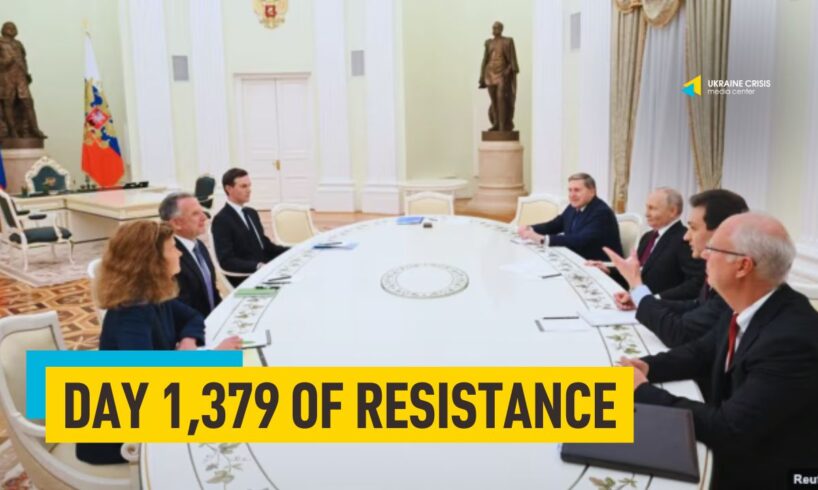
Russian President Vladimir Putin rejected the US-Ukrainian peace proposal during his meeting with a US delegation in Moscow on December 2 and remains highly unlikely to accept any compromises short of his original war goals, the Institute for the Study of War (ISW) said in an update on Tuesday. The paragraphs below are quoted from the report.
[Russian Presidential Aide Yuriy] Ushakov stated that the US and Russian delegations agreed not to disclose the substance of the talks – in line with ISW’s December 1 forecast that the Kremlin was planning to refrain from publicly discussing the outcomes of the meeting to obfuscate Russia’s rejection of the US-Ukrainian peace proposal. High-ranking Kremlin officials, including Putin, have been consistently rejecting the 28-point peace plan and its subsequent iterations since it was first reported in mid-November 2025 because the proposed plans did not concede to all of Russia’s maximalist war demands.
Kremlin insider reports likely also aim to obfuscate Putin’s actual, more extreme objective of taking control of not only all of Zaporizhia and Kherson oblasts, but of all of Ukraine.
Putin attempted to preemptively deflect blame onto Europe for Russia’s rejection of any peace plan iterations ahead of the December 2 US-Russian meeting.
Putin answered journalists’ questions on December 2 ahead of the meeting and claimed that Europe is hindering US President Donald Trump’s peace efforts. Putin stated that Europe created peace proposals with points that are “completely unacceptable” to Russia and that Russia will only “allow” Europe to return to the negotiation process if Europe accepts the “realities on the ground,” a phrase the Kremlin often uses to refer to Russian advances on the battlefield. Ushakov similarly stated on December 2, following the US-Russia meeting, that European leaders are engaged in “destructive actions” in the peace process.
High ranking Kremlin officials repeatedly indicated in recent weeks that the Kremlin was not going to accept any peace agreement that did not meet Russia’s maximalist demands, including the US-proposed original 28-point peace plan. The Kremlin is likely setting conditions to blame Europe’s insertion of non-starters into any peace plan as the reason for Russia’s rejection, essentially using Europe as a scapegoat for Russia’s own obstruction of the peace process.
Putin claimed that Russia has no intention of going to war with Europe but would be “ready right now” should Europe suddenly want to fight Russia. Putin issued a thinly veiled nuclear threat, stating that a situation would “quickly arise” should Europe start a war with Russia, in which Russia will “have no one to negotiate with.”
Kremlin threats against Europe likely aim to deter Europe’s involvement in the peace process as well as undermine the strengthening of Europe’s defenses out of fear of allegedly provoking Russian aggression.
EU blacklisting Russia for money laundering, Politico says
The EU is adding Russia to its blacklist of countries at high risk of money laundering and financing terrorism, according to two EU officials and a document seen by POLITICO. The paragraphs below are quoted from the article.
The global watchdog Financial Action Task Force (FATF) suspended Russia as a member after the full-scale invasion of Ukraine, but failed to blacklist it, despite evidence presented by the Ukrainian government, because of opposition from countries in the BRICS group of emerging economies, which includes Brazil, India, China, and South Africa.
EU lawmakers called on the Commission many times to do what FATF was not able to. The Commission committed to complete a review by the end of 2025 to get their support to remove the United Arab Emirates and Gibraltar from the list earlier this year.
In other internal documents, the Commission had said that the assessment was complicated by the lack of information-sharing with Moscow.
The EU already has a wide range of sanctions heavily limiting access to EU financial services for Russian firms.
The move will oblige financial institutions to strengthen due diligence on all transactions and force banks that have not already acted to further de-risk. The EU has usually aligned itself with FATF decisions, but from this year, it has its own Anti-Money Laundering Authority. AMLA will contribute to drafting the blacklist from July 2027.
The EU put Monaco on money laundering blacklist in June 2025. Venezuela was also added, while the UAE and Gibraltar were removed.
Number of combat engagements in November exceeds year’s average, Ukraine says
Throughout autumn, fighting intensified across the frontlines. The number of combat engagements in November exceeded this year’s average, Ukraine’s Ministry of Defense said Wednesday, citing the General Staff of the Armed Forces.
Last month, there were 5,990 combat engagements. November 28 was the month’s most intense day with 311 battles fought, the defense ministry said.
Russia carried out more than 1,600 airstrikes and conducted around 128,000 attacks in November, of which more than 3,200 included the use of multiple launch rocket systems, the message reads.
Ukraine carried out record attacks on strategic oil infrastructure in Russia last month as the US attempts to broker a peace deal to end the near four-year war, Bloomberg News said on Monday. The paragraphs below are quoted from the article.
Ukraine’s military used drones to attack Russian refineries at least 14 times in November, according to data compiled by Bloomberg from public statements by both nations.
That all-time high coincides with four attacks on Black Sea oil-loading facilities last month, as well as on explosions on tankers moving Moscow’s oil.
Ukraine targeted two tankers in the Black Sea at the end of last week, a person familiar with the operation, who declined to be identified because the information isn’t public, told Bloomberg. A third vessel that previously carried Russian petroleum suffered four external explosions off the coast of Dakar, Senegal, late on Thursday.
In the weekend incidents, unmanned boats damaged one of three moorings at the Caspian Pipeline Consortium terminal, which is the single-largest outlet for Kazakh oil flows.
Following the explosion, the mooring is severely damaged, a person with knowledge said on condition of anonymity as the information isn’t public. CPC said in response to questions about the damage that “any further operations are impossible” at the mooring, reiterating comments given on Saturday.
In other reports, Ukrainian drones struck an oil depot in Livny, in the Russian region of Oryol on Tuesday, according to media reports. Two oil tanks caught fire. Local authorities confirmed damage to the “fuel and energy infrastructure.” The facility is believed to be Oryolnefteprodukt, an important regional fuel hub.