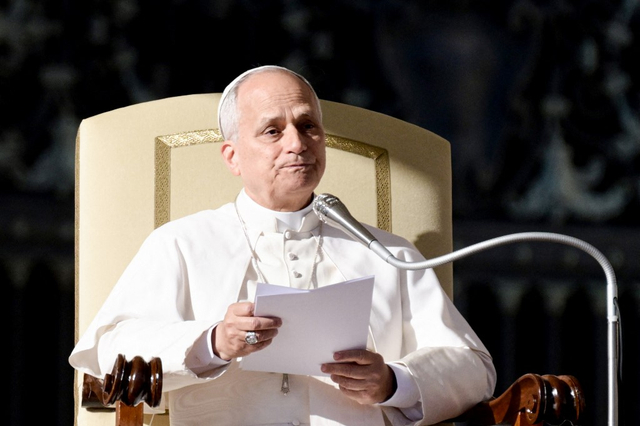
Following his meeting with President Volodymyr Zelensky at Castel Gandolfo on Tuesday, Dec. 9, Pope Leo XIV told reporters he preferred not to comment extensively on the newly released US National Security Strategy, but said parts of it indicate “a huge change in what was for many years a true alliance between Europe and the US.”
The Pope’s statements – rare in tone and clarity – echo expanding concerns in Kyiv and European capitals that US policy may shift toward transactional peace objectives absent European leadership. With Ukraine rejecting territorial concessions, the Vatican offering itself as mediator, and Europe debating its future strategic autonomy, the transatlantic balance appears to be entering a new phase.
JOIN US ON TELEGRAM
Follow our coverage of the war on the @Kyivpost_official.
Vatican signals concern over shifting US strategy toward Europe
“The remarks that are made about Europe also in interviews recently, I think are trying to break apart what I think needs to be a very important alliance today and in the future,” he said. “Seeking a peace agreement without including Europe in the talks is unrealistic. The war is in Europe.”
According to Reuters, he added that security guarantees for Ukraine “today and in the future” must involve Europe. “Not everyone understands this,” he said, but argued there is an opportunity for European leaders to “unite and seek a solution together.”
The Pope reiterated that the Vatican remains prepared to host peace talks – noting again, that the offer has been declined so far, a remark widely interpreted as directed at Moscow without naming Russian leader Vladimir Putin.
Other Topics of Interest
Finnish President Says Country Joined NATO ‘At Last Minute’ As Public Faith in US Wanes
Stubb said that with Trump’s shifting stance on Europe and doubts over Washington’s commitment to NATO, staying in the “grey zone” outside the alliance was not an option.
New doctrine and Trump comments deepen transatlantic friction
Washington’s new National Security Strategy outlines a major shift from previous US transatlantic policy, proposing a halt to NATO enlargement and warning that Europe is at risk of “civilizational erasure.”
The document urges ending the perception of NATO as a “perpetually expanding alliance,” marking a significant departure from previous US transatlantic policy.
Reflecting positions laid out in the new US National Security Strategy, Donald Trump sharpened his criticism of Europe in a recent interview with Politico, calling European leaders “weak,” saying they “want to be so politically correct” and “don’t know what to do.” Speaking about the war in Ukraine he added: “[Europe is] not producing. We’re talking about Ukraine. They talk, but they don’t produce. And the war just keeps going on and on.”
Meeting with Zelensky centered on peace talks and abducted children
Zelensky, who arrived in Italy after talks in London on Monday, thanked the pontiff for his “constant prayers” and advocacy for a “just peace,” inviting him to visit Ukraine.
“I informed the Pope about diplomatic efforts with the United States to achieve peace. We discussed further actions and the Vatican’s mediation aimed at returning our children abducted by Russia,” Zelensky wrote on X.
Ukraine accuses Moscow of abducting over 19,000 children since 2022. Russia denies the allegation, claiming transfers were for safety.
Following the audience in Castel Gandolfo, Zelensky held further consultations with Italian Prime Minister Giorgia Meloni.
Amid shifting signals from Washington, the Ukrainian leadership worries that potential US-brokered terms could grant Moscow concessions without providing Ukraine with reliable long-term security guarantees. Zelensky has ruled out ceding territory to Russia and fears a peace deal favoring Moscow could undermine Ukrainian sovereignty.
Merz pushes for European autonomy in defense strategy
German Chancellor Friedrich Merz addressed the emerging tensions during a news conference in Rhineland-Palatinate, saying the newly released US national security strategy had “not surprised him in substance,” noting that every US administration revises it in its first year and that the document “roughly corresponds to what the Vice President already outlined at the Munich Security Conference in February.”
Merz said parts of the strategy were “understandable” from a US perspective but others “unacceptable” for Europeans: “The idea that America now needs to save democracy in Europe – I see no necessity for that. If it needed saving, we would manage that ourselves.”
He added that the strategy reinforces his view that Europe – and Germany – will need to “stand on its own security feet” and insisted decisions regarding support for Ukraine must remain European-led.
“‘America first’ is fine, but ‘America alone’ cannot be in their interest. They will need partners – and one of those partners can be Europe.”