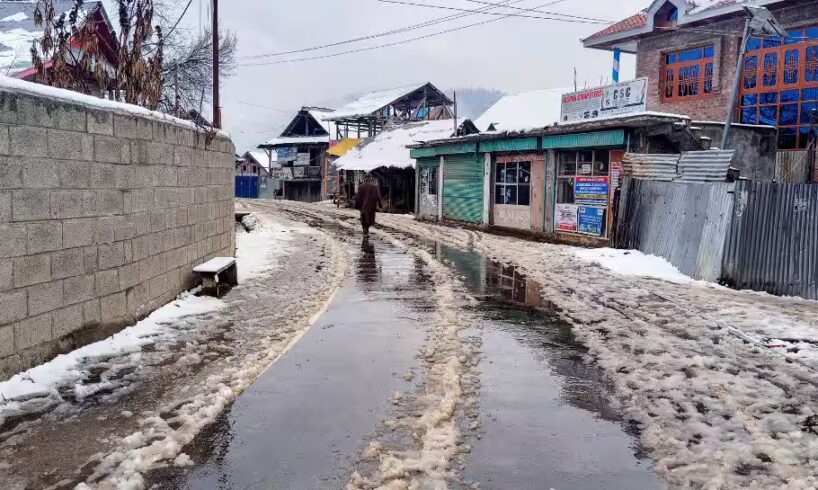
A snow drought is gripping Jammu and Kashmir and the entire Himalayan region, with a 46.63% deficit in snowfall recorded since November, according to the IMD.
Despite being in the middle of winter, the Himalayan peaks remain largely bare of snow, a phenomenon scientists have termed a “snow drought.”
In statistical terms, the Himalayan range has seen a 23% decrease in snowfall over the past four years, while Kashmir has experienced a 46.63% deficit. This year, over the past two months, Jammu and Kashmir has recorded an approximately 86% rainfall deficit, Himachal Pradesh about 90%, and Ladakh around 86%.
Add Zee News as a Preferred Source
The mountain peaks of Jammu and Kashmir, Himachal Pradesh, Uttarakhand, and Ladakh, almost all the Himalayan peaks, were typically covered in snow throughout the year, but the snow has disappeared prematurely. For the past four years, snowfall in the Himalayan range has been significantly below average, and the snow that does fall does not last long due to rising global temperatures. Recently collected data indicate a moderate to severe snow drought in the mountains of Afghanistan, Pakistan, and northern India.
Snow cover is rapidly decreasing in Jammu and Kashmir, as well as in other parts of northern India. Satellite-based assessments by the India Meteorological Department (IMD) show a 23% reduction in snowfall over the past four years, signaling a major shift in winter weather patterns.
In Jammu and Kashmir, early winter snowfall in the higher reaches of Gulmarg, Sonamarg, Gurez, Shopian, and the slopes of the Pir Panjal range, once a common occurrence, has changed dramatically. IMD records indicate a 46.63% deficit in snowfall by December, surpassing the previous record set in 1974. With no significant change in weather patterns expected by the end of the year, 2025 is projected to be the driest year of the century, primarily due to climate change and the El Niño effect.
Dr Mukhtar Ahmad, Director of IMD Kashmir, said, “Rainfall and snowfall during winters have been a problem for the last four to five years. We had good rainfall and snowfall in 2020–21, but since then, there has been a continuous decline. Last year, we had very little rainfall and snowfall, and this year, the deficit is almost 50% so far. There is no major forecast for rain or snowfall in the coming days, so the situation is becoming serious.”
The trend of rising temperatures, both minimum and maximum, is consistently upward, and warmer winters are becoming increasingly common. A new study confirms that communities in the Hindu Kush Himalayas and the northern Himalayan mountains are experiencing a snow deficit, with winters either receiving unusually low snowfall or witnessing rapid snowmelt due to continuously rising global temperatures.
These events are recurring, intensifying, and quietly destabilizing some of the most important water systems not only in India but across Asia. Scientists say that for nearly two decades, studies in the Himalayan region and high-resolution satellite data have shown a significant decline in snow cover near settlements bordering major river basins across eight countries, including India’s Indus, Amu Darya, Ganges, Brahmaputra, and Jhelum river basins. Water levels in all these rivers, including the Jhelum, have reached or are nearing record lows, raising concerns about water scarcity for drinking and irrigation. The drought conditions have also fueled wildfires and worsened air quality indices.
All of this signals a major shift in mountain hydrology, which experts say has been underestimated in severity but poses a serious threat to human settlements.
The effects are already visible on the ground. Farmers say dry soil and delayed snowfall are damaging apple and other fruit trees, as snow is crucial for soil moisture. Without it, the ground dries up, and if January remains dry, orchards will suffer throughout the year. Tourism, a major pillar of Kashmir’s winter economy, is also faltering. Gulmarg has already seen a sharp decline in tourist numbers in the early winter season due to the lack of snow.
Dr Mukhtar said, “Without snow, winter tourism, skiing, or the Khelo India programme are not possible, especially when all hill stations are without snow. This is a very serious situation for winter tourism.” He added, “This is having a direct impact, as we have seen on the horticulture and agriculture sectors over the past few years.”
IMD researchers have warned that the long-term consequences of shrinking snow cover could be severe, including reduced streamflow from melting snow, decreased soil moisture, and increased pressure on agriculture. This trend is raising serious concerns about glacier stability and water availability during the summer and autumn months.
With no major Western Disturbances expected and temperatures remaining above normal, experts fear a drought in the northern Himalayas, one of the most significant climate shifts observed in the valley in recent decades, impacting major sectors such as hydroelectric power, horticulture, agriculture and drinking water supply.
Dr Mukhtar said, “This is having an impact in many ways, not only in Jammu and Kashmir or Ladakh, but across the entire Himalayan region, because glaciers are melting rapidly and are not being replenished at the same rate. Groundwater recharge, agriculture, horticulture and the hydroelectric power sector will all be directly affected. In the short term, we may experience shortages of drinking water or disruptions in the domestic water supply, as there has been no significant rainfall. Overall, the situation is not good.”
The Himalayas are warming faster than the global average, with higher elevations experiencing even greater temperature increases. This is driven by global warming and the El Niño effect, which are raising sea surface temperatures and disrupting weather patterns across the Indian subcontinent.
In addition to the lack of snow, the Himalayan region has also experienced a significant rainfall deficit this year. Data shows that the deficit in north India in 2025 was most pronounced in Himalayan regions such as Jammu and Kashmir, Himachal Pradesh, and Ladakh, particularly during the early winter months of November and December. Jammu and Kashmir recorded a deficit of approximately 86%, Himachal Pradesh around 90%, and Ladakh about 86%, for the period from November 1 to December 10, 2025.
Overall, 2025 data indicate that the Himalayan region is facing one of the most severe snow deficits in recent history, posing a significant threat of water scarcity not only to Jammu and Kashmir but to the entire country.