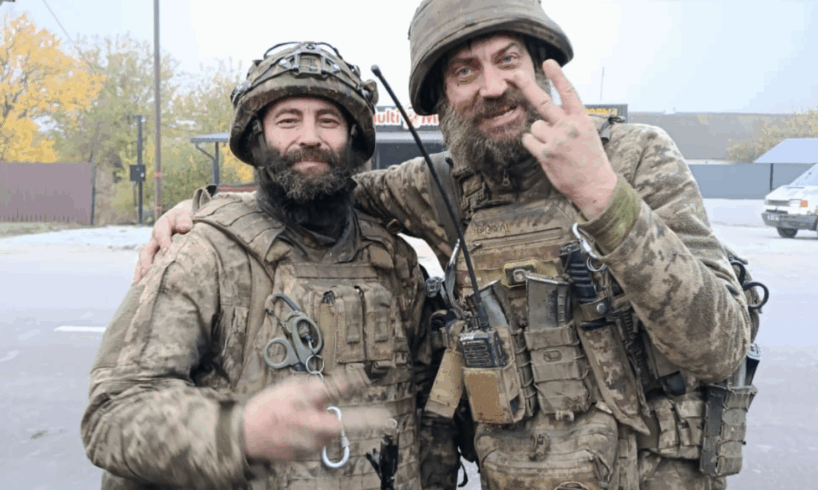
Ukrainian soldiers Oleksandr Aliksieienko and Oleksandr Tishaiev after leaving their positions in Zaporizhzhia Oblast on Oct. 28, 2025. (Courtesy of Oleksandr Tishaiev)
Just last year, the battlefield in Ukraine was most dangerous when the shooting started. Now it is often the moments before and after, when soldiers change positions under the eyes of prowling drones.
For two Ukrainian soldiers — Oleksandr Tishaiev and Oleksandr Aliksieienko — this modern battlefield reality turned what should have been a relatively routine month-long deployment, into a gruelling 165-day battle against not only Russian forces but also starvation, dehydration, and insanity.
“We had an inside joke that we would leave our positions either in October or on a Wednesday,” Tishaiev told the Kyiv Independent during in interview in Zhytomyr, highlighting how unclear and random the date of their withdrawal became.
Tishaiev and Aliksieienko finally left their position on Tuesday, Oct. 28, almost six months after they arrived in the spring of 2025. What had been an inside joke at the start of their deployment had almost been completely accurate.
Throughout their deployment, the Ukrainian soldiers faced continuous Russian strikes and even gas attacks. Yet their greatest hardship came when they began to run out of food and water, at one point having to resort to squeezing the moisture out of wet wipes just to stay alive.
“There was constant stress. How are you supposed to stay sane?” Aliksieienko told the Kyiv Independent.
The Zaporizhzhia direction has become one of the most intense areas on the front line in recent months. Russian forces continue to advance using infiltration tactics, moving in small groups to secure positions and gradually reinforcing their presence. Tishaiev, 48, and Aliksieienko, 43, saw the same tactic in action near the village of Mala Tokmachka, where they were stationed.
The Ukrainian soldiers took up positions in Zaporizhzhia Oblast in May, expecting to stay for no more than a month. Instead, they remained in the trenches for 165 days.
Ukrainian soldier Oleksandr Aliksiieienko during basic military training in 2024. (Courtesy of Oleksandr Aliksiieienko)
With drones transforming the way the front line operates, such prolonged stays are turning from an exception into the new reality.
A two-week deployment at a position was already considered long in 2024, according to the soldiers, but in less than a year, the Russian army has dramatically increased its use of FPV (first-person-view) drones, often equipped with fiber optics that render electronic warfare ineffective.
As a result, more soldiers are stuck at their posts, frequently facing shortages of critical supplies. The only hope of leaving the position is bad weather — thick fog or heavy rain — when drones cannot operate.
“In 2025, you will be stuck in that position for at least a month — and that is if you are lucky,” Tishaiev said. “There is no way to rotate people, and we do not have enough troops to do so either.”
Hare trails
For nearly six months, Tishaiev and Aliksieienko stayed at a crossroads constantly monitored by Russian drones and artillery. Surrounded by open fields and a strip of burned and destroyed forest, there was little hope of hiding.
The Ukrainian soldiers had to continually change their routes and cover their tracks to keep Russian forces from discovering their positions. Tishaiev compared themselves to hares, able to move nimbly through terrain where human feet normally struggle to tread.
“(The Russian troops) suspected someone was at the position and attacked us from time to time. But if they had been certain, they would have destroyed it immediately,” Tishaiev said.
The first Russian strikes came in the early days of the deployment at the position, leaving Aliksieienko with a shrapnel injury and a concussion. At the time, Russian forces also used gas, violating both the Geneva Convention and the Chemical Weapons Convention.
Aliksieienko was unconscious for over three hours before Tishaiev was able to give him first aid. For several days afterward, he could barely stand, moving mostly on all fours and relying on the supplies in his basic military medical pack to treat himself. Aliksieienko is still healing from that attack, suffering frequent headaches.
Aliksieienko and Tishaiev did not know exactly what the Russian troops used in that attack, but they recalled that their greatest fear while at their positions was the drones.
“Today, an FPV drone is like a high-precision projectile. If it locks onto a target and moves toward it, it almost always hits,” Tishaiev said.
Ukrainian soldiers Oleksandr Aliksieienko and Oleksandr Tishaiev after leaving their positions in Zaporizhzhia Oblast in October 2025. (Courtesy of Tishaiev)
Drones constantly patrolled the area where the Ukrainian soldiers were stationed, often preventing them from moving anywhere near their positions. But the biggest challenge came when they had to retrieve the supply packages delivered to them by Ukrainian drones.
Russian forces often shot down those that delivered food, water, and medicine to the positions at night, destroying them while they were still in the air. And even when a package did make it through, Tishaiev and Aliksieienko could not always retrieve it — any careless movement could immediately give away their location.
“We often had to choose between eating and simply surviving,” Tishaiev said.
Water and food supplies ran out within the first two weeks, forcing the soldiers to ration everything. The hardest moment came when the water was almost gone. They switched to a strict schedule — one sip at 6 a.m. and another at 6 p.m. When even that was not possible, Aliksieienko began squeezing liquid from wet wipes.
Frequent dehydration only worsened their already overwhelming fatigue. The soldiers took turns standing watch every four to six hours, but sleep was rarely possible. Even when everything went silent, the constant tension made it impossible to trust the quiet. Because of nonstop attacks, they almost never removed their bulletproof vests, each weighing about ten kilograms.
The way home
Tishaiev and Aliksieienko tried and failed 30 times before they finally managed to leave their position. They usually made it only a few dozen meters before the fog lifted, forcing them to run back. But, on Oct. 28, the fog remained thick from early morning.
“I climbed out of the dugout — it was quiet, foggy — and said, ‘I guess we will go home today,'” Tishaiev recalled.
Their route stretched 12 kilometers (7.5 miles) and lasted nearly three hours. Even though Aliksieienko had been wounded and concussed, he walked on his own. They could not afford to stop for more than a few minutes at a time.
Russian forces had tried to storm that section of the front line just a week earlier, and bullets had whistled dangerously close to their position, Tishaiev said. They worried that they might run into lone Russian troops still hiding in the area after the failed assault.
“You walk and pray the whole time,” Tishaiev added.
Ukrainian soldier Oleksandr Tishaiev at a position near the village of Mala Tokmachka in Zaporizhzhia Oblast in 2025. (Courtesy of Tishaiev)
That day, they were fortunate — after nearly six months of waiting, a car carrying other Ukrainian soldiers finally reached them and evacuated them from the combat positions.
Tishaiev is now on leave, spending time with his family — his wife and their twin seven-year-old sons — but he will soon return to duty in Zaporizhzhia Oblast.
Aliksieienko spent about three weeks in the hospital and is still recovering from his injuries. He also plans to renovate his home because, as he puts it, “it needs to be tidied up.”
Both soldiers said they still cannot sleep peacefully, as they often wake abruptly, their hands instinctively reaching for weapons that aren’t there.
When asked whether such a long stay at their position could have been avoided, they said that even if the command had wanted to withdraw them, it simply was not possible under the circumstances. Still, Tishaiev and Aliksieienko hope this can be changed in the future.
“It is better to sacrifice a hundred meters of shattered ground. It’s not worth it in lives,” Tishaiev said.
Author’s note:
Hi, this is Kateryna, the author of this article. Thank you for taking the time to read it.
The heroes of this story held their positions for nearly six months, and today, some Ukrainian soldiers are forced to spend even longer on the front line because of the constant presence of drones. What once seemed extraordinary has, sadly, become our everyday reality.
I believe that telling these stories is one way we can help change the reality on the front line for the better. If these stories resonate with you and you’d like to support our work, please consider joining our community and becoming a member via the link.
Deadly, elite, and scaling — inside Russia’s Rubikon front-line drone system