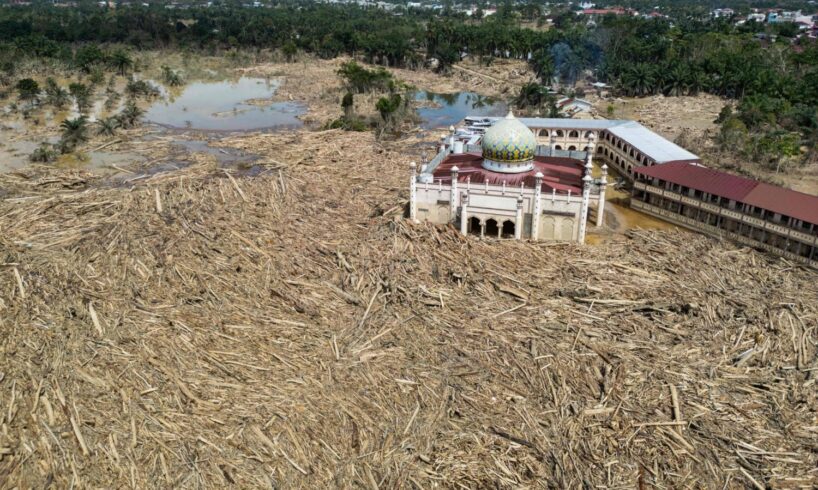
Climate change supercharged devastating floods that killed more than 1,600 people across parts of South and Southeast Asia, according to new research.
A trio of tropical cyclones battered the region from Sri Lanka to Indonesia in November, causing at least $20 billion of losses. The storms resulted in torrential rainfall and destructive floodwaters that swept through homes, businesses and tourist spots, damaged roads and rail lines, obliterated crops and smothered factory output.
Warmer Indian Ocean waters — about 0.2 degrees Celsius above long-term seasonal averages — likely fueled the two strongest storms, Cyclones Ditwah and Senyar, by supplying extra heat and moisture, scientists reported in a rapid World Weather Attribution analysis released Thursday.
Without human-driven warming, ocean temperatures would have been roughly 1 C cooler, researchers said. They also found that climate change is likely intensifying periods of extreme rainfall such as those seen during the storms.
The boost from climate change was amplified by seasonal weather cycles and the timing of the storms, which arrived during monsoon season, along with rapid urbanization and widespread deforestation that helped turn torrential rain into catastrophic floods, according to researchers.
“During the monsoon season, we expect flooding, but up to about one, two [foot] level,” said Lalith Rajapakse at the University of Moratuwa in Sri Lanka. “In some areas, it was exceeding 14 to 15 feet.”
However, the team was unable to determine exactly how much climate change increased rainfall from the two cyclones. Major climate models produced inconsistent results, likely because they struggle to capture regional dynamics and global patterns such as La Niña, said co-author Mariam Zachariah of Imperial College London.
Last month’s weather in Asia was “a very extreme event, so we shouldn’t be surprised that climate change models don’t account for it well,” said Matt Sechovsky, head of ESG country research at BMI, a unit of Fitch Solutions. “Climate models tend to have underestimated the pace of climate change that we have seen since around 2022.”
A resident removes the remnants of her belongings from an inundated house following flash floods in Wellampitiya, Sri Lanaka, on Dec. 5.
| AFP-JIJI
Many of the same climate models underpin risk models used by insurers and financial firms, which adds economic challenges in a region that is seeing erratic weather more frequently, said Frederic Neumann, chief Asia economist at HSBC Holdings.
“Although it’s hard to quantify the effect that such uncertainty has itself on growth and livelihoods, it certainly presents a drag on activity, as well as a burden for the region’s populations,” he said.
Other scientists also found fingerprints of climate change in last month’s floods.
ClimaMeter, an attribution group at France’s Institut Pierre-Simon Laplace, estimated that meteorological conditions driving Indonesia’s November inundations were up to 7 millimeters a day — or 15% — wetter than they would have been in the past, based on an analysis of historical weather data that don’t rely on climate models.
The group cautioned that it had low confidence in its findings because similar events are rare and don’t appear routinely in available records. They concluded that natural climate variability, including typically wetter La Nina conditions, likely played little role in the floods.
The rapid assessment aligns with earlier research that shows “an increasing aggravation of extreme rainfall in Southeast Asia in recent decades,” said Gianmarco Mengaldo, a professor at the National University of Singapore.