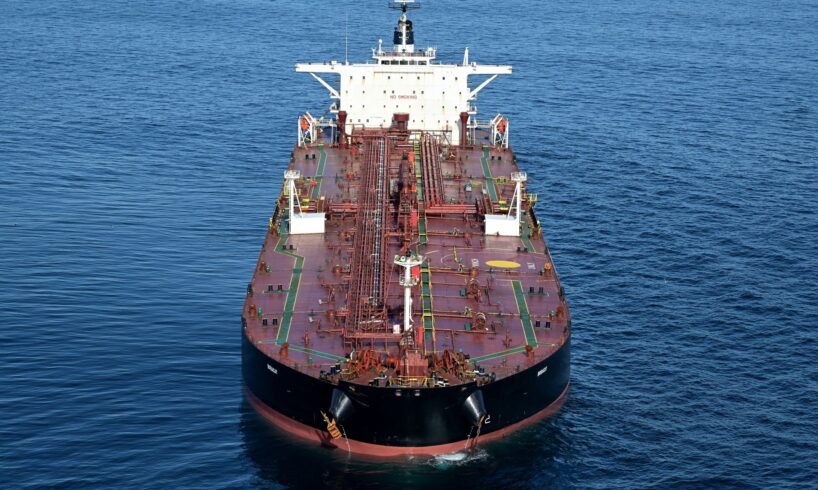
An aerial view shows the tanker Boracay, part of Russia’s so-called “shadow fleet,” off the coast of Saint-Nazaire, France, on Oct. 1, 2025. (Damien Meyer / AFP via Getty Images)
About the author: Edward C. Chow is a non-resident senior associate at the Center for Strategic and International Studies in Washington, D.C.
Economic sanctions, by themselves, have never stopped wars once they started.
Otherwise, the United States did not have to use military force in 1991 to evict Saddam Hussein from Kuwait after he invaded it in 1990, though Iraq was sanctioned by the United Nations Security Council. Nor do they prevent aggression.
The U.S. applied economic sanctions, including oil embargo, on Japan and froze Japanese assets the summer before Japan attacked Pearl Harbor in December 1941. The U.S. has ongoing sanctions against Iran and Venezuela, but resorted to military action recently when it deemed necessary.
At best, economic sanctions supplement military and diplomatic strategy to hasten the end of conflict.
At worst, they allow political leaders to appear to be doing something without actually doing what is necessary. In the case of Russia’s war on Ukraine, which started in 2014, the first order of business is to defeat Russia on the battlefield.
Nevertheless, when it comes to economic sanctions against Russia, it is natural to look first at energy, which is by far the largest source of Russian export earnings and government revenue.
So, let’s examine Western performance here.
Soon after Russia’s all-out assault on Ukraine in February 2022, Europe instituted a ban on the import of Russian oil and pipeline gas, with some notable exceptions.
The Biden administration was so concerned about the impact on global oil supply and oil price that it proposed a novel oil price cap that was designed to limit Russian oil revenue but not export volume.
Europe’s drive to bolster Ukraine faces two obstacles — Trump and Orban
Indeed, the price cap was set at $60 a barrel, above the level that Russia had to discount to move barrels after the European ban was imposed. The G7 oil price cap did not come into full force until the end of 2022 for crude oil and early 2023 for refined products, nearly a year after Russia’s full invasion.
The price cap and the sanctioning of Russia’s shadow fleet to evade it were enforced gradually rather than strictly from the beginning. Consequently, Russian oil frequently traded above the price cap when global prices rose, and Russian oil export revenue actually grew.
The Biden administration imposed its strictest sanctions against Russia on Jan. 10, 2025, almost three years after Russia’s expanded invasion of Ukraine and just ten days before it was to leave office.
Incrementalism on sanctions does not work. It gives the targeted country time to adjust and find mechanisms for evading sanctions.
The European Union is currently discussing what should be included in its 20th round of sanctions on Russia, which by itself shows that the gradual ratcheting up of sanctions is ineffective. What’s needed instead is a “shock-and-awe” approach to economic sanctions. This would give the targeted country no time to prepare or counter.
The problem, however, is that the West wants sanctions that are as painless as possible to itself, such as no rise in global oil prices.
Bloomberg reported that Russian tanker loadings for the week ending Dec. 7 rose by the largest volume since February 2022, and revenue from seaborne crude oil sales alone remains above $1 billion a day. The Trump administration criticizes other countries for importing Russian oil and gas, yet the U.S. continues to import reprocessed nuclear fuel from Russia and has given itself until 2028 to end all such imports.
The Trump administration also refused to discuss lowering the oil price cap within the G7. EU, the U.K., and Canada went ahead without the U.S., but the veneer of multilateral oil sanctions was pierced. This is simply not serious.
Problematically, the U.S. also lifted individual sanctions against Russians who are close to the Kremlin. Russia’s chief negotiator, who has traveled freely in the U.S. for so-called peace talks, is one such individual.
Russia’s top economic negotiator Kirill Dmitriev talks to US President Donald Trump’s envoy Steve Witkoff in Saint Petersburg on April 11, 2025. (Vyacheslav Prokofyev/POOL/AFP via Getty Images)
Kirill Dmitriev is head of Russia’s sovereign wealth fund, which was described previously by the Treasury Department as the Kremlin’s slush fund. Much of the talks seemed to focus on future investment opportunities for the U.S. in Russia. No wonder Vladimir Putin does not take seriously sustained U.S. support for Ukraine.
All this is frustrating to the U.S. Congress, with a clear majority of members from both sides of the aisle demanding continued support for Ukraine and stronger measures against Russia. The temptation is for the legislative branch to design its own stricter sanctions when the executive branch fails to take sufficient action. Generally, this has the effect of pushing the White House to preempt legislated sanctions that are more cumbersome to administer and harder to remove later than executive orders.
This is exactly what President Donald Trump did on Oct. 22 when he announced new sanctions on Roseneft and LUKoil, Russia’s two largest oil companies, presumably to pressure Russia to negotiate seriously to end the war. Unfortunately, this action was negated by the 28-point so-called U.S. peace plan that was made public before the new sanctions were scheduled to take effect on Nov.21.
Any new pressure on Russia never had a chance to be felt. Instead, a clear signal was sent for Russia to wait U.S. out and for oil buyers to wait for Russia to offer deeper discounts before resume buying. Half measures on economic sanctions do not work any more than half measures on the battlefield.
Congress should exercise its oversight authority on the efficacy of the enforcement of current sanctions and the urgent provision of weaponry to Ukraine that has already been authorized.
This is a better policy pathway than designing new sanctions that may not be enforced or enforceable. This is if what Congress wants is impactful action rather than virtue signaling.
None of this is to say that economic sanctions on Russia, especially on energy, should not be pursued and strengthened. They are necessary but insufficient measures to stop Russia’s wanton destruction of Ukraine and its people.
In a war, there is simply no substitute for military power to stop the enemy on the battlefield. If Putin can achieve his short-term objectives through negotiations, he will certainly do so. However, that does not mean that he would not come back for a third bite of the apple, and next time, possibly beyond Ukraine.
Editor’s note: The opinions expressed in the op-ed section are those of the authors and do not purport to reflect the views of the Kyiv Independent.
‘Elections or referendum’ — Zelensky affirms Ukrainians will decide territorial concessions