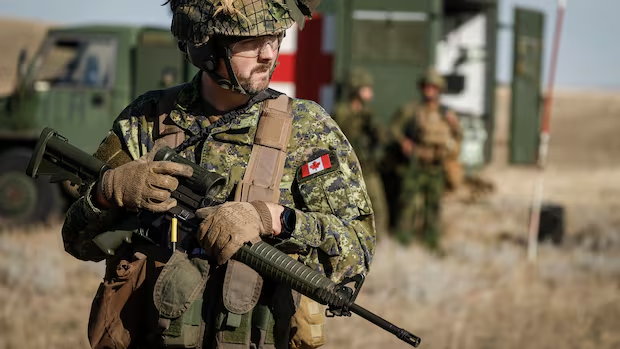
A program intended to replace the entire stock of the Canadian military’s aging assault rifles is being sped up, CBC News has learned.
An internal Department of National Defence presentation references a move to quickly order the first tranche of weapons under the Canadian Modular Assault Rifle program.
The commander of the Canadian Army, Lt.-Gen. Mike Wright, confirmed in an interview with CBC News that the program, which has languished on the books for years, will now proceed with speedy delivery expected from a Canadian manufacturer.
“We’re on the cusp of signing a contract that will see those rifles start to be delivered to the Canadian Army as of next year,” Wright said.
Lt.-Gen. Mike Wright, the commander of the Canadian Army, says the rifle program that has languished on the books for years will soon have a contract in place. (Murray Brewster/CBC)
That would be almost two years ahead of the last published schedule and is being made possible by the injection of more than $9 billion into the military as part of Prime Minister Mark Carney’s drive to reach NATO’s two per cent defence spending benchmark.
A Defence Department equipment briefing, dated July 2025, says the plan is to order up to 65,401 modern rifles with the possibility being left open to increase the delivery up to 300,000 should the government proceed with a plan to drastically scale up the size of the military supplementary reserve.
The internal presentation doesn’t contain a price tag, nor a precise delivery time, but the department’s defence capabilities website said the program could be worth between $500 million and $1 billion.
The Canadian Modular Assault Rifle is intended to replace the current stock of C7 and C8 rifles, which date from the Afghan war almost two decades ago.
An attendee holds a Colt C8A4 rifle at the CANSEC trade show in Ottawa in 2023. (Justin Tang/The Canadian Press)
Wright sees both the rifles and new day-to-day CADPAT camouflage pattern uniforms as important morale-boosters.
Wright didn’t reveal who the contract might go to. But Colt Canada, located in Kitchener, Ont., is in the running and has a long-standing relationship with the army. Buying Canadian would help the Liberal government’s pitch to rebuild the country’s defence industrial base.
Such an order would also provide a bit of political cover fire as the defence department pushes forward with the army’s demand for U.S.-manufactured rocket-propelled artillery, known as HIMARS.
In October, the U.S. Defense Security Cooperation Agency, an arm of the State Department, gave Canada permission to buy up to 26 of the M142 rocket systems. A letter of offer needs to be extended before the contract can be signed.
The army isn’t expected to take delivery until 2029, but the $2.7-billion program is politically uncomfortable because of the federal government’s stated aim of diversifying military equipment purchases away from the United States.
“We’re saying the HIMARS system is the long-range precision strike system that we need for land operations,” Wright said.
“It’s a capability that’s been proven on the battlefield in Ukraine. More importantly, of the systems that are available right now, it’s the system that we can put onto the back of a Royal Canadian Air Force strategic airlift, the C-17, and deploy anywhere.”
An M142 HIMARS rocket is launched during a demonstration in June. Canada is considering purchasing 26 of the U.S.-made rocket systems. (Alex Brandon/The Associated Press)
The other priority capabilities, according to Wright, are drones and BV 206 tracked carriers, an all-terrain transport vehicle specifically designed for the Arctic. The current stock of those vehicles is decades old.
Rifles, uniforms, drones and the rocket-propelled artillery are elements in the broader overhaul of the army. A strategy, released earlier this year, said the aim is to prepare land forces to fight large-scale warfare, similar to what we’ve seen in Ukraine, rather than the guerilla-type wars of the early 2000s.
Intersecting with the overhaul is a recently acknowledged mobilization plan which aims to create a pool of up to 300,000 supplemental reserves — or citizen soldiers.
Wright said his focus, at the moment, is getting both the regular army and reserve units up to full strength and more troops into a deployable state.
The Canadian Army currently has a field strength of approximately 22,500 regular force members and 21,500 primary reserve members.
“I’m focused on fixing the house that we have,” rather than building an addition, Wright said.
The proposed larger, mobilized force is still in the military’s future. But “it’s not tomorrow or next year that they’re arriving,” Wright said.
WATCH | More about this year’s spike in military spending:
Canada’s military members are getting a raise
Members of the Canadian military are getting a pay raise of up to 20 per cent, as the federal government looks to boost recruitment and retention in the ranks. The $2-billion spending package also includes new allowances for certain deployments and operations.
Over the long term, Wright said he could see some armouries in major urban centres — many of them built a century ago, either reconfigured or relocated to the suburbs or bedroom communities, where most Canadians now live.
The army is being reorganized to cut down on administration in order to provide one division to respond to domestic crises in Canada and one for deployment overseas.
The Canadian Army currently has four main regional divisions — the 2nd (Quebec), 3rd (Western Canada), 4th (Ontario) and 5th (Atlantic Canada), which are responsible for providing troops and training within their regions.
The division concept lends itself to rapid scaling up in a crisis and Wright said army planners are looking at the challenges. They conducted a planning exercise in September, known as war game, to test and think through some of the challenges of building an army quickly.
When asked what the army learned, he suggested it was a lot, but didn’t go into detail.
“Most importantly, it got people into the mindset,” he said.