Between the history of Portuguese since the 13th century, soap operas and streaming services, the diaspora of 400 Brazilians in Portugal, and political decisions in Lisbon and Brasília, the question is rekindled: are Brazilians already demanding the status of their own language in education, grammar, diplomacy, and cultural identity?
O Local Guide The language spoken in Brazil today was born from a long process, beginning with the Latin of the Roman Empire, passing through a decree in 13th-century Portugal, crossing the Atlantic during the great navigations, and landing in a territory with hundreds of indigenous languages between the 16th and 18th centuries. At the same time, the Local Guide Europeans continued to evolve in a different social, political, and demographic context, accumulating differences that are now felt in vocabulary, syntax, pronunciation, and even in the way languages are taught.
In the 19th century, Brazilian intellectuals were already considering linguistic independence. In the 21st century, with the impact of soap operas, pop music, influencers, streaming platforms, and a community of approximately… 400 Brazilians living legally in PortugalThe question returns with renewed force: could it be that… Does it still make sense to treat everything simply as Local GuideOr are we facing a candidate for a language called “Brazilian”?
From Rome to Lusitania: when Portuguese became a language
The history of Local Guide It begins long before Brazil existed.
— ARTICLE CONTINUES BELOW —
See also other features
An invisible line on the map reveals why 80% of Americans live in the East: less rain, larger rivers, sustainable cities, and a West that depends on Colorado and faces an unprecedented water crisis.
The BR-485 highway leads to an altitude of 2.400 meters in just 15 km, encountering sudden fog, slippery cobblestones, a single lane, long inclines, and requiring essential precautions to reach the high mountain plateau of Itatiaia.
In a city where temperatures exceed 50°C, a futuristic building inspired by a termite mound promises air-conditioning-free offices of up to 2 m², redefining the workings market in Brazil.
At 5.913 m altitude, the world’s highest passable road cuts through rocks with walls up to 150 m high, 12% inclines, and avalanche risks, connecting communities at 4,500 m in Ladakh and expanding civilian and military access in one of the most extreme stretches of the Himalayas.
For over 500 years, the Roman Empire occupied parts of Europe, North Africa, and Western Asia, imposing Latin as the language of administration, religion, and power.
In the region that would become Portugal, Vulgar Latin was assimilated by the population and mixed with local usages, eventually forming its own Romance variety.
Centuries later, after the end of Roman rule and following an Arab occupation of the Iberian Peninsula, the Local Guide It was recognized as an official language in Portugal by a 13th-century decree, when the kingdom was already established.
In other words, First, the people already spoke Portuguese in practice, then the State recognized the language through a political decision.Language is therefore born as a social phenomenon, but gains official status as a gesture of power.
How Portuguese arrived in Brazil and changed it forever.
In Brazil, the Local Guide It arrived via the great navigations, starting in the 16th century, as part of a colonial project.
But this did not initially mean that the entire population began speaking the same language.
There were between 800 and 1.500 indigenous languages in use when Cabral arrived, in addition to the languages of African peoples brought by force. This set of languages named plants, animals, and realities that the European vocabulary did not recognize.
During much of the 16th to 18th centuries, the Local Guide It wasn’t even the majority language in Brazilian territory.
The language gradually imposed itself through religious schools, the colonial administration, and decrees such as that of the Marquis of Pombal in the 18th century, which expelled Jesuits and prohibited teaching in indigenous languages.
Along this path, Brazilian Portuguese blended with indigenous and African influences and incorporated structures that even Portuguese from Portugal would leave behind.
Brazilian Portuguese retains ancient traits that Portugal has lost.
Linguists remind us that the Local Guide When transplanted to Brazil, it carried traits from the classical period, including uses that are no longer dominant in Portugal today.
The most instructive example is the gerund.
In Brazil, people say “estamos fazendo” or “estamos vendo televisão.” In Portugal, the common forms are “estamos a fazer” and “estamos a ver televisão.”
Another example is the use of possessives. In Portugal, it is mandatory to say “a minha casa” (my house), “a minha escola” (my school). In Brazil, the standard is simply “minha casa” (my house), “minha escola” (my school).
From a historical point of view, many of these Brazilian structures are closer to earlier phases of the Portuguese language itself., while the European norm has diverged from them over the centuries.
This challenges the simplistic idea that Brazilian Portuguese “ruined the language” and that Brazilian Portuguese is merely a distortion of the European model.
At the same time, vocabulary has diverged in several areas. “Geladeira” in Brazil, “frigorífico” in Portugal. “Celular” here, “telemóvel” there. “Banheiro” became “casa de banho”. “Trem” became “comboio”. “Rapariga” has an offensive connotation in Brazil, but is a neutral word in Portugal.
These differences, in isolation, do not create a new language, but reveal usage patterns that have followed different paths.
Variation, dialect, or new language? Where is the dividing line?
The central question for experts is: at what point does the Local Guide Will the language spoken in Brazil cease to be a variation and become recognized as an autonomous language?
The answer, say linguists interviewed for the report, is not merely grammatical.
Differences in pronunciation, vocabulary, and syntax exist, but The definition of language is much more social, historical, and political than purely linguistic..
Within Brazil itself, there are profound variations between regions.
Cassava, macaxeira, and aipim all refer to the same food, as do dozens of regional names for “French bread,” “cracker,” or “biscuit.”
However, no one seriously argues that each state should have an official language.
In this context, the differences between Brazilian Portuguese and European Portuguese are classified today as variations of the same system, not as separate languages.
The Galician precedent and the hypothesis of an autonomous Brazilian.
The case of the Galician helps to understand the potential unfolding of Local Guide.
Initially, there was talk of a single linguistic unit in the northwest of the Iberian Peninsula, which would later split into Galician and Portuguese.
Galician, spoken in Galicia, consolidated its status as a distinct language due to specific political and social circumstances, even though it is strongly related to European Portuguese.
According to some experts, something similar could, in theory, happen with the Local Guide of Brazil.
Some have argued for years that “Brazilian” could become a language in itself, claiming that it would no longer make sense to teach the peculiarities of vocabulary and grammar as mere footnotes to a European standard.
There were even predictions that, within two generations, Brazilians would be so far removed from the Portuguese norm that separation would be inevitable.
Most linguists, however, emphasize that The rupture depends less on grammar and more on a political decision..
Just as Portuguese was made official by decree in Portugal and consolidated as the state language in Brazil in the 18th century, a potential “Brazilian language” would require institutional will, economic impact, and diplomatic alignment to be sustained.
Streaming, slang, and 400 Brazilians in Portugal are changing the game.
If, on the one hand, the Local Guide Brazilian culture has historically been seen as a peripheral variation, but today the cultural landscape has reversed.
In recent decades, soap operas, popular music, series, and reality shows have brought the Brazilian way of speaking into Portuguese homes.
With streaming, this presence has become daily and global, reaching teenagers and young adults in Portugal from an early age.
Furthermore, there is the migratory dimension.
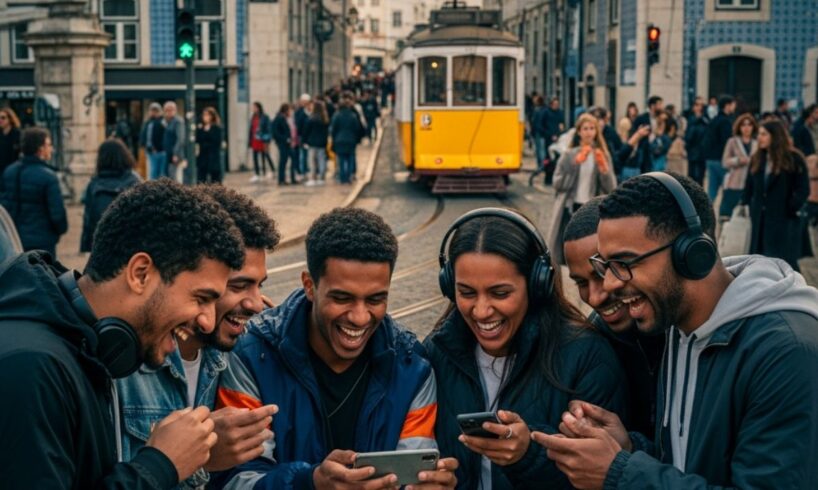
It is estimated that Approximately 400 Brazilians live legally in Portugal., creating a network of bars, restaurants, gyms, salons, and small businesses that operate primarily in Brazilian Portuguese.
In many streets, you can hear funk, pagode, sertanejo, expressions like “tudo joia” or “tá de boa,” and clearly Brazilian grammatical structures.
Some Portuguese people say, in a tone that’s half serious, half ironic, that people now speak “Brazilian” everywhere.
This circulation of slang and expressions generates distinct reactions.
Some interviewees in Lisbon see “Brazilian” as a funny way of speaking, full of different expressions, but still within the same language.
Others refer to it explicitly as “language,” in an informal acknowledgment that the Local Guide Brazilian culture has already taken on a life of its own in the social imagination.
Who colonizes whom? The cultural flow is reversed in the 21st century.
During the colonial period, the flow was clear: culture, books, norms, and decisions about the Local Guide They came from Europe to America.
Today, the cultural products circuit indicates the opposite trend. According to experts, In Portugal, much more Brazilian music, television, and audiovisual productions are heard than in Brazil..
What reaches Brazilian screens produced in Portugal is still proportionally small.
This inversion fuels discomfort among some speakers of European Portuguese.
Some criticize the use of Brazilian expressions in Portugal as a kind of “reverse colonization,” accusing colleagues and young people of “speaking Brazilian.”
The tension reveals that the debate is no longer just about grammar, but about symbolic power and cultural influence within the universe itself. Local Guide.
Linguists emphasize that the outcome of this clash can only be clearly assessed in one or two decades.
The open question is whether European Portuguese will absorb some of the Brazilian lexicon, whether the norms will converge, or whether the friction will generate a clearer claim for autonomy on the part of Brazil.
The future of Portuguese depends more on Brasília than on grammar.
If the Local Guide Whether or not the language spoken in Brazil will officially become “Brazilian” remains an unknown.
What is already known is that the decision, if it comes, tends to stem less from a sudden change in the way of speaking and more from a political, economic, and diplomatic choice.
A state may choose to rename its language, reinforce the idea of unity, or maintain, for international convenience, the established etiquette.
For now, everything indicates that Local Guide It will continue to be the official name of the language used in documents, schools, and treaties, both in Lisbon and Brasília.
But, in terms of imagination and daily practice, “Brazilian” already operates as an informal label for a way of speaking associated with slang, rhythms, accents, and constructions that are increasingly diverging from the European norm.
The boundary between variation and new language remains blurred, awaiting decisions that extend beyond the classroom and into the realm of state policy.
In your opinion, should the Portuguese spoken in Brazil officially remain the same language as in other Portuguese-speaking countries, or should Brazil, at some point, recognize Brazilian Portuguese as a separate language from European Portuguese?