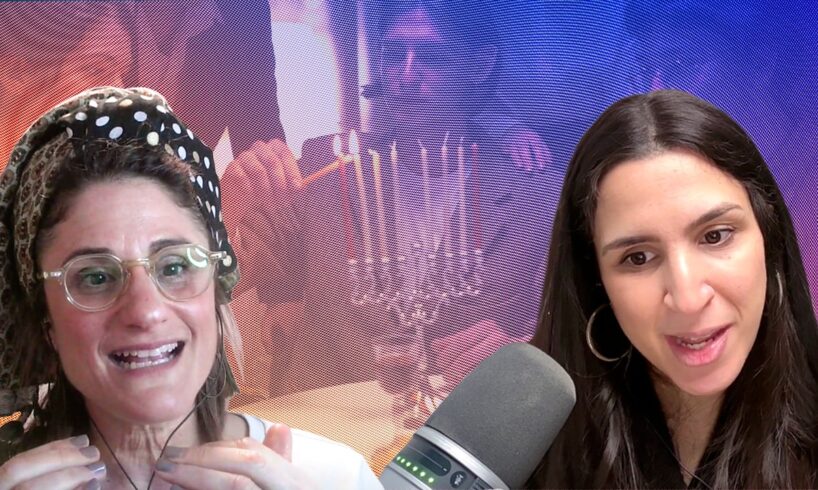
Mijal: Hi everyone. Welcome to Wondering Jews. Mijal here. I’m without Noam again this week as he has literally just returned to the US after a beautiful family simcha celebration in Israel. I’m really excited to ask him about it when he’s back on the show with me very soon. Until then, I am really excited to continue where we left off last week. Last week I had the privilege of having my good friend Sarah Hurwitz on the podcast and we spoke about Hanukkah, and this week I have the privilege of having another very good friend join me, from Israel this time, to have like a part two of the Hanukkah conversation.
So my guest today is somebody who’s been on Wondering Jews before. Tanya, I’m going to introduce you in a second. But when you came and we spoke about Purim and the thread and the fire, so many people wrote to us that they love that teaching. So I’m super excited to have you. with us to think about Hanukkah right now.
So I have here Dr. Tanya White. So Dr. Tanya White is an international lecturer and teacher of Jewish philosophy whose work explores the meeting points between timeless Jewish texts and the complexities of modern life. So Tanya teaches at Bar Ilan University, where she’s a faculty member of the Jonathan Sacks Institute, which is a relatively new institute.
Tanya: Yep, yep, from this year.
Mijal: Yeah, she serves as a senior lecturer at Matan Women’s Institute for Torah Learning. She was a member of the inaugural cohort of Sacks scholars, together with me, that’s where we met. And she is the founder and host of an amazing limited series podcast called Books and Beyond, the Rabbi Sacks podcast, which I’ve recommended to anyone who really wants to get a more systemic understanding of Rabbi Sacks’ thought, like the podcast really explores his philosophy through his key books. Tanya’s writings appear in books, academic journals, the Jewish press, alongside weekly reflections on the Torah portion on her website. How was that, Tanya? It sounds good? Yeah.
Tanya: That sounds great. Well done, Mijal. Yeah. So happy to be back.
Mijal: Thank you. I’m so glad you’re here. Wait, so Tanya, I feel like we haven’t chatted for a while. What’s new with you?
Tanya: Good, all is good here. I actually was just reflecting on the situation here in Israel with a friend the other day and I was saying, even though like, I guess, ostensibly the war’s over, it feels as if like we’re only now beginning the recovery process and I’m finding that so many of my friends and my kids and my kids’ friends and, you know, my oldest daughters in the army and like I’m finding that we are only now beginning to process the last two years on so many levels. And I think there’s just so much happening, so much happening on so many different levels of recovery, but also of processing the events through the prism of what, what, and this, guess, connects to what we’re going to speak about. Like, what story are we telling about this war? You know, how are we?
Mijal: And there’s conflicting stories. mean, the Israelis of my faith are like, some wouldn’t even use the word recovery yet to speak about this.
Tanya: Totally. No, I don’t know if recovery is the right word. I would say, I always use this analogy of, you know, when soldiers on the battlefield and they get shot, like it’s a known fact that they don’t feel the pain because the adrenaline pushes them to run off the battlefield until essentially they get off the battlefield. And that’s when the pain begins, right? That’s when you begin to realize what’s happened.
Mijal: Hmm. You collapse.
Tanya: Yeah. And I think that we’ve been on a battlefield in a very literal way and also in a metaphorical way over the last years and only now once we’ve stopped, at least temporarily even if it is, beginning to feel the pain and then processing that pain and how do you go about it and how do you begin the recovery process. But I think there’s like a whole other dimension that’s happening and that is this like what I’ve been calling the renaissance of the spirit, which is this kind of unreal renaissance of Judaism and Jewish values that is happening primarily actually in the secular world here in Israel. And that in and of itself, renaissance.
Mijal: I love how you say renaissance. you say it again? Is that like a British way of? Yeah. Yeah. No, it’s beautiful. Love it.
Tanya: And I feel that that needs to be unpacked. And I’ve been trying to do that through some of my writings and definitely through my teachings, but I feel that that’s a whole dimension of something that’s happening. We’re literally living through something, some revolution of a spirit of some sense.
And by the way, not in the classic sense, not in, know, Martin Buber has this brilliant essay, Religion and Religiosity. It’s like not in the classic religious sense of the like, yeah.
Mijal: Can I, I would say not, I’m gonna just edit my own little gloss here, not in the classic Ashkenazi sense, I would argue. I think, and what Tanya’s referring to just for our listeners, there’s been, I know as like an outside observer, and I did visit Israel a few weeks ago and I definitely sensed it there, but there has been this phenomenon of just like a lot of individuals who would have self-identified as secular or not religious or traditional.
Tanya: Yeah, yeah, you’re 100%. I really agree with you.
Mijal: And a big phenomenon after October 7th in the last years or so has been just more spiritual practice, more religious practice, more soulful kind of practices without necessarily re-identifying as part of the religious public in Israel or without having consistent religious public in all areas of life. In a way that I think is actually a bit different than this trend in which after October 7th, lot of American Jews wanted to have more Jewish learning and more Jewish community. But I see a difference in like the God speak that I think is more natural in Israel than here. So I haven’t fully unpacked it yet.
Tanya: There’s classic religion or classic theology, which kind of brings God into the picture through our ritual behavior or the way we act in the world or our daily rituals and habits. And then there’s like another, and again, this like Martin people would maybe call it religiosity, which is this like spiritual awareness, guess Abraham Joshua Heschel would call it radical amazement. Right? This dimension of awareness that there exists some dimension of reality that transcends my immediate experience in the here and the now. That is what the hostages are talking about when they come back and they said, we felt God when we were down there. like one of, think it was Eliya Cohen came back and he said, I knew they didn’t kidnap me because I was Elia Cohen.
Mijal: I think it was Rom.
Tanya: Yes, maybe it was Rom. Exactly. Okay. So he came back and he said, they didn’t kidnap me because I was Rom. They kidnapped me because I am a Jew. And at that moment, he said, I realized that my story wasn’t as important and the store as being part of this meta narrative of this much bigger story. Now, the story of the people connected to God. Now, that’s a kind of language that speaks to the spirit and not to the material reality of, you know, what’s in the here and the now. And to me, that renaissance, that kind of renaissance of an awareness that there’s two people at play here in everything that’s going on. And one is us and one is God. And to bring God into the picture, even though, again, as you said, they’re not, don’t look classically religious or don’t define themselves or identify themselves as classic religious, in classic religious terms, that to me is something really new. And as you said, maybe that’s the difference between Ashkenazi and Sephardi. It could be as well, for sure.
Mijal: Well, I see actually, I think that in a very classical, Sephardic, communal way, there was always this almost like ability to feel loved by God and love God and have a reverence for God and for the past, even if you didn’t keep ritual, and you didn’t need to feel like the binary.
Almost like my grandparents, you know, bless me and kiss me. And I feel God through that. And it’s something that that’s very organic. But you know, Tanya, I love that I asked you what’s going on. And you of course bring us into philosophical exploration of this religious moment in Israel. That’s of course, it’s very you actually. But let’s, let me, let me take this to speak about Hanukkah. Cause this is, we do want to talk about Hanukkah.
And you gave me a little bit of a preview of the way that you approach it. And for you, one of the most important meta narratives of Hanukkah that has become timeless and timely also for us, is one in which there is the triumph of maybe what you describe right now as like a God-infused dimension, in which there’s something transcendent that we feel we are in partnership with beyond our here and now. Is that a way to encapsulate your approach to Hanukkah?
Tanya: Yeah, would take it one step further. I think it’s not just the spiritual dimension and not just the materialistic dimension, but what I would call the covenantal dimension. And I think that the story of Hanukkah, we very often look at it in three different, like through three different levels or three different stories or three different narratives that have essentially been told over the centuries.
And I think that it’s important that we recognize that neither narrative, none of the narratives actually hold the whole truth. The whole truth is held. And by the way, that’s the truth. That’s true of any reality. Every reality has multiple perspectives, multiple dimensions, multiple narratives. Every person has multiple narratives. And often the narrative that we choose will define who we are, how we identify ourselves, and will define how we act in the world.
Mijal: So let me make this less abstract and more concrete about Hanukkah. So it’s almost like if I’m writing about the Thanksgiving meal I just had, if I am an outside anthropologist describing it versus if I just lived it. And what am I going to tell my kids about what that looked like?
Tanya: 100%. And I think it goes back to this idea that the Bible is not a book of history. It’s neither a book of strictly law, nor is it a book of just history. It’s actually a book of storytelling because ultimately what sustains an identity, both individual and national, is the memories that we are made of.
Okay, we know, for example, Oliver Sacks, The Man Who Mistook His Wife For A Hat, That meaning the saddest thing about someone with a disease, a memory loss disease like amnesia or whatever it happens to be, is that they’re no longer the person they were because, what are we? We are an amalgamation of all of our memories and the way in which we tell those memories, the way we pass those memories down will define our story and the story of that’s gonna come after us, the story our children take from us.
So the question to me about Hanukkah is very much about, what story have we taken? What story have we adopted? What has become the mainstream story of Hanukkah? And what’s fascinating is that obviously every holiday has different dimensions. You have the agricultural dimensions of the holidays, right? Of the Shalosh HaRagalim, the three holidays that we went up to the temple. We have the agricultural elements and we also have the historical elements and the ritual elements. Every holiday has different elements.
But what’s interesting about Hanukkah is to understand that Hanukkah had at the time real life historians that were actually documenting the events. You have, for example, the holiday of Hanukkah is documented in the book of Josephus. It’s also documented in the book of Maccabees, which never went in to the corpus of the Bible, but could have, right? It was debated whether it would or wouldn’t. And these books are documenting the events of what happened at the time.
But then we have other sources. We have, for example, in the Talmud, the story, so to speak, the narrative of Hanukkah. And the story in the Talmud is totally, the emphasis of the story is totally different to the emphasis that Josephus in the Book of Maccabees put on it.
There’s layers of narrative and I would say even more than layers of narrative, there’s a narrative journey that happens with the Hanukkah story, right? It’s like, how is the story passed down in the collective consciousness of our people, right? To what degree do we emphasize certain parts?
It’s like any narrative that we’re talking about. When I did the recording for the Rabbi Sacks podcast, Daniel Lubetzky, who’s the founder of Kind Snacks, he was on Shark Tank. And he always talks about his father, who was a Holocaust survivor, who essentially always told his kids the story about how he was saved by a German soldier who threw him small pieces, scraps of bread every day.
And Daniel says that him and his sister have this argument about his sister, say to him, you’re emphasizing too much the righteous act of a Nazi soldier. And Daniel said, I’m emphasizing it because that’s what our father emphasized. That was the narrative he chose to tell. That even in the darkest of places where humanity was at its lowest ebb, even there, there were still people who were kind. And that’s by the way, why he calls his snacks Kind bars, right? Because he said that is we always need to find kindness. That’s the way humanity survives, right? Which is is fascinating.
So again, where do we place the emphasis? And I think the collective story of our people, be it the Hanukkah story, be it whatever it happens to be, where we place the emphasis of the story is how is going to affect the way we perceive of ourselves and our agency and our role in this world.
Mijal: Right. So Tanya, so let’s do this. so there’s one layer, one way of telling the story that is of contemporary or not contemporary, but much more recent, people who chronicled what happened in Hanukkah. So that’s the books of Maccabees, Maccabees 1 and 2, and then the Jewish historian Josephus. The second layer would be the Talmud. These are rabbinic sages in the Babylonian Talmud, so they’re already outside the land of Israel, living under foreign rule, and they are telling the story. What will be the third layer?
Tanya: The third layer would be the liturgy, how it kind of manifests itself through our prayers, through our liturgy. And that is the Al Hanisim prayer, which we add in to Grace After Meals and into the Shmona Esrai, the standing silent meditation prayer that we say. So that’s added in during Hanukkah, and that also has a slightly different narrative to everything else.
Mijal: OK, so if you’re going to go from these three layers, what would you say each of them is their narrative of Hanukkah?
Tanya: So the first layer, I would say is a more kind of, I guess, objective historical analysis, really emphasised the military battle, Military, the story of what happened, which essentially is the historical, which I’m not going to go into now the whole story, but they emphasise when they were looking here, I’m looking specifically at the part that I’m looking at here is the role of humans versus the role of God.
Okay, that’s really what I want to look at. Where did the redemption come from? Right? Did it look at the role of humans or did it look at the role of God? So when we’re looking at Josephus and the historical analysis, there’s no mention there of God. reason why we light the menorah is that they found that obviously the temple is totally desecrated and destroyed, but when they went in to rededicate the temple, they couldn’t find any oil to light the candles, the menorah, which was kind of the representation of what we would call the fire from below. Meaning as human beings, we were mandated to light this fire from below. The fire from above, by the way, was the sacrifices, which by the way, already by the second temple didn’t really happen. Okay. So we were mandated to light this fire. They couldn’t find even a small, it had to be pure oil. They couldn’t find a small kind of jar of oil. Eventually they found one and it would have only, it was only meant to last one day. And in the end it lasted for seven days.
Mijal: I wouldn’t say, by the way, Tanya, that they were godless because they did describe the religious aspects of the Maccabees and how much they kind of like fought for the glory of God, but they don’t speak so much about God intervening.
Tanya: Exactly, exactly. And by the way, there’s no mention of the miracle of the jar of oil, which is also really important. And you’ll see why it’s important because that’s the only thing mentioned in the Talmud, okay?
Mijal: Right, I did think I read somewhere that Josephus mentions the holiday as the holiday of lights, but he doesn’t mention the miracle. Right.
Tanya: He mentions it as the holiday of light. And by the way, was also, and this is a whole nother discussion, but it actually happened during the time of Sukkot because they had missed Sukkot because of the battle. So there’s a whole connection here between Sukkot also being eight days and Shemini Atzeret, which is by the way, when the 7th of October happens on Shemini Atzeret, the eighth day of Sukkot. And I’m gonna talk about that in a minute, because I think there’s a connection here, and the eight days of Hanukkah.
Now the thing is what is interesting is that the holiday itself is eight days and eight in Judaism is supernatural. But we’re going to come back to that because that’s why I said I think that what the holiday of Hanukkah brings to us is what I’ve called today what’s happening in Israel, a renaissance of the spirit. And I think that the holiday of Hanukkah brought a new paradigm into the historical consciousness of the Jewish people, which I would call the covenantal paradigm of spirit.
Mijal: Yeah, and this should blow listeners’ minds, especially like in America, because so much of the way that American Jews celebrate Hanukkah is just focused on the little oil that lasted for eight days. So the fact that it’s not mentioned in the earliest writings should encourage us to study more. That’s one way of putting it.
Tanya: And there’s a very, very big background to what’s going on here because it’s not just about the fact that there was this military victory, which again, Josephus and everyone speaks about, but it’s also about the fact that the Jewish people, especially the Maccabees, the Hasmoneans, they came about and they really turned around to a group of more pietist Jews who until that moment, the Jewish response had been, if this is what God wants, we have to just kind of, you know, provide no resistance to Antiochus because God wants us to be under his, you know, to surrender to him because this is some sort of punishment from God.
Okay, so that’s kind of the more historical narrative, which again, as you said, mentions it was a holiday of light, again, probably because it was in the winter at the time or getting to the winter and therefore that perhaps that was related. It might be that he knew about this myth probably of the light of the oil, but it’s not explicitly mentioned in any of those historical sources. The second source is, it takes a total kind of, does 180 degree turn and that is the source of the Talmud. Now again, as you said, why is this happening? There’s definitely a polemic here.
What happens is that after the Hanukkah story, the Hasmonean dynasty takes over the priesthood and they become corrupt because as we often know, when religion and power go hand in hand, there is often a sense of corruption, okay, as Rabbi Sacks always says.
Mijal: So Tanya, let me just make this very sharp for our listeners. According to classical Jewish law, you cannot be like a king, a political ruler, and also the priest, which is the highest form of religious ruler. So this Maccabees that originally came to kind of like redeem Judaism from the rule of Antiochus, the Greek Antiochus, eventually end up themselves kind of like becoming corrupt because they are, and they become kings, they’re holding both sides of power at the same time.
Tanya: Exactly. And so ultimately the rabbis who came a few centuries later turned around and said, you know, because of what happened in the long term and the long term failure of the Hasmonean dynasty, we need to emphasize here that it wasn’t just the military victory that is the reason we’re celebrating this and the fact that we obviously won back a temporary sovereignty in our land, but it’s the fact that God mandated this to happen. God helped us and allowed this miracle and this redemption to happen, meaning they wanted to show that monopoly on redemption isn’t just in the hands of human beings who ultimately can become corrupt, but it is in the hands of God. And God is the one really behind the scenes who is allowing this to happen. And therefore the emphasis and the only narrative that they tell about the Hanukkah story is the narrative of the jar of oil that lasts for seven days or eight days instead of for one day, okay? And that’s the miracle element. That’s like oil, that’s like fire from above. God is in charge, God is, it’s, you know, under his sovereignty that we gain our sovereignty.
Mijal: Right. Interesting, by the way, Tanya, because people give different reasons as to why the Talmudic rabbis de-emphasize the military victory and they really just talk about the miracle of the oil. So one of them is what you said that they want to minimize the Hasmonean dynasty because of its corruption. Another reason that scholars give is that they are living as a vulnerable minority under Rome after the destruction of the Second Temple after the failure of the Bar Kohva rebellion. they kind of, it’s not, I’m going to say it simplistically, it’s not safe for them as leaders of a minority community to be going around and being like, hey, look at us, we are celebrating the way we rebelled against empire. So they make it into a spiritual victory.
Tanya: So there’s definitely that element as well. 100%. 100%. I think that’s also a really, really important part. And again, it also shows how so many different, how history and our narrative is influenced by so many different elements, right, of our story, of why we tell the story we do.
The third story, which I think is probably the most, it’s my favorite.
Mijal: It’s your favorite. Okay.
Tanya: Okay, is the al hanisim prayer, which again is interesting because it doesn’t talk about the miracle of the jar, of the jar lasting for seven days. It doesn’t talk about that. It talks about the military victory, but it frames it in religious terms.
Mijal: And this was composed, We don’t know exactly when, maybe sixth century, seventh century. don’t know, but post, post-Talmudic, we don’t know exactly when, right.
Tanya: Yeah, exactly. No one knows exactly when it was composed, post-Talmudic, which is also even more interesting because what essentially it’s kind of done is to combine both narratives together. It’s kind of said, okay, let’s lend some kudos to the historical narrative. And at the same time, let’s also recognize that the rabbinic narrative is not 100% true to the real events. and again, this goes back to just to look a little bit at the story, what is happening before the whole story of the Hanukkah, at the time the Hanukkah story is that the Alexander the Great’s conquests the Middle East and he has brought with him this Greek culture which he’s called Hellenism, which has become very, very powerful and a lot of Jews have become Hellenized Jews in terms of who we would use today have become assimilated, okay? And they are very taken by the trappings of this Hellenist culture, which is very much emphasis on the bodily form and on material existence in the world and etc. Now, what’s interesting is that the pietists, who are known as the Hasidim, it’s like they’re a small group and they essentially, obviously, totally kept themselves themselves, were not influenced by Hellenistic culture.
And when they saw that, and by the way, what’s happening also is that the priesthood is also being influenced by Hellenist culture and many of the high priests are being appointed by the Greek Empire and they are corrupt and they are bringing corruption, they are bringing this kind of Hellenist culture into the temple. Now, there’s a big argument amongst all the different Jewish factions about how to resist the Hellenizers and they, the Hasids and the pietists, they’re saying, we know that this is obviously God is challenging us. This is some form of punishment and we have to just kind of, you know, give in to what’s happening. There’s nothing we can do. We’re not meant to battle this. We’re meant to just understand that this is in some senses, God punishing us, right? But you have this other person, this opposition faction led by Matityahu and his sons from the Hasmonean dynasty and they are turning around and they are saying, no, we realize that God is actually calling to us as human beings to go back to the biblical model. Now what’s the biblical model? The biblical model isn’t that we just sit back and rest on our laurels and say God’s punishing us. The biblical model is that we are meant to together, with God fight, for things to improve in the world. Okay, that is the biblical model of redemption. Isn’t that God is just gonna bring a miracle. That’s what happened when we came out of Egypt.
But ultimately the biblical model is that together with God, and in fact, if you look at the parasha of coming out of Egypt, where God fights our battles and opens the sea, and the end of that parasha, where we see, that Torah reading, where we see that the people have to fight Amalek, Amalek being their arch enemy who come and attack them in the wilderness. And in that fighting, that battle, you have the people on the ground battling and you have Moses standing on the top of the mountain with his hands risen in the air.
And the Talmud there asks, did God make or break the battle? Like what’s going on here? Is it a miraculous battle? And the Talmud answers, no. Just as long as the eyes of the people were up, were looking up to the hands of Moses, they won and were victorious. And when their eyes were down, they lost meaning.
And this goes back to the idea of a covenantal partnership, which essentially is what the Bible is. The Bible is about bringing a new paradigm into the ancient world, the paradigm where not just that we believe in God, but God believes in us, that we are not just, you know, pawns at the hands of the vicious gods, gods, right? But rather that we have been given divine, a divine gift of human agency that we can together with God, partner with God to redeem the world. That was the model that Matatiyahu and his sons brought back to the fore. And they turned around and they said, wait, we’re not just going to sit down and let things happen to us. We are going to be the agents of our own destiny. And we are going to do it exactly with the model of Amalek. We’re going to do it with our our fists and our weapons in our hands and battling on the ground, but with our eyes up to heaven knowing that ultimately God is mandating us to fight this battle.
Mijal: Right. So it’s so interesting, Tanya, there’s those who deny God. The world is just what we see in front of us. almost like the survival of the fittest, right? So like the stronger is the mightiest. There’s nothing here beyond what we see. Maybe Greek culture might represent that. Then there’s like a religious response that says, we submit to God, we are passive as a way of accepting whatever God throws at us. Right. And then you’re saying the Maccabees and Hanukkah represent something that pushes back against both that says we human beings are going to be active partners and and try to change the contours of reality, but not in a way that is godless, in a way that we believe God is helping us if we turn to God in the right way.
Tanya: Exactly. I think you framed it exactly how I wanted to frame it. And I think even more than that, I would go one step further. We know that Darwin spoke, Darwin and many people speak about the survival of the fittest. And if we look at the Jewish people, they defy all of those ideas. They defy the idea that we are here only as Nietzsche said, the will to power, or as Darwin said, the survival of the fittest, right? In fact, actually in Darwin’s second book, he speaks about the idea that ultimately it’s group altruism that is the most sustainable character trait for anyone, for any being in the world. But we’re not going to get into that now. what’s interesting is that the Jewish people have defied all of those predictions because we are the smallest, we’re definitely not the fittest and the strongest.
Mijal: Speak for yourself, Tanya. Just kidding. Just kidding. Just kidding.
Tanya: No, I mean, but certainly also like even in terms of like, just our numbers, think about our numbers. Like there’s no reason for us to have survived all these empires. Like it just doesn’t make logical sense if we’re looking at it from a materialist way of understanding reality in the world, right? And so there’s something about the Jewish people that is sustainable.
Now, what is that sustainability? Now, again, I think it goes back to this idea of the spirit, that there’s a belief and that there’s a faith that we are not, and again, it’s against the pietists, perhaps the more kind of passive religious posture which says, you know, I’m only going to believe in God to bring about redemption in this world and there’s nothing that I can do and I accept my fate. It would actually be, it would cohere with what Karl Marx talks about the opium of the masses, that religion is basically just saying accept your situation, accept your standing in life because God’s, you know, this is all God’s will and there’s nothing you can do to change it.
And Judaism is a protest against that and that. And Judaism essentially comes in the middle and this is really the biblical revolution. Very often we look at the Bible and we say it was a theological revolution from polytheism to monotheism. But the truth is that it was actually an anthropological revolution where we move from a world in which humans are basically seen to be passive pawns at the hands of the gods on one side. if you want more, I guess today you would maybe call it scientific fatalism where you basically speak about the idea, well, we’re born this way, there’s nothing we can do to change it. Or, you know, this is what my DNA says.
This is the conditions which I’m born into and I can’t do anything. And today, unfortunately, we’re seeing it more and more. And that I call that survival of the right, not just the might.
Mijal: You don’t mean right and left, by the way, you just mean righteous.
Tanya: Meaning it’s, have a right. I don’t mean, I mean right in terms of give me rights because I’m a victim of my circumstances. Like give me rights. Like I deserve to have all these rights because I’m a victim of my circumstances. And Judaism is a protest against both of these things, because Judaism says that I don’t need to accept the fact that I’m passive and I have no agency. No, Judaism says we are born in the image of God and therefore we are given, we are creators. We can be the creators of our own destiny, right? We can change ourselves, we can change the world. And Judaism does not buy in to a victim who mentality. Judaism doesn’t say, well, you know, I’ve been given such a bad lot, and there’s nothing I can do to change it and so I’m just going to demand everything from everyone to give me everything I can so I can remain within my victimhood. Judaism says we need to change our destiny. God has given us the mandate to work with him meaning we don’t defy the fact that there’s another dimension of which we don’t necessarily, we can’t necessarily access all the time but we can feel its footprints. There’s a theologian who speaks about, Neil Gilman, I think it’s Neil Gilman. So he speaks about this idea of God’s footprints in history. In my mind, I spoke last time about the idea of the invisible string, right? And I spoke about the idea that since October the 7th, Jews all around the world have felt the tug of this invisible string. In my mind, one of the most beautiful ideas that Hanukkah brings to the fore is like, because you could just see it as a festival of the fact that, yeah, we run a historical battle. That’s essentially what the history books tell us. Or we can see it as purely spiritual. This was all God and humans had nothing to do with it, which is ultimately the polemic that the rabbis were trying to put forth because they were upset about the Hasmonean dynasty and all they were worried about, whatever it happens to be. But I actually think there’s a middle ground. And that is, to my mind, the authentic biblical paradigm. And the authentic biblical paradigm says, I’m a human being. God has mandated me with agency. I have a role to play in this world. I can bring redemption into this world, but I also have to always be conscious that God’s footprints are in history, not just mine. And to my mind, that is detecting God’s footprints in the narrative arc of Jewish history is the invisible string. That is the way I connect to my people at a very basic level. That’s the way I connect to my people.
And so to my mind, the story of Hanukkah has to be a story in which we tell both narratives. We tell the narrative of the miracle because that is detecting God’s footprints in history. But we also tell the story of human, of the battle, on the battlegrounds, of the gibor, right? Of the hero, right? Of the Maccabees as the heroes, of the story of the battle of the small over the many, right? All of those things that we talk about in the Alanis in prayer, all of those things have to also be mentioned and we can, and we don’t negate the strength of human power, right? But we do it knowing that the strength of human power comes from its connection to the spirit.
Mijal: You know, it’s so interesting, Tanya, because you’re really advocating for the liturgical kind of like approach to Hanukkah, which is, I’m not even going I think in my, in my mind, what it’s doing is it’s redefining the idea of a miracle, right? Because the prayer is literally called Al Hanisim, which means for these miracles, we are thanking God, but it includes in those list of miracles, human feats.
And my mind, the place my mind is going is that I think in America, it’s so interesting because, and I’m saying this without criticizing, for many reasons in America, a lot of the way the Hanukkah is celebrated is actually similar to Christmas. We’ve retrofitted Hanukkah as a celebration that American Jewish kids could do and feel proud of their holiday, you know, as a minority population when Christmas basically takes over the commercialized Christmas. But I think that there’s something about that that has also led kind of like us American Jews to almost only emphasize the kind of like supernatural miracle, right? You know what I mean? Which is about like the little flask of oil lasting for eight nights.
And I think a big message or a big question for us is how do we reclaim? I think in Israel it’s easier to reclaim. I’m just going to say this because you have in Israel a history of Jews in the last 80 years, 70 years, whatever, fighting, right? And actually seeing themselves as shaping through military feet. Right. And a lot of Zionists love the story of Hanukkah because it was almost like a precedent for them of what they wanted to reclaim.
Tanya: Modern-day Maccabees basically.
Mijal: You know, after like the vulnerability of diasporic Jewish history. But in America, we don’t have this. And I think part of what I’m asking myself and just sharing with our listeners is what does it mean for us American Jews to reclaim the radical miracle of Hanukkah, which is not a miracle that is supernatural in a way that is devoid of human courage and bravery.
So I think that that’s the question that we need to really figure out.
Tanya: So I think it’s a really important question and I’ll just add to it that at the time I think that there was a massive struggle to understand the significance and the religious dimension of this holiday, right, at the time I’m saying, of this Hasmonean victory and because it was marginal, because it was temporary, right, and because it wasn’t long lasting, I think there was this real kind of, there was a contest of interpretive schema, which is the one that’s gonna be the ultimate narrative we’re going to adopt. And I think even more than that, it was a sharply contested marginal victory. And because of that, the question was, is it really God’s hand? Is it really a miracle?
And so the rabbis emphasize, yes, it was a miracle. It was God’s hand. And the battle itself was a miracle, even though was at the hands of human beings. And it was at hands of human beings, which was, again, was a sharply contested paradigm, even at the time.
Right? And if I think about now what’s happening in Israeli society, it’s like history is repeating itself because you have one group of people who are saying, well, if we just concentrate and learn all the time and close ourselves in the bubble, God will save us. We don’t need a big army. In fact, we don’t need to go to the army at all.
Mijal: You’re talking about Haredi Jews.
Tanya: I’m talking about the Haredi Jews, the Haredi outlook versus the modern Orthodox and secular outlook. The Haredi outlook is, we’re not going to the army because we need to sit and learn because God will save us. We don’t need an army. Okay?
Mijal: God will provide.
Tanya: And you have the modern orthodox Jews who are saying, hold on a minute, you can have both. You can believe in the spirit and in God and in learning and in Torah and say that this is what God wants us to do. He wants us to be his partners down here on earth. He doesn’t want us to wait for a miraculous victory that’s supernatural.
He wants us to bring the spirit into the dimension of the material of the everyday of the here and the now. And I think that like maybe America is more binary, like this binary way of looking at religion that religion has to fall with into the category of the supernatural of the miraculous and everything else can fall into the natural. And Judaism says, no, it’s actually got to be an organic whole.
Mijal: Right.
Tanya: And can we make space for the spirit even in the dimension of the material? And that’s what the Hasmoneans teach us.
Mijal: Right. And part of what you started with, Tanya, was actually mentioning that in Israeli society, there has been a shift now that it’s not only a dialogue or conversation between, know, haredim and modern Orthodox or religious Zionists. There is now a whole trend of secular Israelis who are in their own way finding the spirit, and God in a way again that like is not, know, the, the, the, just say like the Orthodox way or whatever. But it’s actually also an attempt to move beyond the binaries. let me just ask you very quickly. When I was in Israel, like Hanukkah time, my favorite thing was walking around and like just smelling the bakeries everywhere. favorite.
Tanya: Well, I have four celiac kids, so we ain’t got none of those nice donuts.
Mijal: Are you celiac?
Tanya: I’m not, neither me or my husband. I feel it’s terrible. We can’t bring these amazing Roladin donuts into our house when… Yeah.
Mijal: I have been watching little TikTok reels of, I don’t know why the algorithm is targeting me. There’s this guy who has like a bakery in Jerusalem and he just creates these stunning, beautiful, baked goods. I have just been, I have just been missing Israel by watching bakers in Israel make the most stunning, not just pretty, but they look like they taste, they look like they taste good.
Tanya: I know it’s an art. It’s an art. It’s literally an art.
Mijal: Yeah. So now you don’t want to make me more jealous by telling me what Tanya, how could you?
Tanya: I haven’t even gone into a bakery yet, because if I go in, I’ll end up eating that. It’s like my, that’s my my weakness for like things like that.
Mijal: Okay. What about like latkes, which in Israel they call levivot? Because that’s what you can eat basically.
Tanya: Yeah, yeah, we love latkes because in our house we make lots of those. Exactly, exactly.
Wait, I just wanted to finish with one thing which I’m going to finish with and I just realised that my light’s gone out but doesn’t matter, okay. Which is this idea which I think is absolutely fascinating is that if we look the 7th of October happens on the 7th of October. But it actually, on the 7th of October number seven in Judaism generally is nature.Everything, and everything natural happens in sevens, right? Seven is the days of the week. It’s like nature, but in Judaism, eight represents the supernatural, meaning eight is the dimension of the spirit. It’s something that we can’t quite grasp. It’s something that’s above the cognition of humankind. It’s something that’s transcendent in some way. And to me, it’s fascinating that on the 7th of October, it was the eighth day of Sukkot. Okay. Now the 7th of October is natural.
According to the natural law, we should not be around. The Jewish people shouldn’t be around. We are surrounded by enemies and one of those enemies came across the fence and basically tried to destroy us. But what we showed on Shemini Atzeret on the eighth day is that we are above nature. On the eighth day we came together against Darwin’s prediction of survival of the fittest. We came together with absolute altruism, with compassion for our people, even though we had literally been ripping each other apart before the October the 7th with all the infighting that was happening. And on the eighth day, we showed that the reason we have survived as a people is because when push comes to shove, we will fill that invisible string no matter where we are and no matter what we are doing, we will come together as a people.
And in my mind, that’s what the Hanukkah story reminds us. Yes, we fought the battle and if we’re looking at it purely from a historical naturalistic lens, right, like Josephus stars and whatever, then, okay, we won and it was an amazing victory, right? But it was amazing because just somehow this strategy or the tactics of war were better for the Jews than they were for the enemy. But when we look at it through the lens of God’s footprints in history, we realize that there’s something more happening here. And that spirit that is within us, it’s God’s spirit, it’s the spirit of the Jewish people. It’s the idea that there’s something, another dimension above what’s given in the here and the now that is imbued and literally inherent within all of us. And that spirit allows us to come together and to survive, and to win and be victorious of the battles over our enemies, even when all the odds are against us. And so we look at, by the way, it gives me hope today, Mijal, especially I know in America, you are struggling and I know we’ve been speaking about it. I think Jews in America now and in Israel, everywhere Jews are struggling with the reality that we’re facing. But one of the things that I keep reminding myself of, and Rabbi Sack speaks about this, is that faith is the belief in the law of possibility over the law of probability, right? And ultimately, that is the spirit.
Mijal: That’s a beautiful encapsulation of Hanukkah,
Tanya: That’s the, yeah, that is the dimension of the spirit. So to me, what the Maccabees reminded us is that we don’t just rely on miracles and spirit, and we don’t just rely on kind of the material dimensions of the here and the there. We combine them together into this paradigm of covenant where we recognise that God has given us a spirit within ourselves and when we tap into that spirit and we connect with our people, we are able to transcend any given reality.
Mijal: Beautiful. Thank you so much, Tanya. I love it. I mean, you say you’re not a theologian, but this was a lot of theology in the best of ways.But just always love chatting with you, Tanya. Thank you again for a really interesting and so provoking conversation. For everybody listening, happy Hanukkah. I’m Mijal Bitton. This has been Wondering Jews. Until next time.
Tanya: Thank you for inviting me.