2025-12-10T23:35:05+00:00
font
Enable Reading Mode
A-
A
A+
Shafaq News – Najaf
Before dawn settles over Iraq’s Najaf province, Hassan Hamdi
Khuwait steps out of his home and follows a path he has known since childhood.
This quiet walk is a practice handed down through generations, a small ceremony
that connects him to a lineage shaped by the Sea of Najaf.
With each passing year, however, the land he crosses looks
subtly altered, marked by a growing dryness that has redrawn the geography he
once took for granted. What was once a stable landscape now carries the visible
signs of climate stress, reshaping a routine that once felt immutable.
Known locally as Bahr Al-Najaf, the Sea of Najaf is a
seasonal inland basin stretching west of the city. For centuries, it collected
floodwaters and underground flows, forming a natural salt reservoir that
supported a traditional economy passed down through families like Hassan’s.
Once a broad, shimmering expanse, Bahr Al-Najaf steadily contracted in recent
decades under declining rainfall, rising temperatures, and disrupted water
systems. What remains today is a fragmented body of retreating pools struggling
against the region’s intensifying heat.
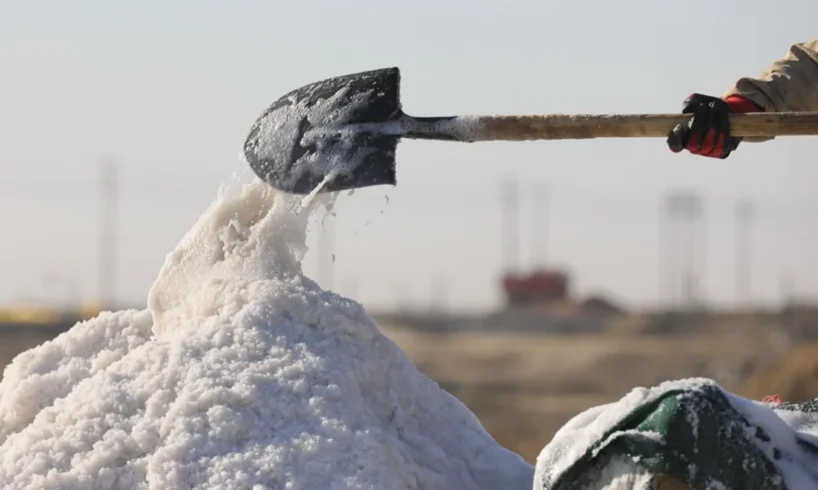
At the salt flats, Hassan joins his brothers in a routine
that relies on precision and endurance. They draw water into shallow squares,
stir it until it clouds, and leave it under the sun for months. The
transformation is slow and exacting, demanding careful control of texture,
timing, and temperature. But the equilibrium that once governed the craft is no
longer reliable. The process no longer follows familiar seasonal rhythms;
surfaces behave unpredictably, and the mineral formations that once accumulated
evenly now emerge in irregular patterns, forcing the family to adjust methods
that had remained unchanged for decades.
The disruption facing Najaf’s salt workers mirrors changes
rippling across Iraq. In northern provinces, natural basins have increasingly
failed to recharge during seasonal cycles. In the south, rising salinity has
forced authorities to invest in treatment technologies once considered
unnecessary. The Shatt Al-Arab, long central to southern agriculture and daily
life, now carries pollutants that affect drinking water, livestock, and
farmlands. Though the causes vary—from reduced river inflows to rising temperatures—the
outcome is consistent: traditional systems are being pushed beyond the
conditions they were built to endure.
Environmental stress is unfolding alongside chronic
infrastructure failure. Iraq’s water reservoirs have accumulated sediment
faster than they have been maintained, while irrigation canals lose vast
quantities through leakage before reaching farms. According to Iraqi water
specialists, national allocation policies—many drafted decades ago—have not
adjusted to modern consumption patterns or intensifying climate extremes. With
losses compounding across supply chains, local communities are left with increasingly
limited capacity to absorb sudden fluctuations, magnifying the strain on
families like Hassan’s.
For Najaf’s salt workers, the consequences are immediate and
measurable. Their product supplies tanneries, sesame mills, livestock-feed
operations, and aluminum processors that rely on salt in production. The
return—about 40,000 dinars per ton (roughly $30)—has never been generous, but
it once offered a dependable, if modest, livelihood in a region with few
alternatives. That dependability is now slipping away.
“If we stop working, the factories will turn to imported
salt,” Hassan says. “And we will have nothing left.” His voice remains steady,
but the uncertainty is unmistakable. A craft that once felt secure now stands
exposed to forces entirely beyond the control of those who inherited it.
“We inherited this work,” Hassan says, watching the receding
flats. “I don’t know if my children will inherit anything at all.” Fine grains
of salt drift over the remnants of a sea that no longer resembles the one his
ancestors knew—marking not only the erosion of a landscape, but the quiet
unraveling of a generational economy shaped by water, sun, and time.
Read more: Iraq’s water crisis deepens: Reserves collapse, mismanagement continues