2025-12-13T14:47:15+00:00
font
Enable Reading Mode
A-
A
A+
Shafaq News – Erbil
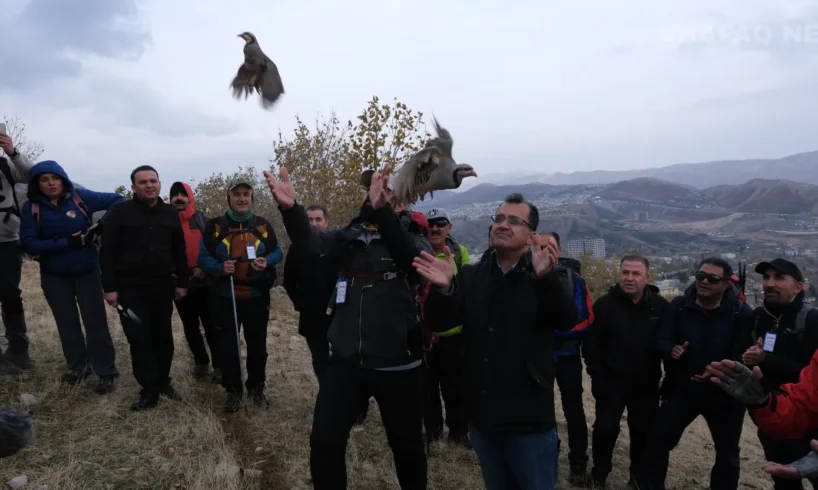
The chukar partridge, regarded as the national bird
of the Kurdish people, is increasingly threatened across Iraqi Kurdistan as
uncontrolled hunting and mounting environmental pressures intensify.
Wildlife specialist Rizkar Gharib told Shafaq News
that chukar populations have “declined sharply in recent years,” attributing
the trend primarily to excessive and illegal hunting, including the use of
non-selective methods such as nets that can capture large numbers of birds in a
short time.
Gharib said habitat destruction has further
accelerated the decline, pointing to urban and agricultural expansion,
overgrazing that reduces vegetation cover, and the effects of climate change,
which have diminished water and food sources essential for the species. Field
monitoring by wildlife teams, he added, shows a clear drop in chukar numbers in
areas where the bird was once abundant, including the foothills of the Zagros
Mountains and parts of Kirkuk, Duhok, and Al-Sulaymaniyah.
Known scientifically as Alectoris chukar, the bird
inhabits rugged mountain ranges stretching from the Middle East to South Asia.
In Iraq, it is closely associated with the Zagros and Taurus mountains and is
commonly found in Kurdistan’s highlands, where rocky terrain, dry climates, and
seasonal water sources suit its lifestyle.
Although capable of flight, the chukar relies
mainly on rapid running and agile climbing to move across steep slopes and
evade threats. The medium-sized bird measures between 32 and 38 centimeters and
is distinguished by gray-brown plumage, black-and-white flank stripes, a bold
black line extending from the eyes to the neck, and bright red legs and beak.
It feeds primarily on seeds, grains, grasses, and small insects, and is highly
adapted to arid environments, often surviving long periods without direct
access to water.
The bird nests on the ground, with females
typically laying between eight and 20 eggs during spring. The chicks are able
to move almost immediately after hatching, an adaptation that helps them cope
with the challenges of mountainous terrain.
Beyond its biological traits, the chukar plays an
important ecological role in mountain ecosystems by dispersing seeds and
helping control certain insect populations. Environmental activists note that
its presence is often an indicator of ecosystem health, while declining numbers
reflect habitat degradation and increasing human pressure.
The chukar also holds deep cultural significance,
symbolizing freedom, resilience, and the Kurdish people’s historic bond with
the mountains. “The chukar is not just a wild bird,” environmental activist Ako
Abdullah shared with our agency. “If we lose it, we lose part of our identity
and our natural heritage.”
Despite this symbolic status, the bird continues to
be traded in some local markets, including Kirkuk’s bird market. Bird seller
Samir Shwani said that demand remains high because of the bird’s beauty and
cultural value, noting that some traders try to avoid selling birds captured
during breeding periods. Another vendor, Azad Shakur, affirmed that chukars
were once widespread in the mountains but have become noticeably scarcer,
urging hunters to respect protection seasons.
Without firm enforcement of hunting regulations and
effective protection of natural habitats, experts warn, the chukar partridge
could disappear from parts of Kurdistan within a few years, marking the loss of
both a key ecological species and a long-standing cultural symbol.
Heard in folk songs, echoed in poetry, and depicted
in traditional art, the chukar remains a living presence in Kurdish popular
identity—one whose survival now depends on whether this heritage continues to
be protected in practice, not only remembered in tradition.