(function(w,q){w[q]=w[q]||[];w[q].push([“_mgc.load”])})(window,”_mgq”);
Today, the biggest news comes from Europe.
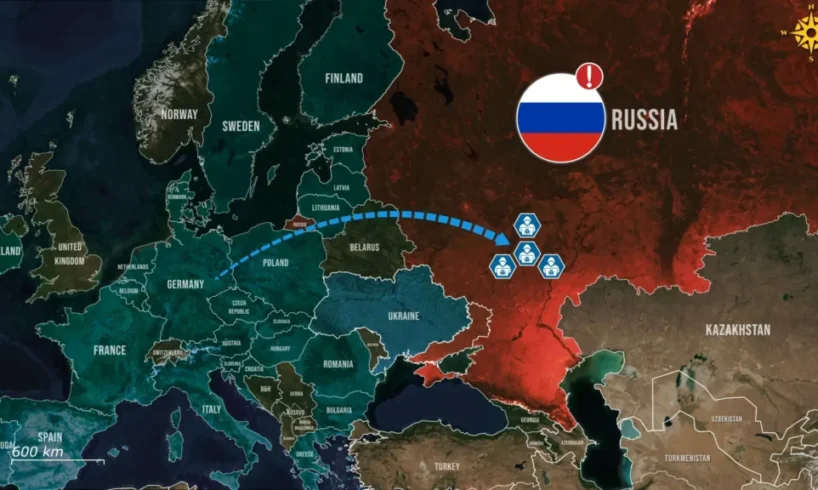
Here, a clear shift in mood is spreading across capitals that spent years absorbing Russian hybrid pressure without responding in kind. As Russia’s deliberate escalation pushes governments over the edge, many now state they are preparing non-kinetic tools that match the scale of the Russian problem.
Europe is fed up, as Baltic leaders have warned that Russia’s hybrid campaign is now targeting the foundations of European security, and senior EU officials say the bloc must be ready to respond by launching cyberattacks and information operations of its own.
The turning point is recognizing that purely defensive measures do not alter Russia’s behavior. This comes as Russian hybrid activity has grown steadily and predictably.
Russian hybrid activity across the Baltic
GPS interference over the Baltic has forced rerouting of commercial flights multiple times in recent weeks, including near Estonia and Finland.
Attempts to tamper with rail lines, most recently in Estonia, have triggered investigations and raised concerns about coordinated pressure. Airspace incursions from Kaliningrad and the Baltic, often brief but deliberate, continue to test reaction times.
Online, Russian-linked accounts with millions of followers spread stories aimed at weakening trust in institutions.
Cyber scenarios targeting the Yelabuga drone hub
As a response, attention is now turning to what a cyber operation against the Yelabuga industrial hub could achieve, and specialists describe three distinct scenarios.
The first, considered the most valuable, involves infiltrating and remaining hidden within the system, thereby giving Europe access to the exact specifications and software of new Shahed variants and enabling the sharing of this knowledge with Ukraine. This allows Ukraine to develop countermeasures immediately, rather than after weeks of examining wreckages.
Covertly embedding within Yelabuga’s cyber systems would also reveal delivery routes and storage sites. This enables Ukraine to anticipate where strikes will come from and pre-position air defenses accordingly, as well as target launch teams and warehouses before drones are released.
The second scenario focuses on slow degradation, where malware quietly interferes with production and programming. Small inefficiencies would accumulate over full cycles, potentially reducing output by hundreds or thousands of drones over time.
While malware inside the guidance software could also make new Shahed models less accurate, easier to intercept, or less capable of performing the complex flight maneuvers Russia relies on to bypass defenses.
The third scenario is a full shutdown, where factory operating systems, programming bases, and backups are deleted entirely.
This would reduce production not by half but to zero, forcing Russia to rebuild the entire digital infrastructure from scratch, a process that could take months before the line even restarts and far longer before it regains its previous efficiency.
Options targeting energy infrastructure
At the same time, Europe is considering cyber measures targeting Russia’s energy infrastructure, with a focus on digital controls. A momentary disruption could reduce refinery throughput by 5 to 10% for several days and delay pipeline scheduling across several regions.
A longer disruption would create export bottlenecks at three to four major terminals, slowing the flow of revenue that creates Russia’s budget. Since energy remains central to Russia’s stability, even modest disruptions in digital systems increase financial strain at a sensitive moment, without damaging physical infrastructure.
Disrupting Russia’s military logistics
Europe is also reviewing options that target Russia’s logistical networks, as Russia’s rail system relies on centralized routing software to coordinate long-distance military shipments.
A short disruption could delay priority movements by 48 to 72 hours, while a broader disruption could reduce east-west transport capacity by 20 to 25% for several days. These delays ripple quickly: units wait longer for resupply, rotations lose timing, and regional stockpiles become misaligned with demand.
However, with each increase in the severity of attack, cyber defenses would harden and gaps closed, meaning the decision which action to take relies fully on the consideration between short- and long-term gains for Europe and Ukraine.
Information operations under consideration
The final measure under discussion is a large-scale information operation targeting Russian society. Europe has seen how Russian networks shape debate in the West, often operating from accounts outside Russia with vast followings. A European operation would focus on accurate information on economic pressures, casualties, and the cost of the war.
Reaching even 5 to 10% of the online Russian audience would increase search traffic related to shortages and losses, forcing the Kremlin to allocate more resources to domestic messaging and censorship, a practice that will become obvious to even the most hardened Kremlin supporters.
A signal, not a replacement for military support
Overall, Europe’s shift toward non-kinetic retaliation marks a real change in how it intends to manage hybrid pressure. By preparing cyber options and targeted information tools, Europe is signaling that Russian activity will now face direct consequences.
These steps do not replace military support for Ukraine, but they introduce new uncertainty into Russia’s planning and raise the cost of continuing its current approach.
In our regular frontline report, we pair up with the military blogger Reporting from Ukraine to keep you informed about what is happening on the battlefield in the Russo-Ukrainian war.
(function(w,q){w[q]=w[q]||[];w[q].push([“_mgc.load”])})(window,”_mgq”);