Matt Thomson spends his free time pushing toward his yearly goal of biking 10,000 kilometres around Orillia, Ont. A furniture-maker by trade, he also builds bat boxes and installs pollinator gardens to support the forests, lakes and wetlands he’s loved his entire life. Lately, he’s been getting worried.
A few kilometres from his home in Severn Township, the pinch of land between lakes Couchiching and Simcoe and Georgian Bay, developer LIV Communities and its partner Bosseini Living, cut a trail through a wetland, clearing trees and catching the community off-guard. The trail connects a private beachside park with the approximately 180-home subdivision the developers are building. Thomson began raising the issue to neighbours, the municipality and then local news in early 2024 to see what could be done.
“People were concerned,” Thomson said. “A lot of people were thinking … ‘If this developer can get away with building a road through a wetland, who else is going to do it?’ ” Residents worry the disruption could worsen flooding in the area this spring but municipal officials say they have no authority to intervene. And, ultimately, the approximately 250-metre long path has already been laid and opened to residents of the Serenity Bay subdivision — with cameras making sure no one else trespasses.
This new pathway cutting through a provincially significant wetland in Severn Township, Ont., was “more extensive” than what the developer of a connected subdivision initially proposed, according to a municipal statement. The township has notified Ontario’s Ministry of Natural Resources and Forestry about the pathway, the statement said.
In June, Severn Township Mayor Mike Burkett told Orillia Matters that to him, the path is “not a walkway. It’s a road,” calling it “upsetting.” But in late November, Severn Township told The Narwhal in a statement that “The trail is not a road.” The township said the subdivision application, “which encompasses the multi-use trail within its limits, underwent a thorough review during the approval process by the Township of Severn and the County of Simcoe, the ultimate authority for subdivision approvals.” That review included an environmental impact study, archaeological assessment and stormwater management report, according to the statement.
“The actions undertaken by the developer to establish a pathway are within their rights,” it continued.
However, the statement explained, once the Serenity Bay pathway was built, “the work was more extensive than what was proposed, and we learned about it through local media.” At the time, Burkett told Orillia Matters he was surprised by the development, adding he wished “residents had said something” before the path was built, but “It was all done before we even were aware.” At this point, according to the statement, the township notified the Ministry of Natural Resources and Forestry.
The province can hand down fines for degrading a wetland, among other measures. The primary regulation is the Conservation Authorities Act, under which the ministry can fine $50,000 or more, mandate the developer to remediate the land or even order jail time. But the wetland crossed by the path lies just beyond the border of two different conservation authorities, putting it outside their jurisdiction. And LIV Communities does not appear to have broken any rules.
For Thomson, the options are few. He could attempt to challenge the development at the Ontario Land Tribunal — a process he feels is too expensive and uncertain, or hope the ministry steps in. Neither seems likely.
“The damage is already done,” he said. “Once a wetland is destroyed, you can’t really undo that.”
LIV Communities, Bosseini Living and the Ministry of Natural Resources did not respond to The Narwhal’s detailed questions about building in provincially significant wetlands.
Rama First Nation, whose traditional territory includes the wetland, said it was not consulted by the developer or province. “Chief and Council of Chippewas of Rama First Nation are deeply concerned by reports of unauthorized road construction through a protected wetland in our traditional territory,” it told The Narwhal in an emailed statement.
The chief and council continued that wetlands are sacred to Anishinaabe people, and “carry spirit and memory, and their protection is a shared responsibility.”
The nation said developments that may adversely affect Treaty Rights must be preceded by consultation with First Nations. “Meaningful consultation is a legal responsibility and requirement — not an optional step of the planning process. We call on all levels of government to ensure accountability, require immediate remediation and work in partnership with Rama First Nation to prevent further harm,” the statement said.
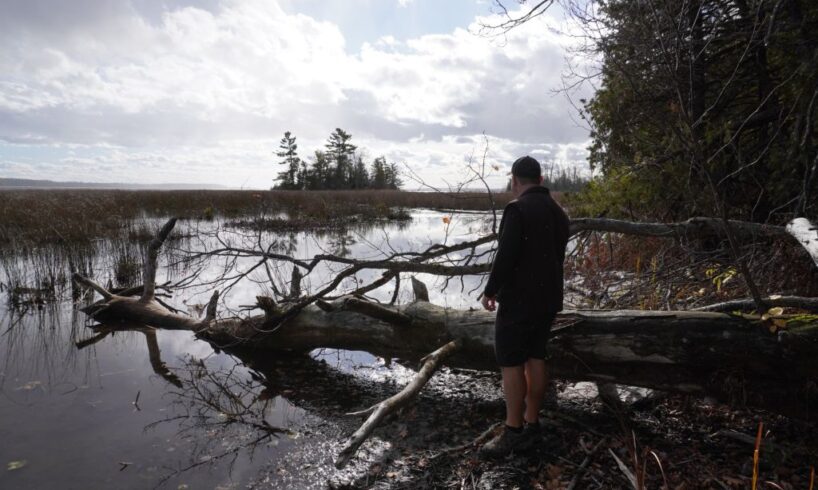
“Once a wetland is destroyed, you can’t really undo that,” Matt Thomson said. He worries the path through the wetland will cause increased flooding in the area next spring.
What happened in Severn reflects a much larger shift across Ontario, one that experts warn is reshaping the province’s wetlands far beyond a single disputed path.
Ontario contains about six per cent of the world’s wetlands, but has lost nearly three-quarters of what it once had. Those losses have continued under recent provincial policies encouraging rapid development and easing restrictions for environmentally sensitive areas. “We’re getting a taste of how things are going across the province, because we’re forcing a lot of these housing projects,” Thomson said. “Environmental stuff comes last.”
Ontario wetlands are now ‘pretty easy’ to ‘take a bite out of,’ experts say
Swamps, fens, marshes and bogs, like the sprawling peatlands of northern Ontario, are critical in the face of mounting climate change. They’ve been called “nature’s kidneys,” for their ability to purify environmental pollutants. They support 20 per cent of species at risk, significantly reduce floods and the consequent damage costs by up to 38 per cent and store 29 billion tonnes of carbon in the province.
And the Orillia area is a powerhouse. In a 2023 study published in the Journal of Geophysical Research, Florin Pendea and others from Lakehead University found the type of wetlands in the Lake Simcoe watershed were 50 per cent more effective in storing carbon than other wetland ecosystems they studied, second only to salt marshes along seashores. This is because the areas are nutrient-rich, highly productive and frequently flooded — all conditions that boost organic matter build-up while slowing decomposition.
The wetland where the new path appeared is listed as provincially significant on government maps, meaning it’s identified by the province as being valuable for its ability to store groundwater and manage flooding, provide wildlife habitat and support biodiversity, among other measures. Provincially significant wetlands, like this one, are granted stricter protections than others, but under environmental protection zoning for the area in Severn, “passive outdoor recreational activities, such as trails,” are allowed, according to the township. While the Severn wetland falls just outside the jurisdiction of any conservation authority, the watershed monitoring agencies generally regulate areas like this across southern Ontario and some of the north.
But it’s getting harder and harder to protect any wetland under the current Ontario government.
Under changes introduced by Premier Doug Ford in the last few years, including Bill 23, the Build Homes Faster Act, the Ontario Wetland Evaluation System was rewritten in ways that make it easier for developers to downgrade or remove protections.
Species at risk no longer factor into evaluations. Wetlands that function as interdependent ecosystems can no longer be “complexed” together, which means portions of larger interconnected wetland systems can be carved off and lose protection. And consultants hired by developers can re-evaluate wetlands and upload revised maps directly to the provincial database with no oversight from the ministry.
“Many wetlands that were formerly protected — under these new, more loosey-goosey rules [they] don’t meet that bar anymore, and so developers can go and re-evaluate them and have portions of a provincially significant wetland complex de-listed,” Rebecca Rooney, the founder of the Waterloo Wetland Laboratory at the University of Waterloo, said. “That has occurred in many watersheds across Ontario.” Earlier this year, Mississippi Valley Conservation Authority reported this sort of delisting in their jurisdiction east of Ottawa.
When the changes were proposed in 2022, Rooney and a group of more than 70 aquatic scientists and experts, as part of the group Save Ontario Wetlands, signed a letter saying these changes remove key oversight responsibilities, create a piece-meal and under-resourced evaluation process and disregard the importance of these areas for threatened species.
Thomson walks his bicycle in Severn Township, Ont. The type of wetland here in the Lake Simcoe watershed was found to be 50 per cent more effective in storing carbon than other wetland ecosystems considered in a study out of Lakehead University.
Further, changes to the Conservation Authorities Act have included the recently proposed consolidation of the number of watershed protection agencies across Ontario from 36 into seven, and weakened these authorities’ ability to protect wetlands.
While the province announced a $9.6-million investment to “restore and enhance wetlands” to protect communities from flooding and other climate-driven events in fall 2025, the question of enforcement and consequences when wetlands are destroyed remains.
Insurance companies are also recognizing the importance of protecting these ecosystems for their bottom line. Intact Financial Corporation is funding research on maintaining wetlands in their natural state to reduce flood damage. A computer simulation of a pilot site in Waterloo calculated a savings of $51.1 million in damage costs, thanks to a natural wetland.
Yet changes to the evaluation system makes it possible for wetlands to quietly disappear on paper long before anyone recognizes the consequences on the ground. “There’s no watchdog, nobody’s really tracking what’s happening,” Rooney said. “It’s pretty easy now to take a bite out of a provincially significant wetland.”
The trials of citizen wetland monitors in Ontario
In 2023, a Severn resident was reprimanded for dredging and operating a vehicle in a provincially significant wetland, according to local media. The penalties were a $4,000 invoice from the township for the cost of gates to keep him out and a stop-work order from the Ministry of Natural Resources.
At the time, Mayor Burkett told Orillia Matters the small township relies on complaints from the public to respond to these issues, echoing his stance on the Serenity Bay development. But it has proven difficult to figure out just what development is happening, and if it’s legal, before shovels are in the ground.
After, there’s little to no recourse.
For residents like Thomson, the Ontario Land Tribunal is often the only remaining avenue to challenge development.
Rooney served as an expert witness in one such case involving an area of the Greater Cataraqui Marsh in Kingston, Ont., part of which is a provincially significant wetland where homes and commercial buildings were proposed. Kingston’s city council originally denied the developer’s application, defending this decision at the tribunal after the developer filed an appeal.
During the hearings, it came to light that a portion of the wetland was no longer listed as provincially significant. This is despite prior protection as part of the larger complex, according to Laura Jean Cameron, a professor of geography and planning at Queen’s University, and one of several residents who opposed the project. But it was hard for citizens to determine what was no longer listed.
“It’s endlessly frustrating,” Cameron said.
Even with a background in historical geography, Cameron struggled to find clear records showing how parts of the Kingston marsh had been designated provincially significant in the past, and when those borders changed. Using provincial maps, she learned the borders of the wetland complex had been updated in 2024.
Then, in the hearing, Cameron said it was confirmed the developer paid for the re-evaluation that resulted in the map being changed.
“It’s not straightforward at all,” she said. “Citizens can have the up-to-date information, but there’s no legacy information to make the comparison, so you don’t know what’s changed.”
A new subdivision outside of Orillia, Ont., called Serenity Bay, is built close to a provincially significant wetland on the shores of Lake Couchiching. Some neighbours fear a path built from it will adversely impact the wetland.
To understand all of this, Cameron worked with geospatial librarians and data scientists, assembling information from past wetland maps to see how and when the wetland’s designation changed and which carved out portions could now be built upon more easily. It’s work most residents would never have the time or expertise to do.
“If citizens are supposed to speak up, they need people to help interpret these sources of information,” Cameron said.
Despite the effort, after five weeks of hearings in early 2024, the tribunal sided with the developer and zoning was ultimately approved by the province, allowing the development to move ahead for further approvals. “Because of the expense and all the time, it’s going to make people just feel like there’s no point in fighting these things at that tribunal level,” Cameron said.
For the area in Severn, where the provincially significant wetland status still stands, Cameron sees troubling parallels. “My worry for the citizens of Orillia is that no action will be taken by the ministry or anyone — that the developer will face no consequences,” she said in an email to The Narwhal. “And ‘fixing’ their mistake would be a matter of permit signing and paperwork, not the removal of the road or an attempt to repair the wetland.”
Thomson fears the same. He continues biking in the area, watching construction advance. He worries about flooding come next spring. “There’s very little attention paid to what’s being lost,” Thomson said.