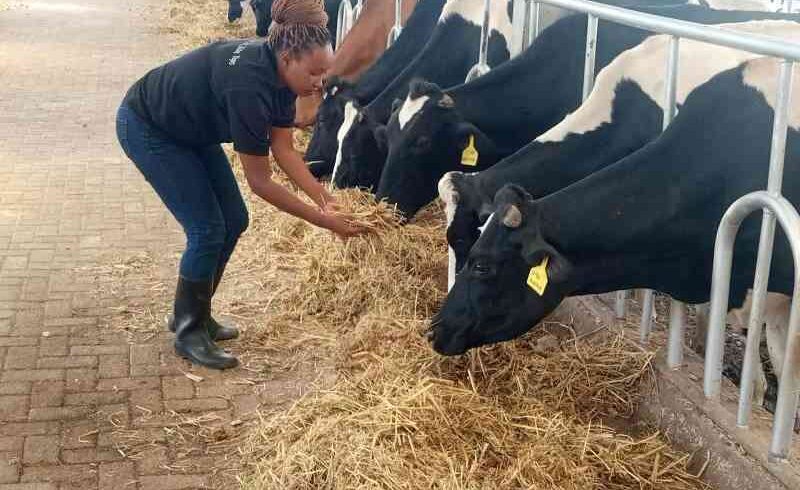
Njeri Gatheca from Naiposha dairy farm in Naivasha feeds dairy cattle with hay amid an increase in prices of livestock feed by over 50 percent in the last two years. [Antony Gitonga/Standard]
Dear Joseph,
I am a regular reader of your column, and thank you for the nice work you do in trying to educate farmers like me.
I have recently experienced reduced production in my two dairy animals. Some of my farmer friends have proposed the use of feed additives. Is it something you would recommend, and do they have any side effects?
Anastacia Njung’e,
Follow The Standard
channel
on WhatsApp
Murang’a
Thank you, Anastacia, for the good question and for reading the column. Farmers are always looking for ways to increase the productivity of their animals while at the same time reducing the cost of production.
Feeds are the single most costly input in farming, and anything that works to reduce this cost is always a welcome idea.
Yes, feed additives are a common practice in livestock production for several reasons.
Feed additives are minor components of livestock feeds, which serve to improve the nutritional value of feeds, improve feed utilisation by increasing the intake and digestion efficiency and subsequently the productivity of livestock while reducing the cost of production.
Feed additives reduce the cost of feeds by making them palatable, hence increasing their uptake, digestibility, and consequently productivity.
The common additives include probiotics and prebiotics, enzymes, antioxidants, emulsifiers, growth promoters, and preservatives.
With the current challenge of antimicrobial resistance, growth promoters have been banned in some countries.
They are anti-microbials that were initially used in sub-therapeutic doses to prevent diseases.
However, the administration of such doses is called underdosing and has been shown to contribute to antimicrobial resistance.
By giving the sub-therapeutic doses, the micro-organisms undergo mutation, making them resistant to the active ingredients.
Stay informed. Subscribe to our newsletter
Probiotics, on the other hand, are organisms and substances added to feeds to improve the microbial balance in the gut for improved digestion.
Probiotics are either live or non-living organisms. Common examples are Lactobacillus.
They not only improve digestion but also immunity, and hence are becoming more important with the current antimicrobial resistance. They are readily available in the market.
Unlike probiotics, prebiotics are non-digestible substances that selectively stimulate the growth of favourable bacteria while inhibiting the growth of unfavourable bacteria. Prebiotics are food for microbes.
Antioxidants are either natural or synthetic additives that preserve feeds or increase the shelf life of feeds, improving the quality of feeds.
Animals, especially monogastrics, may be deficient in the ability to digest some types of feeds.
Without intervention, the feeds may not be utilised.
Enzymes as feed additives help to unbind such nutrients. For example, carbohydrate-degrading enzymes act on complex carbohydrates to break them into “smaller compounds” that can be easily digested.
When added, they improve digestive efficiency and hence productivity and growth.
There are other additives, like colourants, that improve the feed’s texture, hence improving their uptake.
There are also other nutritional additives, including yeasts, amino acids, and trace elements, which can add more value to the feed.
All these additives are available in agrovets and animal feed outlets.
[Dr Othieno is a veterinary surgeon and the head of communications at the Food and Agriculture Organisation (FAO) Kenya. The views expressed here are not necessarily those of FAO but his own]
Follow The Standard
channel
on WhatsApp